Shooter Flash: “Sole Survivor” by Alexandra O’Sullivan

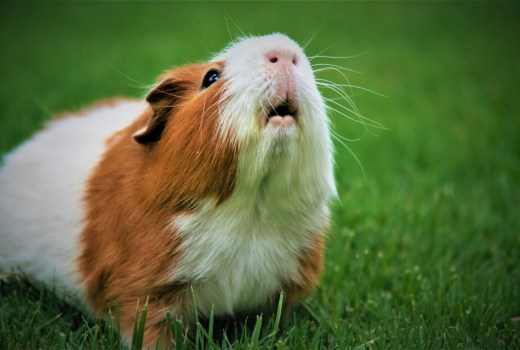
I parked the car after the school run and took the core of the apple I’d been eating to the guinea pigs on my way past. There, at end of the cage, lay a potato-shaped lump.  

“Oh no,” I said as I knelt to confirm what I already knew, that Nutmeg, the matriarch of our pig family, had died. 

“What?” grunted my fourteen-year-old son as he slumped past on his way to the house.

“Nutmeg has died.”

“Oh,” he said, his voice rising to betray his teenage apathy. 

He wavered a moment, glancing toward the cage, then turned and continued his slouch toward the house, blue school bag slung over his shoulder.

I buried her under the tea tree beside the graves of her two children, Storm and Gumnut. Her body was still warm as I cradled it into her final resting place. I had buried her children quickly, wanting to get the gruesome task over and done with, but with Nutmeg I lingered, crouching by the hole to stroke her silky, brown coat and say my silent goodbye.  

It wasn’t just that she was my favourite, though she was, unashamedly, my favourite. It was that her death signified more than the end of her life, it was the end our life as a family with guinea pigs. I knew that her husband, Flash, the sole survivor, would have to be rehomed, unless I could borrow a companion pig to help him to see out his days.

Guinea pigs are social creatures. They have been known to die from solitary confinement. In some places it is illegal to have only one. I’d long worried about what to do with the last remaining, but I never expected it to be Flash, the frail old patriarch with a slow stride and a cataract, who’d outlive his wife and children. 

My son was eight when we got Nutmeg and Flash. Nick was a good age to take on the responsibility of pet ownership. A good age to use pets to learn about the birds and the bees. I grappled with the questionable ethics of backyard breeding, before deciding to allow them to have at least a litter, and to use it as a learning experience.

Before the litter was even born, we’d developed a habit of sitting for long periods by the cage. It was meditative, watching them bustle about, up and down the ramp, through the plastic tunnel, in and out of the blue igloo. Via google we learnt that the hilarious growling whole-body vibrate Flash did when near Nutmeg is called rumble-strutting, and it indicates affection. We learnt that the eccentric sudden leap accompanied by a mid-air twist was called popcorning, and it indicates happiness. I felt a vicarious surge of joy every time they popcorned. 

When the first litter was born, Nutmeg came into her own as a mother, guiding her four babies down the ramp and chatting to them, constantly, with encouraging squeaks, while they bopped along behind her with a chorus of chirpy peeps. 

“Mummy, Mummy, Mummy, Mummy…” I joked to Nick as we watched them. 

It was easy to make up words for them. They were constantly chirruping, peeping and making a hysterical high-pitched scream, called ‘wheeking,’ whenever we walked into the backyard, that Nick and I translated as, “Feed us!! Feed us!!” 

Flash was also frequently rumble-strutting at Nutmeg, even after two litters and the ‘snip, snip’ operation. 

“Hey there, pretty lady,” I imagined him saying with a low drawl as he sidled up alongside her, vibrating.  

They were a dream couple. They raised two litters of healthy babies and got to keep one from each.  During the pandemic, they got an extension on their home. Nick, aged ten, spent hours building them mazes and miniature playground equipment from scrap wood, though Flash always preferred his blue igloo, humping it along on his back like a turtle in a way that made us laugh. 

Years later, as I was feeding them their hand-picked grass, a job that had long been my sole responsibility, Flash humped his igloo along to reach the stalks, and I pointed it out to Nick, aged fourteen, as he headed towards the car.

“Flash is being a turtle.”

“Huh,” he grunted, barely achieving a syllable. 

“Nothing.”

When the second daughter died, I told Nick we’d lost another pig as I made dinner. He’d just returned from his girlfriend’s house, and I expected a monosyllabic reply, but he made actual eye contact with me as he gasped, “Not Nutmeg?” 

“No,” I said, resisting the urge to hug him. “Not Nutmeg.”

When Nutmeg did die, I arranged for Flash to move in with my friend’s pig, who was coincidently also recently bereaved, having lost her sister to a dog attack. It seemed like fate. I sent Nick, who was at his girlfriend’s house, a video captioned Flash meeting Luna.  

I imagined him watching the clip of Flash rumble-strutting up to his new woman. My phone beeped. I read his reply. 

Nice. 

*

Alexandra O’Sullivan lives in Regional Victoria, Australia. She writes fiction, creative non-fiction, articles and reviews. Her work has appeared in publications such as Westerly, Meanjin and The Big Issue Fiction Edition. She works as a high school English teacher and was recently included in the anthology Teacher, teacher published by Affirm Press. Her current work-in-progress is an anthology of interconnected school stories. Instagram: @alexandraosullivan84

Submissions open for “Sweet Hereafter”

Submissions are open for issue #20 of Shooter Literary Magazine, with the theme of “Sweet Hereafter”.

We’re looking for stories, essays, memoir and poetry to do with afterlives: life after death, life after work, life after having a baby, life after divorce… Anything to do with what follows a major change in life, when someone or something ends and significant adjustment occurs. Pieces that treat heavy subject matter – grief, heartbreak, loss, bereavement, ageing, death – with a light or humorous touch would be especially welcome. A positive (or wild, or bizarre, or comic) spin on what comes after a difficult ending or change would be in keeping with both parts of the theme.

The theme is open to wide interpretation, but please adhere to the submission guidelines. In addition to thematic relevance, we seek engaging, elegant writing that maintains a high literary standard.

Writers should send short stories and non-fiction of 2,000-6,000 words and/or up to three poems by the deadline of June 22, 2025. Please submit according to the guidelines at https://shooterlitmag.com/submissions.

Shooter Flash: “Sabbath” by Rebecca Klassen

Mum called it Suicide Sunday and had done so since she was a girl.      

‘A day so boring you wanted to kill yourself,’ she told me. I wondered if other parents said similar things to their teenagers. 

Throughout her childhood, she’d adhered to the Sabbath traditions of duty and no play, though this was more under her parents’ guidance than God’s. Post church, she would sit on the stairs in her best clothes and listen to the heathen neighbour children through the wall, blowing recorders and laughing. She’d been round there once for tea. The mother had given them sugar sandwiches and let them gouge holes in the lawn with sticks. 

‘Mind my bloody azaleas,’ the mother had told them. Mum had repeated ‘bloody’ to her mother and had never been allowed back.

When my grandfather died, Mum was a freshly divorced, single parent. With grandfather gone, Nana expected Mum to attend Suicide Sundays again with me in tow. The new criteria no longer required Mum at church, though we were told it would be nice if we came along once in a while. Only knitting, reading, and watching Songs of Praise were permitted in Nana’s chintzy sanctum. Watching other programmes risked a brazen ‘hell’ or ‘bugger’ slipping into the atmosphere to sully the day.   

One late autumn Suicide Sunday, I pivoted round and round on my backside in front of Nana’s gas fire, hoping that, like a rotisserie chicken, I would eventually cook on all sides. Nana worked her knitting needles. Mum stretched so that her feet almost touched the fire’s orange bars, the heat making her tights give off a plastic smell. I watched Mum nodding off, imagining having to grow up here every day. A new family lived next door with the sounds of computer game music, squabbling, and giggling coming through the walls.   

As the gas fire reddened my cheeks, I suddenly stopped pivoting as I remembered the crumpled piece of paper in my schoolbag. 

‘Mum?’

‘Hmm?’ 

‘I’ve got cookery class at school tomorrow. I’ve got to take ingredients in.’

Mum’s eyes flicked open. Nana’s needles stopped.

‘What have you got to make?’ 

‘Apple crumble. Sorry, I forgot.’

Both women were on their feet.

‘What’ve you got at home?’ Nana asked Mum.

‘No apples, that’s for sure.’ 

Nana went to the kitchen, Mum close behind. Cupboards banged over notes of infuriation.

They returned, Mum carrying a bag. 

‘Nana’s only got Braeburn apples. We’ll have to see if we’ve got the other ingredients at home.’

‘Can we go to the shop for the rest?’ I asked.

Nana shook her head.

‘You should’ve told me yesterday,’ Mum said to me. I’d always wanted to leave Nana’s before Songs of Praise, but not like this. Mum apologised to Nana.

Nana shrugged. ‘Sometimes life throws us trials.’

The drive home was quiet. Intermittently, I apologised. Mum said she knew I was sorry, yet there was no talk of forgiveness. 

‘It’s always up to me to sort these things, never your father,’ she said. After that, I stopped apologising. 

I couldn’t picture where my father was or who he might be with, and I didn’t know when I would see him again. Even though her father was dead, Mum had the same dilemmas, but the similarities didn’t unite us. 

When we got home, Mum put the butter, wrapped in its golden foil, on the kitchen table.   

‘We need oats too,’ I said tentatively, ‘because it’s a healthy crumble.’ 

‘Bring me the recipe.’

I brought her the forgotten list, which she read while I brought Nana’s bag of Braeburns to the table. Mum weighed and decanted ingredients into plastic tubs. Little white clouds billowed; granules were spilt. She banged the cinnamon jar on the counter. The clumps wouldn’t burst, so she threw it in the bin. I put the tubs into the bag with the apples. The butter remained unweighed on the table. Mum put away the scales and muttered as something tumbled from the cupboard. 

‘Where shall I put the butter?’ I asked. Mum rounded on me as more clutter fell from the cupboard. 

‘Up my arse!’ she yelled. 

‘Okay, but you’ll have to come to school tomorrow.’

My words floated precariously into the air. They’d been a gamble, particularly on a day we didn’t laugh. Mum said nothing as she put her face in her hands. The silence built over the hum of the fridge. I wanted to cram the words back into my mouth and fill my cheeks with the trouble they’d caused. Then her shoulders shook as her legs folded. Her hands dropped. She was laughing, shaking all over.

*

Rebecca Klassen is co-editor of The Phare. Her work has featured in more than forty publications including Mslexia Best Short Fiction, Popshot, Ellipsis Zine, Burningword, Barren, and The Wild Word. She has won the London Independent Story Prize, and was shortlisted for the Oxford Flash Prize and the Laurie Lee Prize. She regularly performs her work at Cheltenham Literature Festival and Stroud Book Festival.