Shooter Flash: “Good Girls” by A. S. Partridge

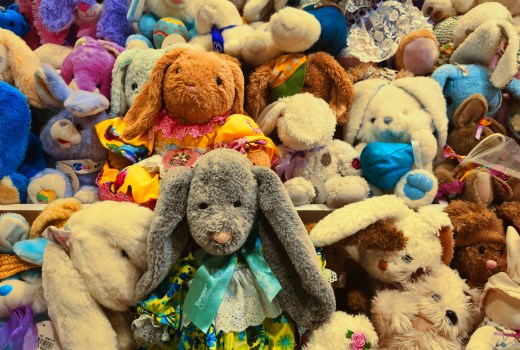
The window of the second-hand shop was littered with soft toys: a dirty cream bear, a pink bunny with a missing ear, a grey cat with scratched glass eyes. Callum paused and peered in, feeling a sharp stab in his heart. A large black horse with suede hooves. Another bear, this one sporting a Hug me jumper.

Inside, the shop smelled musty. By the clothing rails, an old lady methodically combed through the flannel shirts and thin pastel blouses. At the far end, in the children’s section, a woman was trying to persuade a small boy to release an orange foam gun.

“Put it back now,” she insisted.

“Excuse me,” smiled Callum as he squeezed past.

“Look, the gentleman wants to get by,” the woman scolded as her boy stared up at Callum, mutinous.

Callum reached above them to the shelf of cuddly toys, scooping all seven from their dusty row. He carried the armload to the already cluttered counter and smiled apologetically at the lady behind the till. She glared at him, tight-lipped, as he slid the fluffy mass onto the chipped counter.

“Can I leave these here for just a second?” he asked. She didn’t answer. He hurried back to the front window and reached for several more teddies, plucking them from their jumbled display like burrs from dog fur.

“That’s all, please,” he said, returning to the counter. The sales lady narrowed her eyes and didn’t budge.

“I know what you’re doing,” she hissed.

Callum tried to look innocent.

“Kid’s birthday,” he muttered sheepishly. “A lot of birthdays coming up.”

“I should hope so,” the lady replied grimly, rummaging the pile with sharp grabs and swiping her scanner over the labels. “Some kiddie loved each and every one of these. They deserve to go to a good home.” She gave him a final, level stare.

Callum tumbled out of the shop in relief, juggling his load and swinging the big horse by the hoof. He cast them all into the boot of his car and set off for home.

As the car bounced over the rutted track leading up to the house, he could hear the dogs start up their welcome chorus. His heart seized at the absence of Maisie’s high-pitched whine-bark. He’d given her a good life, everyone said. He’d rescued her after a bad start and provided her forever home. Only forever had turned out to be just six years, and Callum felt, after all the good times they’d shared, that was too young to go, disease or no. But it didn’t matter what he felt; she was gone, which left him with a pack of three.

The dogs scrabbled and yowled for his attention as he entered the kitchen. “Good girls,” he calmed them, manoeuvring past the tongues and tails and straining paws. Depositing the teddies in a large crate in the utility room, he eyed the furry jumble: a fuzzy arm poking up here, a broken button eye peeking out there. Maisie would have loved the horse; he could imagine her carting it off like a victorious cheetah, one suede hoof in her mouth and the legs trailing and bumping beside her on the ground.

He selected two teddy bears and a bunny, saving the horse in Maisie’s honour. Swinging them round the heads of the excitable pack, the dogs cavorted after him as he led them outside.

“Ready?” he cooed. “One… two… three!” He cast the toys up as far as he could throw them, up briefly into the pale sky and then down to thud limply onto the lawn.

The dogs bounded after them joyously, each scavenging a prize and claiming it between their teeth. With great ripping sounds, the creatures came apart at the seams. Stuffing began to spill out across the grass, fluff flying like feathers in a henhouse.

Hilda, Max’s Border terrier, shook the cream bear ferociously by the neck, tossing it in the air before catching and terrorising it again. Polly the pointer placed her paws either side of the bunny’s pouchy belly and tore off its lone ear with surgical precision.

Bella, the mutt Callum had adopted at the same time as Maisie, took her time to inspect the wiry brown bear. She sniffed and licked it, turning it over with her nose and settling down with a grunt in the overgrown grass. Callum had noticed that Bella had been subdued since Maisie had been put down.

Slowly Bella started biting the bear’s face, softly sinking her fangs into the patchy fur. She caught Callum’s eye and watched him as she chewed rhythmically, methodically, with a degree of care that looked, almost, like love.

*

A. S. Partridge has published poetry, flash fiction, and short stories in numerous magazines including Aurora, Malahat Review, Popshot, Scribble, and others. She lives in Edinburgh, where she is working on a satirical novel about motherhood.

Shooter Flash: “The Torturer’s Dog” by Edward Barnfield

“Look at him. Look at him.” 

Makis points a bony finger to the door, and we watch together as his dog, a dirty grey terrier, circumnavigates the sides of the room to reach us. 

“Going blind, you see. Old dogs, they stick to the walls.”

It takes about a minute for the animal to reach the sofa, and once it arrives it squats, pathetically, unable to summon the energy to jump to its master. Makis takes pity and lifts it to his lap. 

“Time beats us all in the end,” he says, scratching its raw pink belly.   

The apartment has high windows and art deco details, a sense of old-world expense, but most of the furniture is as raggedy as the dog. There are no curtains, and I’m distracted by movement on the balconies opposite. This neighbourhood has aggressively resisted the gentrification that has reshaped the rest of the city, and my eyes are drawn to a thin man in a red vest sunning himself. Makis points to my recorder, moves the moment along. 

“You have questions?” he says. 

“I’m interested in why you think you were recruited. What did they see in you?” 

He sighs and strokes the dog’s neck, and it makes a soft noise like a horse’s whicker. For a moment I think he’s going to go silent, or ask me to leave, and then –

“They picked good boys. Obedient. Families.”

“Middle class?” There’s a sneer in my voice I hope he doesn’t catch. 

“No, no. I don’t think there were three years of schooling between us. Just working boys who could swing a hammer. Who cried when they threatened our families.” 

“And did they?” 

He manoeuvres his pet onto a faded green cushion and rolls his sleeve up. There are five or six old scars on the back of his arm, thick as zebra stripes. 

“You want the communists to rape your sister, boy?” His voice is harsher, the memory of an old tormentor thickening his accent. “These were all in the first week. They heated a metal bar on a brasier, and you had to sit there and watch it glow.” 

I’d heard the stories, of course. The colonels wanted malleable young conscripts to help with interrogations. They sought out the illiterate and the apolitical, finding kids as young as fourteen and putting them in uniform. Of course, if your objective is brutality, you first need to brutalise. 

“Everything they wanted us to do, they did to us first,” he says. The scarred arm moves to pet the dog. 

“How long before they put you in the Special Interrogation Section?”

“A few months. They knew, you see, that I’d do what they ordered.” 

“How many men do you think you interrogated while you were there?” 

Makis sits back, stares out of the window. The man in red has moved inside, so I’m not sure what he is looking at. I wonder if I should repeat the question. 

“I wanted to be a painter when I was a child. Can you imagine? Six brothers, three sisters, yellow fever all over the countryside and I wanted to paint. Where could that idea have come from?” 

The anecdote hangs there, and for an uncomfortable moment I feel a swell of pity for the man, old and alone and unable to unravel his own mysteries. We always think of the lives of others as linear, but our own experience refutes that. Memories loom large, and the pain of long-ago wounds returns, until you’re left clinging to the walls because you can no longer see clearly.

Then I remember my purpose. 

“Makis, how many?” 

His gaze moves from the window and back to me. His voice drops to a whisper.

“Too many to count.” 

“Did you interrogate the politician, Konstantopoulos? The army major, Moustaklis? Did you know he never walked or spoke again after his release?” 

 “I don’t –”

“Do you remember the slogan on the walls, Makis? Do you remember what it said?” 

I’m conscious my tone is too angry now, and that my interviewee is staring at me with fresh eyes, wondering who this middle-aged woman in his armchair might really be and whether her journalistic credentials can be trusted. 

He shakes his head, silent. 

“Those who enter here, exit either as friends or as cripples. Do you remember that?” 

The dog picks up on the tension in the room and growls faintly without raising its head. 

“Miss, I’m sorry. I’m an old soldier on a pension who volunteers at an animal shelter. That’s all. I made a full account of my actions to the tribunal, and even that’s been forgotten. Who I was, before this… It’s all gone. Why are you interested?”  

“They said you were the worst, Makis. The ones who survived, they said you were the cruellest on the punishment block.” 

“But they are gone too, my dear. Prisoners and guards, colonels and radicals. What does pain matter a generation later?” 

On one level, he’s right. The building that housed the Special Interrogation Section is now a museum celebrating the life of a leader of the liberation movement. The park behind it, where they dumped the bodies of those who couldn’t take any more, has three branded coffee shops and a fitness area. 

But then I think of my own experience, a father’s face I only knew from photographs. I think of how my mother withdrew from the world and stayed hidden even after the junta fell, and how – when she died last month, just shy of her centennial – she told me she had never forgiven them. I think of the hammer in my handbag. 

The dog stretches and half-rolls, half-falls off the sofa. It trots to me, its nose cold against my bare legs. Despite myself, I pat behind its ears. 

*

Edward Barnfield is a writer and researcher living in the Middle East. His stories have appeared in Ellipsis Zine, Lunate, Strands, Twin Pies Literary, Janus Literary, Third Flatiron, The Molotov Cocktail, Roi Fainéant Press, Leicester Writes and Reflex Press, among others. He’s on Twitter at @edbarnfield and Instagram at barnfieldedward.