Shooter Flash: “Winter Camp” by Gary Finnegan

The middle distance absorbed her gaze. Her sleeves, her nerves, frayed. Moths had chewed holes in the coats of the children; the children had eaten nothing for days. Days had been given to a journey, to the mantra, ‘Things will be better when we get to the camp.’ 

Now, her five-lined brow, like sheet music without a note, knew hope was a hollow lie. To be hungry and afraid and uncertain and on the move was the second-worst state of being. Hungry, afraid, uncertain and stationary was worse by miles. 

‘Did you wash those hands,’ she said, clawing at the paws of the youngest, fussing at a tap. ‘Got to wash those hands every time here, okay? Every time. Or you’ll get sick, like her.’

She nodded towards the next tarp, the day-old home of a family nursing a preschooler through the vomiting bug that was pinballing its way through the camp. 

Her own youngest straw-haired child stood passive and slack as her mother worked the gaps between the child’s fingers with a cement-coloured flannel. 

‘Did you change that vest,’ the mother asked. ‘Gotta change damp vests or you’ll get sick.’

She was curt, she knew that, but child management was the only available task and had to be done with vigour. It was, she reminded herself, in the children’s interests that their mother maintained standards. If you slid into apathy, you accepted death’s call.

The child was silent, and had been since they arrived. The three of them – the father having stayed behind – filed down the line until they reached an unribboned tent. There they tied the piece of cloth collected at the gate around a pole ‒ their claim on nine square metres of shelter, open on one side to the brown dust and ceaseless flow of human anguish. 

‘When is food coming, Mom?’

The older child, listless now, spoke for her sibling, spoke for everyone in the camp. The mother changed tack, opting not to lie, not to say, ‘Soon, love, just wait another while.’ 

Instead: ‘I don’t know.’

Would it have been better to stay and spend their hope under a familiar roof? As she wondered, an unwelcome competitive instinct surged within her at the sight of more new arrivals. ‘They need to shut the camp,’ she exhaled in a whisper. ‘Place is full.’

How many could be fed here? How many could make it across the border when it reopened? Who would decide who stayed, who went, who ate, and how much? 

She could do nothing. And it killed her to seek help while wishing it were denied to others.

‘Come here to me,’ she barked at the eldest child. ‘Those socks need changing.’ 

*

Gary Finnegan’s fiction has appeared in Litro, The London Magazine, The Phare, Roi Fainéant and Flash Fiction Magazine. He is the winner of the Frazzled Lit Short Story Award 2025 and received an Agility Award from the Arts Council of Ireland in August 2025. He has an MA in creative writing from Maynooth University and is working on a novel. 

Shooter Flash: “On the Rocky Shore” by Clayton Lister

We were happy. Fatherless, but who needs one? Money was tight, but if it wasn’t, would we have appreciated what did come our way?

My brothers tormented me, of course. Every youngest’s tribulation. Which is why I had escaped the house on this particular afternoon. Some trivial thing, I am sure, only blown big by excessive sensitivity. Mum’s favourite – youngest’s privilege – even she had warned me against this weakness. Why is anybody tormented if not for a reaction?

In any case, umbrage was nothing a buffeting wind couldn’t salve. And some hundred yards off the esplanade, close to the shore’s rocky drop into the North Channel, I recognised my sister as that there lass conferring with some fella. It didn’t take long to comprehend my redemption in this scenario. 

But had I time to run home? 

So, I gambled. I burst my lungs. Regardless, from the foot of our stair, drew air enough to holler, “Ali! Mac! It’s June! With a fella!”

Mum was off the sofa and in the hall doorway even before they had hurtled down full pelt like the heroes to me they truly were. She need pull me to safety out of their way. 

Ali had the advantage of ready-donned trainers and was gone. But Mac, eldest, most naturally athletic of us all, lost barely a moment slipping his on. The prospect of coming second to anyone in any pursuit galled Mac.

Mum’s squeeze of my shoulder told me, “Follow.”

Back on the esplanade, I clocked June strolling alone now and her fella soon enough. Picking his way across the sea-slick rocks, he paused to raise his binoculars; amid the wind, crash, suck and cackle of the surf, he heard nothing of Ali’s approach. I hadn’t a hope of hearing their exchange. This rankled. So, my raw lungs regardless, the scorch of lactic acid regardless, hauled my arse to the steps.

Mac, for his part, had slowed seeing Ali detain the fella. But by the time I gained the beach, he’d drawn level, and Mac wasn’t one for blather. He punched hard and without questions. How impressive do you think the thud of that wee fella’s head on the rocks must have been? Ali kicked him for good measure.

Upon clocking the action, June had doubled back. She checked the fella’s anorak and wallet. Mac and Ali rolled him off the rock’s edge. 

What would have been the point in my catching up now only to double back myself? But before they could thank me or give me my share, behind and above me, June spied someone at the esplanade rail. Our elderly neighbour Morag wrapped tight in her knee-length mac and plastic hairnet, no doubt awaiting the bus to her daughter’s. 

It would have been rude not to acknowledge her. At the top of the steps, in turn, we did.

“Perverts,” Mac lamented. 

Morag agreed. “Aye. They’re everywhere.”

So they are. And who needs thanks or money, anyhow?

*

Clayton Lister has had stories published online and in magazines, with a few shortlisted for prizes. In 2023, Stairwell Books published his first novel, The Broke Hotel. He’s now trying to interest publishers in his second, The KamaDevas: Opening.

Shooter Flash: “The Chemistry of Friendship” by Alison Wassell

It starts with us sharing a packet of cheese-and-onion crisps, and before we know it we’re sharing everything: sucking liquorice lozenges and laughing at our black tongues in the cloakroom mirror, buying an orange lolly every lunchtime from the ice-cream man who parks on the school field, figuring out that the vending machine outside the sixth-form common room dispenses hot chocolate for ten pence when it should be twenty. We giggle like a couple of conspirators, planning what we’ll say when our dishonesty is discovered, being almost disappointed when it never is. 

People describe us as joined at the hip, our names coupled like Tom and Jerry, Mork and Mindy, Starsky and Hutch. We meet up one Saturday to go Christmas shopping and buy cheap aftershave sets for our dads and stationery sets for our mums that will never be used. We watch Abba the Movie at the cinema and bump into Janice with her twin sisters, pointing at each other when Janice asks us who dragged who there. 

By the second year, the cracks are showing. We’re no longer we but you and I. Little things start to matter. The way you shield your work with your arm in class, the tall tales you expect me to believe about your dad being a Russian spy, the time you make yourself sick on the chocolates I give you for your birthday and blame me for buying them, the comments about my greasy hair, my crooked teeth, the spots on my chin. 

More divides us than unites us. When I come top in English you say the only thing I can do with that is teach. You’re destined for greater things with your science subjects. I secretly gloat over the way you use long words incorrectly. Hypothetical, lugubrious, lackadaisical, you haven’t a clue what any of them mean, but spit them out anyway. I start spending lunchtimes alone in the library.

We stop sharing secrets. When my periods start I don’t mention it. You cheat on me with Janice, go to see Kate Bush without inviting me, despite me having spent two nights copying out song lyrics from the album sleeve for you because all you had was a counterfeit tape. I  confide in my mother that I don’t think I even like you anymore. She says she can’t stand most of her friends, which doesn’t help.

I fantasise about breaking up with you, make a list of grievances and grounds for separation, imagine a blazing row, a stomping off, a slamming of a classroom door, everyone taking sides. You’re the one who ends it though, with a whisper rather than a scream, one Wednesday morning in the chemistry lab when I struggle to light the Bunsen burner. “Useless,” you mutter. Just that, nothing else. By the end of lunchtime you’ve emptied your desk and gone to sit next to Janice. That’s when I realise you’ve been making a list of your own all along.

 *

Alison Wassell is a writer of short and very short fiction from Merseyside, UK. Her words have been published by Fictive Dream, Does It Have Pockets, WestWord, Trash Cat Lit, Frazzled Lit, Bath Flash Fiction Award, FlashFlood Journal and elsewhere.

Shooter Flash: “Sink or Swim, or Both” by Billy Craven

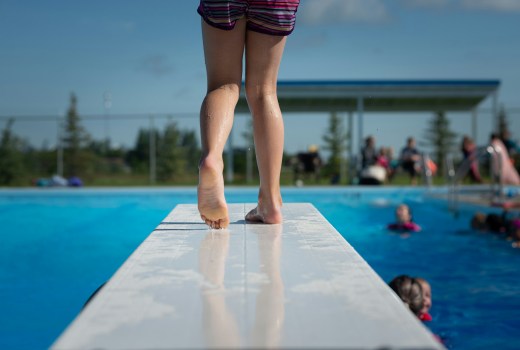
I saw her from the balcony of our hotel room. She was swimming lengths of the pool with expert strokes, legs and arms working easily, causing barely a ripple. I decided to forego my sullen teenage brooding for a while and make my way poolside.

As I approached, her beauty was even more apparent: tanned skin, lithe body, flowing black hair. I became painfully aware of my pale, skinny torso and unruly mop, but hoped our proximity in age and the general boredom of a resort miles from anywhere might afford me a chance.

Flip-flopping my way around the edge of the pool to the deep end, without pause or ceremony and trying desperately not to look in her direction, I cannonballed into the water. I sank to the bottom where I kicked up and out of the depths with flailing arms and eyes squeezed shut. I stole a glance in her direction but she paid me no heed. She swam one more length before exiting the pool and returning inside. The cannonball had missed its mark. 

Treading water in the deep end I realised that any potential for summer romance was going to take a little more finesse on my part. This was a sophisticated girl who would not be won over by immature splashing. My course of action was clear: I would have to learn to dive. 

I spent that morning perfecting my dive as disinterested tourists drinking watered-down mojitos reddened in the sun. My efforts from the pool’s edge were not too bad, and despite nostrils full of chlorinated water I found a method that I was happy with. But I was under no illusions. I knew what was required to woo the sweet siren of my dreams. 

I eyed the diving board with a mixture of determination and dread. 

The following morning the object of my infatuation was again swimming effortlessly in the pool while the other revellers were still battling for space at the buffet, devouring sausages that didn’t quite taste right.

I watched her from the safety of my balcony, pining away, planning our future together, composing breathless love letters . . .

After she vacated the pool I made my way downstairs. I had a rough idea of the mechanics of a dive but the additional three-foot height of the diving board threw me off completely. My efforts were embarrassing. I belly flopped painfully until my body was red and sore and my skin felt like it might split apart if I continued to subject it to such torture. But, as Huey Lewis had informed me that summer, the power of love is a curious thing, and again and again I hauled myself out of the pool and back onto the diving board until I was eventually called away by my parents. (The power of love unfortunately did not extend to avoiding day trips to ruined temples.)

The mornings were my own and once my Love had left the pool I would go down to work on my dive. My dad began calling me Greg Louganis and my mother eyed me with suspicion, but I was undeterred. After five mornings my technique, while far from impressive, was certainly passable. I sprang up and out from the board, my biceps tight to my ears and my hands stretching out in front. My legs pressed firmly together and I had learned to time my body tilt so that I entered the water smoothly and straight. I would then proceed to swim a length of the pool underwater before emerging breathless and gasping for air at the far end. I spent another day or two practicing my breath control until I managed to swim a length underwater with a degree of comfort. 

After a week, I was ready. 

Following a night of jitters and absurdly complex fantasies I made my way to the pool early the next morning. I watched her lower herself into the water, breaststroking once or twice before transitioning into front crawl and swimming away. I took up my position on the edge of the diving board, breathing deeply as my heart pounded away in my chest.

I waited until she had swum two lengths, knowing she would customarily take a short break at this point at the far end of the pool. Once she had stopped and turned I seized my moment. 

The dive was flawless, perhaps the best I had managed all week. It caused barely a ripple and I swam strongly and steadily beneath the water towards the far end of the pool. Having touched the wall, with the most casual expression I could muster I stood up in the shallow end and smiled in her direction. Except it was no longer her direction. She was off again, swimming towards the deep end in her perfectly languid style. 

Seeing little alternative I hauled myself out of the pool and returned to the diving board where, again, I performed a perfect dive and swam to the far end. But to no avail. She was either deliberately ignoring me or remained unimpressed. Five dives later and I was feeling defeated. Mercifully, my dad appeared and told me to go and get ready; there were two-thousand-year-old ruins that couldn’t be kept waiting. 

The next few mornings played out in a similar fashion until it was finally time to go home and I was left baffled as to how she had failed to fall in love with me. My progress from cannonball splat to expert dive was a hero’s journey to be proud of, yet I had failed to win the girl. 

She was all I could think about for the rest of the summer and I wished I’d learned her name so I could yearn after something more tangible, but she was destined to remain a mystery.

After all, it had never occurred to me to actually speak to her.

* 

Billy Craven is a teacher living in Dublin, Ireland. He has previously had short stories and poetry published in a variety of magazines including The Caterpillar, Ram Eye Press, Ember and Paper Lanterns.

Shooter Flash: “Quantum Choices” by C Goth

“Can you pass the salt?” Smith asked as politely as possible.

“Sure.” 

This wasn’t even small talk. 

“Thank you.”

Microscopic talk.

“Welcome.”

Quantum talk: the smallest blocks of syllables that could build a conversation. 

He was telling Smith how jealous he was, with icy indifference.

Weeks of this, and for what? Succeeding? Everyone in their cohort had applied, not just her. The mentors repeatedly stressed the importance of applying: “Our program only exists because of companies like Rockreed/Harken. They’re the reason we can accept so many students.”

Quantum physics was a tough field. The religious protests, the push for government funding into the military, the dwindling student population; it took a toll on the department. Funding was scarce in a field where success was frequently hypothetical and all but impossible to measure. Those who were in the department knew its importance, but that didn’t translate to marketability. The secrets of the universe were cool, yet grants were hard to come by. 

Smith’s application was done the same day the post went up. She knew she could help people.

Smith had a concrete vision for her research, and needed a certain amount of start-up capital you just couldn’t expect in academia. 

Rockreed/Harken agreed; she got her official offer of employment less than a week later. 

She’d been frozen out by her colleagues just as quickly. Today was the last of it. This luncheon was the last time she would be with the entire cohort, and she started at R/H tomorrow. The traditional graduation ceremonies had become steadily less appealing as her colleagues had isolated her. 

I got hired by Rockreed/Harken. Nobody said this was going to be easy. The mantra kept her going.

*

Smith’s hands trembled while signing the last line of the contract. Twenty-seven pages of fine print, most of which she’d skimmed.

“Let me be the first to say it,” the HR representative said. “Welcome to Rockreed/Harken!”  Smith’s heart soared. 

Then she saw her office. 

Each door in the hallway had a sturdy bronze sign, with a section label and quote.

WEAPONS DEVELOPMENT

“A weapon isn’t good or bad, it depends on the person who uses it.” 

Jet Li

Smith looked at the guide, sure there was a mistake. 

“The atom bomb was no ‘great decision.’ It was merely another powerful weapon in the arsenal of righteousness.” 

President Harry S. Truman

The hallway stretched out before Smith in dizzying endlessness.

“The more you sweat in peace, the less you bleed in war.”

General Norman Schwarzkopf

Her guide kept walking. 

“Leaders must invoke an alchemy of great vision.” 

Henry Kissinger

She was supposed to be in renewable energy, her research had nothing to do with weaponry.  The thought of it disgusted her. 

“Is this…” Smith trailed off, but the guide continued walking forward without any hesitation. “Is this where I belong? I mean, this isn’t my department, is it?” 

“Of course. When we saw the drafts you provided, the immediate application jumped off the page.” 

The blood drained from her face. “I thought the offer – the job would be in the energy program?” 

“Yeah, we get a lot of flack if we’re too upfront about it. People want the safety of a strong defense, but get queasy about how we get there. Like the old saying, right, about hotdogs? Bombs are the same way.” 

He chuckled, as if bombs were just as much of a joke as hot dogs. As if a whole department dedicated to destruction was funny. As if death as a career choice was normal. 

“You’re going to be on Project Brooklyn.” He waited for her to get the joke. “Like first we had Project Manhattan… and Brooklyn is the new Manhattan?” She couldn’t laugh, preoccupied by the enormity of her mistake. He continued, “I guess you haven’t spent much time in New York.” 

*

Moses was told to hide from the face of God. It would have been too much for him to witness. Even for holy Moses the sight of the Almighty could not be risked. 

You can’t look at a nuclear blast. If you see the mushroom cloud, it’s too late. The pain is an instant away. That’s assuming you survive the blast to begin with: the acute radiation syndrome, the burns, the melting, the ongoing horrors. 

God did not show Moses the awesome power of the face. But we did. We used nuclear bombs to decimate a city. To kill tens of thousands of civilians. And then, days later, we did it again. Who are we to do what God deemed too dangerous?

*

A sleek computer displayed her research. Seven years of work – her hopes and dreams – displayed under the R/H logo. She shivered. Per the instructions, she opened the document labeled Background Memorandum and began to read. The devastation she felt upon seeing the bronze plaque was nothing compared to how she felt now. Her research would fit in. If anything had been in her stomach, she would have vomited. 

Smith was finally left alone to catch up on the status of Project Brooklyn. She couldn’t fully grasp the depth of it, but she had just enough of a view of the big picture to see how deadly the plan was. Out of habit, her mantra sprang to mind: I got hired by Rockreed/Harken. Nobody said this was going to be easy. 

*

Rockreed/Harken’s headquarters were surprisingly flammable. No one batted an eye when Smith stayed late. After all, she was catching up on decades of work. Nineteen hours into her first and last shift, she started the newest plank of her life plan. A safety search of the building, a quick check into office data-retention policies, a few well placed bundles of tinder, and a disconnect of a server. For all the technology in the world, fire was still more advanced. 

Smith turned away from the building, tears streaming down her face, unable to look directly at what she had accomplished.

***

C Goth is an artist, writer, and all-around sleepy guy. Goth works full time as a public defender, hence the pen name. On bluesky and instagram @g0thlawyer. Website: g0thlawyer.com

Shooter Flash: “The Escapologist” by Sherry Morris

Dad didn’t wow crowds by bursting out of burning caskets like other escapologists. He didn’t wriggle free from straightjackets or emerge jubilant from chained trunks. Mom claimed he was a helluva Houdini anyway.

She meant his knack for disappearing whenever there were chores to do. Gutters stayed cluttered, grass grew high, the kitchen tap dripped constant as a ticking clock. Dad dodged other duties too: kissing boo-boos, reading bedtime stories. He vanished at the first sign of raging tears, monster-fears, or any kind of hug. Sometimes, Mom wondered aloud how we three girls had even been born. Then she’d smile and shake her head. 

‘Your father is a true magician. They never show their tell.’ 

Other times, when she thought we weren’t about she’d shout, ‘Marriage is more than smoke and mirrors, you know.’  

Dad would calm her with a kiss. ‘Shh, don’t break the spell.’

We loved our escapologist dad. Even when he evaporated from birthday parties, family reunions and long stretches of Christmas day. We kids would sit outside his locked study door. We’d chant all the magic words we knew – Abracadabra, Hocus Pocus, Bibbity-Bobbity-Boo – then wonder why our words took so long to work. Agreed the budding feeling in our guts was simply anticipation. And when he eventually reappeared, looking crumpled and spent, enveloped in a strange scent, we’d rush to him, ask him where he’d been. He’d sneeze. Look over our heads. Take in air like he had a long answer prepared. Then smile and shrug. In a rushed exhale he’d say, ‘Magic is complicated work.’

We got used to his non-appearances at our school plays, music recitals and high-school basketball games, but never that odd feeling in our guts. We accepted we’d never pin him down for photos and tried to engage him in other ways: asked for homework help, advice on boys, tips and tricks to pass our driving tests. We said, ‘Tell us about your day.’ In the middle of telling him about ours, we’d suddenly find ourselves alone – the image of his lopsided grin shimmering in mid-air.

We did our best to interest him in our lives and when Dad took early retirement, Mom said for sure we’d see more of him. Instead, he announced he was moving out. He’d found the love of his life – Janice – and planned to live with her, her cat Bunny, and Barnaby, her ten-year-old son. We looked to Mom to see if it was true – she looked like a lady cut in half. 

Things didn’t quite go to Dad’s plan. He developed a severe allergic reaction to Bunny. And Barnaby didn’t like sharing his mom full-time with Dad so he moved into a bachelor pad, temporarily, while everyone adjusted. Then Parkinson’s got hold of Dad. He couldn’t escape that.

Mom took him back to convalesce. She said she did it for us kids though we were nearly adults by then. She repeated what the doctors said – the disease made him behave the way he did. We couldn’t blame Dad, she said. We all nodded our heads. No one wanted to believe Dad was an escapologist at heart. 

We looked on the bright side: We still had time with Dad. But with the tremors and balance loss, he wasn’t up for much. We tried to reminisce, but our best memories didn’t include him. He shrugged when we asked what he remembered about us. We joked Dad was so skilled, he’d find a way to dodge death.

He didn’t, of course. And Mom shocked us all with a curse-laden outburst, shouting maybe Dad was finally f-ing happy now that he was free of us. We supposed this tirade was Mom’s grief speaking. Enclosed her in a group hug. Told her he’d loved us in his own way. Reminded her of his charm, his magic touch. We said all the things he’d said himself a million times. But from our mouths the words sounded hollow. Clichéd. 

Somehow, the words worked on Mom. She pulled out a smile from somewhere and ta-dahed it to her face. Said it was our duty to keep Dad’s memory alive. We went through his stuff (there wasn’t much) and found a cheap cutlery set he’d bought while living on his own. Mom announced we’d use it for our Sunday roasts, his favourite meal he sometimes ate with us. 

At first when we gathered around the table each week, it was nearly normal. We talked, laughed, reminisced. Dad’s empty chair was reinstated so it was almost like he was back. It wasn’t exactly the same though. Our voices were too loud, too rushed, ventriloquist-dummy high-pitched. We shovelled in mounds of food blink-quick as if we had both hungry hearts and empty bellies to fill.

Then one Sunday, instead of his face, all I saw was his shoddy fork and dull knife in my hands. The white plastic handles had already started to discolour. And yet, these bargain-basement utensils were more real to me than Dad. 

I listened to the clink, clatter and chatter that tied us to him. Wondered why we still worked so hard to maintain the illusion. Why we never allowed ourselves to be mad at our always-absent dad. And why we weren’t enough for him. 

I pressed the fork tines deep into the meat, securing it to my plate. Too bad we couldn’t use cutlery on Dad. I positioned the knife to slice but stopped. My appetite had disappeared. My eyes pricked as the world blurred. I wished we hadn’t shushed Mom’s rage. Or called the childhood anger resting in our guts ‘anticipation’. I took a deep breath. 

‘Dad was a complete shit,’ I exhaled. ‘I won’t be his complicit assistant.’

Into the speechless silence, I said the words again – louder this time, then once more. Something lifted; a spell was broken. I released my grip. Watched the cutlery fall to the floor. Opened the windows. Slid open doors. Walked outside to the sunshine-filled yard.

*

Originally from Missouri, USA, Sherry Morris (@Uksherka & @uksherka.bsky.social) writes fiction from a farm in the Scottish Highlands where she pets cows, watches clouds and dabbles in photography. She presents a monthly online spoken-word radio show featuring short stories and flash fiction on Highland Hospital Radio. Many of her stories stem from her Peace Corps experience in 1990s Ukraine. “The Escapologist” was originally published with The Sunlight Press. www.uksherka.com

Shooter Flash: “Whiteout” by Julia Carver

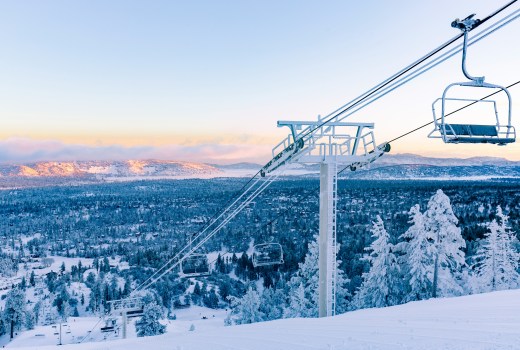
The ski lift bumped Rick onto its metal bench and toted him skyward. Glittering slopes fell away, frosted runs and dark crevices of trees winding down to the valley floor far below. In the distance, toy cars pulled into the parking lot from the snaking highway, which ribboned back along the edge of the foothills, over the frozen river and behind the humpbacked mounds of earth that sheltered town.

As they’d put the newspaper to bed later than usual the night before and he’d woken to a whiteout, Rick figured he could be late for the weekly editorial meeting. The editors would gripe but after three years of covering small-town courts, cops and haemorrhoid-inducing council meetings, he didn’t care.

He propped one ski on the footrest and let the other swing, gently rocking the chair. The landscape lay silent and serene, air refreshing as ice water. He nodded to a beat in his head. He’d left his headphones in the house this morning, as well as his ski gloves, hustling to get out of there while Candice was in the shower. She was wigging him out with all the baby stuff, having ramped up her mission since turning thirty.

He couldn’t imagine having kids. It just didn’t compute. He figured it would happen some day, sure — later, down the line. But this was his first job out of grad school. He was living in the now; the future was a nebulous concept hanging somewhere in the distance, blank and unfathomable as the winter sky.

The chairlift groaned and, with an icy scrape, clanged to a halt. Rick’s chair bounced and he stopped swinging his leg, waiting for the cable to resume its uphill tow. He craned his head to see what was happening at the base. No-one was in sight and no-one else appeared to be riding the lift, either.

Rick sighed and settled back. Empty quads dotted the way ahead to the exit ramp, an aerial ellipsis that marked time between the end of one run and the start of another. He blew into his hands and watched the thickening snowfall settle on the swaying chairs. He would miss the whole meeting at this rate, but whatever.

A crimson ski patroller was flashing down from the lift tower, carving swift turns beneath the stalled chairs. He slid to a precise halt under Rick, skis perfectly parallel.

“How you doing up there?” he called. “You alright?”

“Yup. What’s happening?” Rick called back.

“Bullwheel’s stuck. We’re takin’ a look at it. Just be a few minutes I reckon. Otherwise we’ll have to get someone out here to evacuate you. You ok to hang tight for now?”

“Yeah,” said Rick, startled at the prospect of being winched down like a cat from a tree. “How will—” he started, but the patroller had pushed off already, surfing the sparkling snow drifts around the chairlift pillars like powder waves.

Damn, he thought, a cold crackle running over his body. Why in hell had he come out here before work? He could have gone to the meeting, on time, and driven out here afterwards to hit a few runs during lunch.

The fingers on his left hand were tingling now, a pins-and-needles sensation. What if he didn’t get down soon? His fingers were nipped; soon actual frostbite would set in. What if he lost fingers? How would he do his job?

Candice would leave him. She was already disgruntled; why would she stick with a digitally-compromised freak? She might have to support him. Would loss of fingers qualify for disability? This thought calmed Rick slightly. Benefit money. Ok. He could take some time, write a novel. That might not be so bad.

He peered down at the ground: it was a solid fifty, maybe sixty-foot drop. This was crazy; he was stranded. His phone was sitting in the car. No skiers had gone by in thirty minutes.

To the east, he could see skiers riding the Marmot lift. Because Thunder was down, everyone was avoiding the area. Rick’s goggles began to steam up. He worked a rigid finger behind the lens to wipe it clear and finally spied someone, a snowboarder, carving turns down the Ampitheater run. 

“Hey!” he shouted, waving his arms. “Hey! Over here!” The boarder had seen him, had cut away from the centre of the run and was sliding towards him. She sent up a powder spray as she swung the board round sharply and edged to a halt. She pushed up her goggles.

Oh god, Rick thought.

“Rick?” The girl peered up at him, first in disbelief, then amusement. He found himself, momentarily, flashing back to their last interaction, when he’d laid into her for missing an assignment at the courthouse. “What’re you doing up there?”

“Hi Jaz,” he said. “They sent you out here?”

“Mike heard ski patrol was gonna evacuate someone over the scanner,” she said, slinging her backpack onto the ground and fishing out equipment. “Told me to come get the shot.” She grinned, fitting lens to camera.

“Come on, Jaz,” Rick said. “Give me a break. Mike’ll flip his lid. Can you go get ski patrol instead? I’ve been sitting up here for over half an hour. My fingers are about to fall off.”

Jasmine cocked her head. “I’ve got to get the shot, Rick,” she said.

Two patrollers swept towards them towing a rescue sled. “We’re gonna get you down,” called the one from earlier. Jasmine planted her snowboard next to the pillar, trudged through the snow for a better angle and started snapping the rescue mission. Rick wished he’d jumped when he had the chance.

The patrollers slung a rope over the lift cable. One of them rooted himself into the snow to belay the other, who climbed up to Rick’s chair. “Howdy,” he said when he reached the top, strapping Rick into a harness with expert efficiency.

“I could probably just climb down myself,” Rick grumbled. Jasmine was clicking away.

“Gotta strap you in. Safety regulations,” said the patrolman, signalling his partner to let out the rope. Dangling Rick between his legs, he rappelled them both earthward. Rick felt like a bit of meat on a line: editorial bait. His legs buckled when he reached the ground.

He dreaded to think how he would explain himself to Mike. His job, his relationship, his life — everything seemed suddenly, thanks to one innocent matutinal detour, to teeter at the edge of a crevasse. He dug his poles into the snowpack and pushed off, quickly, to catch up with Jasmine.

“Jaz!” he called out, drawing level. She’d strapped her pack back over her neon jacket and was rocking her way downhill in the slouchy, rhythmic manner of snowboarders. “Jaz, just say they evacuated the person before you got there. Don’t show them the pictures.” She turned, but Rick couldn’t see through the tinted lens of her goggles.

Jasmine pulled ahead. Snow was falling in fat, heavy flakes, whiting out his view. Like broken bar lights, her neon form started to sputter behind the curtain of snow. Whatever, he thought. He’d catch up with her in the parking lot. Right now, he’d just try to focus on the short run he was going to get, and forget about the other stuff. It was really blizzarding; he could hardly see five feet in front of him. The earth, the sky, the world was white: a blank, empty void, full of nothing, and he was skiing right into it.

*

Julia Carver is a former news reporter who lives in Gunnison, Colorado, with her husband and two dogs. She has published fiction in the Whitefish Review, Salt Hill, Helix, Tahoma Literary Review, and elsewhere. She is currently working on a novel.

Shooter Flash: “Thursday’s Dresden’s” by Jacksón Smith

Twenty minutes past my reservation. I’m late for a meeting. My foot taps; I check emails. The Barber – thick beard, leather apron – rolls up his sleeves. One-man shop. Too late to go anywhere else. 

Last week my new manager said I looked like a highland cattle. I had to Google it. Turns out: majorly insulting, and a brag about his Scottish whisky tour with the Board. Clean it up, he said, pointing his toothpick at my hair, or quit and go back to hacky sacking with your pals. 

Finally, the Barber’s done sweeping the last guy’s hair. The bell rings. In comes an old bald man. Tall-faced and sorta droopy, with delicate wireframes and a beige cardigan.

The Barber clasps the man’s shoulders and escorts him into the well-worn chair. 

What a way to run a freaking business. I stand and hold up my iPhone. “I have a reservation.”

The Barber’s face screws. “With who?”

“What do you mean with who?”

He points with his scissors at the clock. “Twelve thirty on Thursday’s always Dresden’s.”

“For what?” I point at the man, who is bald. 

“Well, oh.” The old man adjusts his glasses. “It’s not – well, yes. You’re right.”

“Ritual,” Barber says. His voice is mirthful, different than before. “Thursdays we have fun. Dresden gets The Works.” 

“Oh come on, I made a reservation online.”

The Barber taps his scissors on his beard like he’s thinking. “Huh, online!” He snaps the bib around the man’s neck. 

And what the hell do you say to that? 

So I sit, arms crossed. Make them feel bad for making me late. 

The Works: steaming towel, oil lather, peppermint, huge calloused hands massaging his scalp, the both of them talking, laughing (giggling, even), on and on. Twelve-inch feather dusters, leaky urethras, son-in-laws, thin mints (the Barber’s daughter is a Girl Scout). 

Emails buzz my pocket. I ignore them; my foot stills. The Barber’s cheeks flush (a joke about sauerkraut), and then he hands Dresden a mirror. Jesus, does he really need to examine his – but I catch myself. It doesn’t matter, his baldness.  

I rub my temples. I have a strange, beautiful image in my mind of a bunch of cattle playing hacky sack. The crisp sound of beans on a hoof.

I tried, boss. I tried to don the tie, to be a businessman, to have a nice framed photo on Mom’s mantel, just like my brother’s, but go ahead, mock me, fire me, because, well, I guess Thursday’s Dresden’s for Christ’s sake. 

“Hey,” I lean forward. “Do you have another order form? I love thin mints.”

*

Jacksón Smith is a writer based in Washington, DC. His work has appeared in G20, Diplomatic Courier, Childhood Education, and The Golden Antlers. He studied PPE and Creative Writing at Claremont McKenna College. His fiction explores the tension between logic and absurdity, the surreal within the mundane, and the strange ways people collide with their pasts.

Shooter Flash: “River Without Current” by Thomas McEvoy

In Mama’s last letter, she wrote that there’s no opportunity at the Napo River Lodge, where Papa works. She warned that if I continued to live with Papa, I would end up like Yolanda, chopping vegetables in the kitchen, or Maria, who cleans rooms every day. She even asked him what future our girl has at the lodge.

When Papa finished reading the letter, he crumpled it and threw it into the bin. I had to flatten it and read it alone. I wanted to talk to Papa, to ask him when I could go and join Mama, but I was afraid. I’d seen the look on his face as he read it, and I didn’t want to see that again.

The Napo River is all Papa knows. He wouldn’t leave because there’s nothing else for him.

That night, I used a flashlight and cocooned myself under the bedsheets, going over every word about Mama’s city, imagining the hotel she worked at and the school I’d go to. Papa had homeschooled me all my life, but I yearned to be part of what Mama described. I fell asleep thinking of the capital’s smooth, asphalted roads.

The next day, I told Papa we should go out searching for caimans, just the two of us, like we used to when I was younger. I figured that way I could talk to him, convince him to let me go and join Mama.

“We’ll go another time,” Papa said. He’d been out all day bird-watching with a group of Americans. Americans are the most demanding clients, but they tip the most, so Papa makes an extra effort with them. 

Then I lost the letter. I’d kept it under my mattress so nobody could find it. I’d read it every night, thinking that if I did, I would dream of the city. It was my way of bringing what I desired into existence. The letter was gone. I wondered if Maria had found it. I didn’t want to say anything in case she read it or told Papa. Instead, I tried to remember the letter, word by word.

One evening, Papa finished dinner with the Americans and looked for me.

“Come on,” he said. “We’re going caiman searching.”

I didn’t feel like going anymore.

“You wanted to, right?” Papa said. “Fetch your light.”

My flashlight was a prized possession. It was silver and looked out of place in the jungle. That’s why I liked it. It was a gift from a Dutch tourist, one of many who pass by for a couple of days, never to be seen again.

We set out in the canoe without a word. We knew the right spot. As we approached, we lifted our oars and shut off our flashlights. We floated on the river without a current, bathed in total darkness. At night, the Amazon comes to life. You hear the loud and constant buzz of cicadas, the croaks of frogs, and the howling of monkeys deep in the jungle.

Papa believes caimans are stoic. I didn’t know what that word meant until he explained. Caimans like to stay close to the shore, partly submerged in the river, motionless. Usually, the crest of their head, spine, and tail is visible. If you make a sudden movement or sound that scares them, they will lash or disappear quietly in an instant. The trick is to mirror them and relax. Papa showed me. If you do, they’re happy to lie still as you shine on them, their eyes blazing like marbles of fire.

“Papa—”

He turned on his flashlight. “There they are, look.”

Two caimans huddled together by the bank. The distance from their orange eyes to the tips of their long tails showed just how large they were. We illuminated their leather bodies, staring into their unblinking bright eyes. It was a game we used to play: shining on the caimans to see how long they’d stay.

We kept our lights steady, trying not to frighten them. After a couple of minutes, the bigger caiman went under without a sound, like a silent submarine. We focused on the remaining caiman, trying to extend the moment. The canoe ebbed side to side, mimicking Papa’s slow and deep breaths. Then the second caiman left.

“They’re gone,” I said, disappointed.

Papa closed his large hand around mine, placing a worn piece of paper in my palm. The weight told me what it was: Mama’s letter. It wasn’t Maria who had taken it from under my bed. It was him. He knew I’d been reading it.

“I wanted you to have it back,” Papa said quietly. His voice sounded like the creak of the canoe, something old and strained.

I berated myself, feeling as though my nightly rituals with the letter had sealed my fate. Holding it again, the city’s pull faded, replaced by guilt. 

“It’s time,” Papa said softly, as he picked up the oar. 

A man of few words, I knew this was how he let me go. I placed the flashlight in front of me, but I didn’t switch it on, not wanting him to see my face. I grabbed my oar to help us back. I opened my mouth to speak, but the jungle drowned me out.

*

Thomas McEvoy is a Paraguayan-born British writer who has lived in Panama, Honduras, Ecuador, Japan, Canada, Spain, and England. He is currently pursuing a master’s degree in Creative and Critical Writing at the University of Liverpool. His fiction has appeared in J Journal: New Writing for Justice, Scoundrel Time, and Collateral Journal.

Shooter Flash: “Lisa’s Little Lie” by Steven Bays

The wheels of the gurney squeaked as an aide moved Lisa to recovery. Half asleep, she stirred, then moaned and curled into a fetal position. She pulled the sheets over her shoulder and stuck one foot out from under. When she saw the blue hospital sock, she remembered where she was. A feeling of nausea overcame her and she cupped her hand under her chin. A nurse noticed and held a small kidney-shaped bowl, just in time for Lisa to vomit.  

“It’s the anesthesia,” a nurse said. “It’ll pass. Drink this.” She gave her some apple juice. Lisa tried drinking but the nausea came back. She closed her eyes. “Could I have some ice chips instead, please?” she asked. 

Lisa did better with those. They soothed her thirst and she no longer felt sick.

The nurse asked, “Are you ready for a visitor?”

Lisa nodded, and her boyfriend Peter came in. He sat on the edge of her bed. 

“You okay?” he asked. “You don’t look so good.”

Lisa nodded. “Yeah, just a little nauseous.” 

Peter waived his hand. “What smells?”

“I puked. Sorry.” 

“How do you feel?”   

“Like I was out drinking all night.”

Peter waited until the nurse stepped far enough away that she couldn’t hear. 

“No, I mean now that it’s over. Any regrets?”  

“Peter, not now.”

“I’m sorry. I’m just having a hard time with this.”

The nurse came back to check on Lisa.  

“When can she leave?” Peter asked. 

“As soon as she can keep something down, use the bathroom. Won’t be too long.”

Peter had always been good to Lisa. She knew that someday he would ask her to marry him. Even now, after what she’d put him through. He’d brooded about her indiscretion for days but he forgave her. Still, he didn’t want her to have the procedure. She remembered the argument.  

“It’s not right. It’s a sin. We’re Catholic for Christ’s sake. I don’t care if it ain’t mine. We’ll get married, and I’ll adopt it.”

Lisa knew she wasn’t ready to be a mother and doubted Peter would make a good husband.

“Who’s the father?” he’d demanded.

“Does it matter? I made a mistake, I’m sorry. Can we leave it at that?”

“I know the guy. Is that it?”

“No, you don’t. And it’s better if it stays that way.”

“Can you at least tell me how many times you cheated?”

“Once.”

“Once?” 

“Yeah, imagine my luck.” 

“Does the father know?” 

“No. And I’m not telling him.” 

The nurse brought some apple juice and asked, “You feeling better yet hon?”  

Lisa smiled yes. As soon as the nurse stepped away, Peter asked, “Are we still going to Brian’s?” 

“Yes.”

“Why? Do we have to?” 

“It’s close by and I can rest. Don’t worry, he’s working. I have his key.”

“I’d rather take you home.” 

“Are you kidding?” She whispered so no one would hear. “You want me to sit on that train for a freaking hour? My mother will flip out when she sees me like this. What do I tell her? Oh, I skipped work to have an abortion? No. Take me to Brian’s.”  

“Is he the father?”

“Keep your voice down. No. Just a friend.”

They were silent for a bit. Peter worried whether he could ever trust her again. Lisa’s guilt about what she’d done to him made her wonder if she’d made the right decision.

The nurse broke the silence. “Do you think you could use the ladies’ room?”

Lisa said yes, and the nurse walked her to the bathroom.  

After being discharged, they took a cab to Brian’s.

“I’m gonna take a nap,” she said. Lisa went to the bedroom and climbed into Brian’s bed.   

Peter watched TV in the living room. After a while, he stuck his head into the bedroom. Seeing Lisa awake, he asked, “Are you okay?” 

“I could use some Tylenol,” she said. 

Peter checked the bathroom. “None in here. Guess I’ll run out and buy some.”

“Look in the kitchen.”

Peter did as she suggested. He looked in the cupboards, shuffling things around, searching behind cereal boxes and cans. Utensils rattled as a drawer opened, then slammed shut. The noise stopped, and Lisa heard the tap running. Peter walked into the bedroom holding a bottle of Tylenol and a glass of water. 

“Here.” He handed it to her. Lisa took two pills and then gave back the empty glass.  

“I thought you said you’d never been here before.” He stood with his arms folded in front of his chest. “How’d you know where he kept the Tylenol?”  

Lisa frowned. “I didn’t. It was a guess. Don’t your folks keep any meds in the kitchen?”

“I don’t know if I can believe anything you say.”

“Look, I’m not lying. I’ve never been here before. And Brian, first, he’s not the father, and second, he’s just a good friend from work.”

They started arguing again. The same argument they’d had when she first told him of her infidelity, only more heated. 

“Yeah, you’ve been fucking Brian,” Peter said. “Who knows how many other guys you’re screwing behind my back.”

Stung by his accusations, she decided to tell him the truth. At this point, Lisa didn’t care if she hurt his feelings.

“I wasn’t going to tell you who the father was, because,” she hesitated. “Well. I figured keeping it a secret from you would be the best thing to do. So, I lied. I never cheated on you. The baby was yours. If you knew you were the father, you’d never let me have the abortion.”

Peter raised his hand to strike her. Lisa stared at him, daring him. He froze for a moment, then dropped his arm and stormed out of the apartment. 

*

Steven Bays was born in Greece but at the age of two immigrated to the US, where he was raised in Brooklyn, New York. He always dabbled in writing but took it seriously after retiring from a thirty-five-year career in telecommunications. He enjoys long walks, listening to music, working out at the gym, and playing guitar in a rock-and-roll cover band. His stories have appeared in various online magazines.