Shooter Flash: “If, Man, Son” by Al Crow

And—which is more—you’ll be a Man, my son! – “If” by Rudyard Kipling

Pint up, contents down, and I’m up, down the corridor. Drink then piss. Same old drill for an old soul. No need to spell it out. Quite a walk actually, for an ageing gent like me who’s really, really got to go, but I get there fine. In time. Double take on the sign. Notice the rhyme. Didn’t notice the sign before though. A little horseman with an oversized sombrero and a machine gun on the door of the gents. Supposed to be funny. So little effort in the rest of what goes for a boozer in this Monopoly-board railway station and there this six inch gun-toting Mexican lad on the bogs. They must be making sure the really leathered blokes still get the right place. Well, I’m not that gone. Not by halves. I push. Pull the next one, and it gives me four urinals, a sink and a single cubical with the door shut. Quite the drinker’s vista. Two gentlemen already there. One in the crapper. Pair of jeans resting on lime green trainers. Some old rocker at the far wall-mounted john. Leathers, raggedy beard, and a steely stare towards the poster at his front, which is adverting erectile disfunction. 

A man like me. A place like this. All these ifs in my head. 

You can try and drink away the ifs, but they’ll get you in the pisser. That’s the actual pisser, I think. When the ifs come for you in the pisser. 

The raggedy rocker nods a hard-arse glare my direction. Spurs me into life. I take the second lane, so there’s one slot between this half-price Slash’s slash and me, while I’m not so bang up against the sink that this will turn into a problem. Not that anyone here is going to wash their hands, but thems the rules. Decorum, anyway. Me and the rocker, we’re both hoping no-one else comes in and has to tuck in between us, but we’re okay. For now. So, I hunt out my Johnson in these tight arse pants I got from Amazon about a month before the sixty seconds that I’m drinking so shit hard not to think about happened. 

I yank a boxer leg up first, which is too long to get myself under, so I try to unfathom the intricacies of a knob-tunnel system that’s more impenetrable than the Tora Bora caves. This might be taking a while, but I’m gazing forward. Always look forward in the gents. Golden rule, and the poster at my eye level blurs into focus. It’s goading me to Be The Best, and I realise I’m far from the best, so far from my best. Haven’t been the best in me for so long. Don’t need an ad to tell me that. I got sucked into something for my boy. He was infinite. Perpetual. So much life in those gleaming eyes that it didn’t seem possible that he could be anything but there – couldn’t be anything by twenty and sharp and charming, always catching a ball or a cute girl’s eye – and I didn’t encourage him. He found that path himself. 

Sure, he was playing up to his old man. Sure, there were footsteps. Boots to fill. An apple and a tree. Sure, he was imitating, emulating, coating himself in what he thought was the very best of me, only I never said he should go down that route. I never told him the person he should be. 

In the pisser, here I am, playing that card as if it’s a get out of jail free. 

Ha. There it is again. I’m a poet and I know it. A poet like all those messed up word-wankers that went before me with their drinks and their England. Take Kipling, my mirror. He wrote all that clap about being a man, then he bluffed his short-sighted son passed a medical and square into a cavalry charge, gifted the blundering vole the once in a lifetime opportunity to have a jog at a gun post. The national treasure never forgave himself. Funny that you learn that one at school. Funny, not funny. 

“This country grinds you down.” 

It’s the rocker speaking, breaking the rule of not talking to strangers in the gents. He’s pressing the dispenser as if he genuinely believes there might be some soap in there and it’s like time has slipped. I didn’t notice him move from the urinal and the thought strikes me that perhaps he’s God and Jesus is taking a dump above the lime-green trainers in trap two. 

I wipe a stray tear. Guess that’s a more logical explanation of why he’s talking at me. 

“Too fucking right,” I say. 

As I do, the room is filled with the sound of the toilet flushing. It echoes about the bare-walls until it feels like the place is going to be filled, and I imagine drowning in there. I picture myself floating above the urinals and the sink, being washed higher until my head knocks on the ceiling and I smile at the rocker and take a last breath, which allows me a few moments under the tear and bog water, before the air seeps from my lungs and the darkness comes into my head, pushing away all the ifs with its milky-black ooze. 

“Well, you have a good afternoon Buddy,” the rocker says. “Perhaps go a little easier on the sauce.”

I smile.

I’m about to say something when the cubical door opens, and the kid who comes out is about twenty, blond hair, slightly foppish, and one of those smiles. For a moment, I think it might be him. My boy. I think it might, and he looks across. Those eyes unchanged. For a moment, I’m flooded, dragged further beneath that boat load of ifs.

*

Al Crow works across fiction, creative non-fiction and poetry, exploring this challenged world and human fragility. Recent work is featured in The Last Song, Words for Frightened Rabbit; Masculinity: an anthology of modern voices; Last Light, an anthology of Apocalypse Poetry; Lighthouse and The London Magazine.

Shooter Flash: “Trash” by Bethany Swett

Marg got used to the smell after her first week on the job. Slinging the slick black garbage sacks into the oily maw of the truck all morning, she got so steeped in the stench that she ceased to notice it. It was like water: once you were in it, you were wet. The smells, like drenching rain, only bothered you if you had something to keep nice in the first place.

She tied up her waist-length dreads after Cal, the jerk-off, pretended to feed them into the chomper on her first day. Jack, who drove the truck, more kindly suggested she might want to consider restyling if she didn’t want to end up processed like meat through a grinder. But her dreads were the product of years, connecting her way back to Burning Mans (Men?) of yore. Another life. She’d rather chop off a leg.

The loose bags sagging into each other on the sidewalk she tossed straight into the chomper. Trash cans and recycling got slotted into the mechanical arms and lugged in a big metallic hug into the bowels of the truck, then dumped back down again, like a kid too big to get picked up for long.

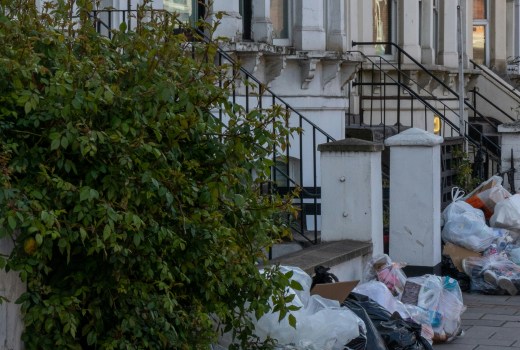
Marg hustled to the next set of bins on the worn-out street, its townhouses faded from lack of care and grayed-out by a drizzle of rain. The buildings were mostly brick with concrete stoops; sometimes old people shuffled around out front and hobos, towing errant shopping carts, rooted through the trash. Anyone looking like they had a job tended to scurry in and out like mice after cheese, wearing the cheap suits of office drudgery. Marg knew they looked down on her, if they looked at all, yet she wouldn’t trade places. She didn’t like sitting still, feeling pinned down.

She set a can into the last empty slot on the truck and hit the lift button. As the arms hauled up their load and dumped the contents, something clinked out onto the sidewalk near Marg’s boots. Its glint caught her eye, and she bent to pick it up: a silver ring set with a small diamond. Marg turned it over awkwardly with her thick padded gloves. She looked up at the nearest house, which had a matt-black door and window-frames, recently painted, not peeling like most of the others. No-one was racing out after a missing ring, anyway.

“Come on bird nest, let’s move it,” Cal yelled as the truck lumbered up the street, leaving Marg in its wake, gawking.

Quickly she tugged off her glove and shoved the ring in her pocket, fumbling with the zipper to yank it closed before hustling on up the street to catch the blundering truck, which was gassing and steaming like an old bull elephant.

Later, when Marg returned to the high-rise apartment she’d occupied for the last three years, she sat down and pulled the ring out of her pocket. It winked at her weakly in the dim light. She tried to slide it on. It was too small for her ring finger, but it fit on her pinkie. She twirled it there for a moment, then pulled it off and sank back into the sofa, opening up her phone.

She swiped and tapped to a familiar profile, bracing for the usual self-flagellating burn that came from scrolling his photos: the man she’d loved with the woman he’d left her for, living their best lives. The woman who, in fact, he’d been with before he did Marg the courtesy of leaving. She’d got better lately at resisting the urge to torture herself, but the ring had reminded her, and lured her back.

To her disappointment, though, his feed hadn’t been updated much for several months. Taking time… said one of his posts, captioning a mountainscape with a trail of hug emojis and hang in there buddy comments – and one saying, girls come and go but beer is always there!

With a crackle of anticipation Marg sat up and clicked through to the girlfriend’s profile page. She saw, among her numerous public pictures, the woman draped around the shoulders, torso, and assorted other body parts of a bronzed, toned, tall, and very much different man.

“Wow,” she exhaled to herself, flopping back into the cushions. She felt giddy, but also oddly queasy. Marg realised she was still in her work clothes, faintly off-gassing the morning’s garbage, and headed for the shower, scooping up the diamond ring from the table.

In the bathroom she shucked off her clothes and rummaged in a drawer, coming up with a thin silver chain. She slid off the cheap charm that had swung from it and replaced it with the ring. Squinting down at herself, she attached the chain around her neck, and looked up at the mirror, at the person standing amid the rising steam, bare but for a glint of light resting just above her heart.

One woman’s trash… Marg thought, fingering the ring. Maybe the saying would prove true for one man’s trash, too.

*

Bethany Swett works for a tech company by day and writes fiction the rest of the time. She has published short stories in Lilith, Quick Fiction, Bayou Magazine, 365 Tomorrows, and elsewhere. She lives in Denver, Colorado, with her dog Sushi.

Shooter Flash: “Drift” by Sammi LaBue

Alex wore her half of our heart necklace long after high school, but when they found her across the bay, she wasn’t wearing jewelry. Just her long hair around her neck like a noose of wet string. 

She finally moved to New York from Tampa two years after I had. She lived in Queens and I lived in Brooklyn, but we made Beach Day an official weekly holiday, no matter the weather, to remind us of home, and I got her a job at the bar where I worked.

She found me in the walk-in refrigerator during the shifts we shared. I’d mix cheap vodka with cranberry juice and slices of lemon, our seventeen-dollar happy-hour cocktail, and she’d talk about her new friends, her roommates, her artsy kind of sadness. The refrigerator’s vacuum seal suctioned us in behind her, as if to preserve us. 

*

We’d walk down the beach warp-powered by the Adderall she brought. I thought of our purse of shells and treasures, our iPhones and keys left behind, thinly veiled by faded bath towels. But she’d say, Let’s never go back, smiling. 

Days would slip by without a whisper from Alex. “Sometimes friends drift apart,” Mom said when I called her instead. Then Alex would be back again, our teeth hard-set against the cold of the walk-in. Her voice sounding more and more like the silent void of her voicemail.

Want an adderall, a xanax, anything else? The sand-stained coin purse started to fill with chalky blue-and-white pills – nothing like sea glass. 

*

Still on for Beach Day?

Is it going to rain?

Meet at DD, right?

Im Here

?

I waited outside of Dunkin Donuts flipping between my doppler app and messages and back again. A green mass crept across the screen pixel by pixel.

When the smell of rain had washed over the roasted nuts cart and the car exhaust, Alex appeared with her hands shoved into the pockets of her leather jacket. I was getting worried. She wasn’t wearing her necklace. Where’s your bag?

After the intersection, she threw a laugh over her shoulder then ran across the boardwalk and down to the beach. I chased after her, rain needling my skin.

She dropped her clothes in the sand. The metallic reflection of the waves striped her skin, her hair melted out across the water’s surface as she waded deeper. 

Alone on the beach, time expanded as she pushed out and out. 

I remembered bike races to the beach back home and how you could eat the heavy evening heat right out of the air. 

I remembered her theory about being adopted, even with her mother’s round, clamshell eyes, those straight eyelashes, the scattered sand freckles across her nose. 

I remembered the first day she showed up to work drunk, when she breezed past the walk-in window.

The storm faded as fast as it arrived, and then so did she. I could see her. I could see her, until I couldn’t. Like a star stared at too long in the night sky, she flickered out as the lifeguard’s whistle blared. 

* * *

Sammi LaBue is a Brooklyn-based writer and educator. She founded Fledgling Writing Workshops (Best Workshop in NYC, Timeout 2019) and is the author of Words in Progress (DK 2020), a creative writer’s guided journal. Her writing can be found in Literary Hub, Glamour, The Offing, Mutha Magazine, Hobart, and Sonora Review, among others. She received her MFA from the Vermont College of Fine Arts, is The Penn Review’s 2024 Poetry Prize winner, and has recently finished a dual memoir written in collaboration with her mom.

Shooter Flash: “Red Light Green Light” by Johanna Bernhuber

Mornings were always rushed, but Angie was particularly antic today – racing around, playing, not getting dressed when asked for the twentieth time. Susan had ten minutes to get her to school and she wasn’t even dressed yet herself.

“Come on!” she bellowed, as Angie tore past wielding a set of streamers like the Olympic torch. “Get dressed now!” And before she could push it away: You little shit, she thought. 

Delete, delete, delete, she thought frantically and froze. She could hear nothing but the sound of Angie playing, still not getting dressed.

Susan hurried to the bathroom and looked in the mirror, peering closely into her eyes. Her heart seized when she perceived, deep within the right pupil, a speck, not of green, but of red.

She ran into Angie’s room, where the child was finally struggling into her sweatshirt. Susan grabbed her slim, warm body and hugged her tightly. “I love you,” she said. “I love you so, so much.”

“Mom!” Angie protested, squirming. “I’m trying to get dressed!” But her little face was smiling, and when she finished pushing her arms through the sleeves, she threw them around her mother’s waist and returned her hug.

Maybe it’s alright, Susan thought, stroking Angie’s smooth hair and dropping a kiss upon her head. It was just a small blip. Maybe nothing will happen.

“Come on,” she said gently, kissing her one last time. “We’re going to be late.”

Together they got up and got ready to leave, Susan gathering Angie’s backpack, water bottle and jacket while Angie strapped on her shoes. She threw on a long coat over her pyjamas. The house looked like a hurricane had hit it, but Susan resolved to tackle the mess later, once Angie was safely in school.

They reached the door, opened it, and were halted by a man dressed in gray on the doorstep.

“No,” Susan gasped, clutching Angie. 

“Mrs Harber,” the man said. “We received an alert of a verbal infraction.”

“No,” Susan gabbled, “it was nothing. I was just trying to get Angie dressed and now she is, you see, and we have to get to school. She’s late as it is. We must get going, will you please let us by?”

“Verbal infractions need to be followed up,” the man said, waving forward a woman, also in gray, who waited behind him. “Let’s have a little chat.”

The woman held out her hand to Angie. Susan hung on.

“You musn’t,” Susan gasped. “She’s very well looked after. I look after her, all the time, every day. I love her, you mustn’t take her.”

“We just need to speak with your mom,” the woman said to Angie, ignoring Susan. “You come with me. I’ll get you a special treat, would you like that? But come now otherwise you might get into trouble, and you don’t want that.”

Angie looked up at Susan. Her hazel eyes, always so beautifully clear, shone with worry. Her mouth quivered. “Don’t worry Mom,” she whispered. “It will be ok.” She eased from Susan’s arms and went with the beckoning woman, who led her to a van parked on the street in front of the house.

Susan tried to go after her, but the man in gray blocked her path.

“Shall we?” he said, gesturing into the house.

Susan sobbed, Angie having melted from view, and turned helplessly to retreat into the house, collapsing on the nearest sofa. The man perched on a neighboring armchair and leaned forward.

“Mrs Harber, I am Agent Blain,” he said. “Do you know why I’m here?”

“Yes,” Susan said, miserably. “But it was only a split second, a careless moment. I was frustrated. It didn’t mean anything. I love my child, more than anything. It was just a moment.”

“Mrs Harber,” the agent said, “life is made up of moments.” He paused. “That’s why moments are important. Do you feel unable to perform the day-to-day duties of motherhood?”

Susan shook her head vigorously. 

“No, not at all. I mean, I’m fine – I’m in control. I’m happy.” She smiled awkwardly, against the tears. 

“You may think it’s just one thought, but our research shows that actions – negative actions – don’t occur without the negative thoughts that precede them. With right thinking, right actions follow.”

Susan nodded, kneading her hands in her lap.

“It won’t happen again,” she said hoarsely. “It’s never happened before.” Forcefully, she pushed I’m not lying I’m not lying across her brain.

“It’s true this is your first infraction,” said Agent Blain, standing up and adjusting his jacket – the one all agents wore, with the high, circular collar. “And as such we will return your child to you, with a warning. But we will, you understand, have to take some precautions. Including placing you under elevated watch.” He moved to the door and, as he opened it, Susan could see the woman in gray leading Angie back up the path to the house. 

“You’d better get this one to school,” the woman said, releasing her with a pat on the back.

“Yes of course,” Susan said, flooded with relief. “Right away. Thank you.” She knelt down to hug her daughter close, but felt Angie stiffen.

“Are you ok?” she asked, pulling back to look at her. In the background, the agents’ van pulled away from the kerb. Angie looked slightly dazed.

“Why did you think that?” she whispered.

“Oh sweetheart,” Susan said, feeling stabbed through the heart. “It wasn’t about you, it wasn’t. It was just – you weren’t cooperating, and I felt stressed. I didn’t mean it. It wasn’t something I said.”

“But you thought it.” Angie’s voice rose.

“That’s not the same. You can’t always control your thoughts.” She hesitated, then added, “But we do have to try.”

“That’s what the lady said.” Angie looked up, frowning, and met Susan’s gaze. Looking into her eyes, Susan caught her breath.

Deep within Angie’s right pupil, surrounded by the soft flecked gold of her iris, glowed a bright speck of green.

Which then, within Angie’s accusatory face, abruptly flicked to red.

* 

Johanna Bernhuber is a psychologist who has written for the Chicago Sun-Times, and has published short fiction and non-fiction in Whitefish Review, Ginosko and Denver Quarterly. She has three children and lives in Illinois with her husband, one dog, and too many books.

Shooter Flash: “Pool Wolf” by Robin Dennis

I pull the handle and the door nearly comes off in my hand. I take a plate as thin as a sucked Polo, thin enough to crack over your knee. Just the weight of it puts me off my dinner. 

Dad’s busy at the sink like all this is normal. Maybe it is normal for him now. But if it’s normal now, then it must’ve been normal before; you can’t just change who you are. All that time he must have been pretending, hiding the fact that he can live like this. 

He turns to me, then turns back without speaking, like I’m miles away. There’s barely enough of him to dry up the dishes. 

*

He takes me to his room in the attic. He shows me the banister over the stairs. He puts my finger on a groove in the wood. He asks what I think made it, the groove in the wood. 

We sit at the table, and I can’t leave until I eat. In Africa, kids are starving. They lie with flies in their eyes, bored as horses. I guess it’s normal for them. 

*

Wednesday’s swimming, so we go to the pool. Dad pays us in and sits on a fold-out bench with his fists on his knees. 

I bob in the water, swim to and fro. The wolf doesn’t seem to be here today. I ask someone if he is, and he says no. Underwater, I open my eyes wide enough to check the grates, blood beating in my ears.  

*

In bed I watch Steven Seagal put holes in people and roll their bodies off his boat. I can hear him in the attic, the man who was here before. I can see him on the stairs, a rope round his throat – perfectly still, as though he’s floating. The plates are his. The plates and pretty much everything else. He made the marks and the rips on the lino, broke the cupboard door. My dad just came and took it all. 

*

The wolf’s back on Wednesday, walking on hind legs and running his claws along the walls – plaster crumbling, wires pissing sparks. One’s dancing like a snake, shooting fire across the tiles, and I wonder what’d happen if it went in the water. Sparks falling like upside-down fireworks, glutting the bottom with gold. 

He takes a woman’s head off and her girl starts to cry. She’s young, maybe five. He takes a bite and drops it, then disappears round the corner to the little pool, through the footbath that connects the two. I look to my dad, but his bench is empty, folded up. A lifeguard’s already coming over with a bucket and mop. 

* * *

Robin Dennis is from the East Midlands, and teaches English in southern Germany. His writing has previously appeared in Stimulus Respond.

Shooter Flash: “Teenage Kicks” by Billy Craven

When we were young, there was a man in our town named Shotokan. He was pale and balding and sported a ponytail that was at once tragic and defiant. More importantly, he could dodge bullets.

Growing up in the suburbs in the 1980s, bullets were hard to come by so we were forced to take him at his word which I, for one, did happily. Anything that broke the monotony of housing estates and skinheads and the endless talk of unemployment was to be applauded. Whether you believed him or not, the very idea of Shotokan dodging bullets was a chance to dream of something beyond the ordinary.

Dodge might be the wrong word actually. As he explained it, it was less about dodging and more about bending the flow of the bullet around him. Everything had a flow, and everyone had the capability of disrupting that flow, but it took years of training, concentration and discipline. On summer evenings he would stand in the middle of the green wearing full karate garb. It was his Gi, he informed us, much to the delight of my friends. He had studied martial arts throughout Asia. He had mastered Bushido, Aikido and even Shen Long, and he was held in the highest esteem on the island of Okinawa. Along with his Gi, he wore a black belt with three red tips. He said the black of his belt was the darkest shade possible and the red was a reminder of the blood on his hands. When pressed on this he would get a faraway look in his eyes and remind us that Karate should only be used in self-defence, a lesson he had learned the hard way. 

Shotokan was the subject of ridicule among my friends, and though I laughed along with them, I noticed that nobody dared mock him to his face. The potential of his fighting skills and his supposed mastery of the dreaded Dim Mak technique kept the sceptics in check. And even if there were those who doubted his tales of unsanctioned death matches, the fact remained that standing in the centre of the green in his pristine white outfit performing his kata while twenty teens and children waited impatiently for a game of football, took courage. 

To me, his powers bordered on the supernatural and I would watch fascinated as he worked his way methodically through his routine, half expecting him to conjure a fireball in his gracefully twirling hands. He didn’t punctuate his movements with any sound effects, no hi-yahs or Bruce Lee wails, but the whip-crack of his loose fitting Gi as he performed roundhouse kicks and Karate chops against invisible enemies accompanied his strikes. He was a study of poise and concentration. His moves went from meandering and balletic to sudden and violent in the blink of an eye. None of us knew where he lived, which only added to his mystique, and we would never see him approaching the green. He was always just there, as though he had materialised from the earth beneath him. He became a fixture of the summer of ’88, as ingrained in my memory as the European Championships and Ray Houghton’s winner against England. I can still see him, side-kicking and leg-sweeping his way across the grassy surface, oblivious to everything but the imagined foe in front of him.

The summer was stuttering to a close and my thoughts were turning with apprehension towards secondary school. I’d been working up the courage to ask Shotokan if he would consider taking on a pupil, when he abruptly vanished. There was joy amongst the youth of our estate as they reclaimed possession of the green, reestablishing football in its rightful place above Karate. And while I shared in this general happiness I couldn’t help but wonder what could have caused his sudden disappearance. Had he returned to Okinawa to avenge his murdered Sensei? Was he fighting in some underground tournament on an exotic island in the Pacific? Maybe he was in Nepal, high up on a snowy peak, bending bullets, time and space to his will. I really didn’t know, but I was content to leave it a mystery, to let my imagination fill in the blanks. His absence would only enhance his legend and if, like me, you prefer the legend, then at this point you should stop reading. 

It was my friend Daragh who showed me the article in the local newspaper. He was waiting for me at the top of the road, a football in his hands. He handed me the ball and took a page from his back pocket, unfolding it carefully, like a treasure map. And there he was, not Shotokan, but Sean, his smiling face pictured above the caption: Sean Murphy (29) of Leixlip Park was struck by a car and killed in the early hours of Saturday morning. Grief and shock nestled in my stomach. I felt sick and strangely betrayed. He hadn’t gone anywhere. He wasn’t mystical. He wasn’t even Japanese. He was Sean Murphy. He was mortal, and now he was dead. Daragh folded up the page and snatched the ball from my hands.

 “You’re trying to tell me he could dodge a bullet, but he couldn’t dodge a bloody Toyota!” he laughed. He turned and booted the ball onto the green where a group had gathered to play. “Come on. You’re with me. We’ll be Brazil,” he said, chasing after the ball. I watched him run away and found I couldn’t follow. As he disappeared amidst the roiling bodies, I turned away and walked slowly home. 

It was late August and the summer evening light was waning. The sky in the west was a deep amber and the first chill of autumn could be felt on the breeze. In Japan, the people of Okinawa were sleeping soundly in their beds.  

*

Billy Craven is a teacher living in Dublin, Ireland. He has had short stories and poetry published in a variety of literary magazines including Ram Eye Press, The Madrigal and Paper Lanterns. His first full-length manuscript was longlisted for the Mercier Prize. Twitter/X: @billycraven2

Shooter Flash: “Death of a Ladle Man” by Jet McDonald

Food had an algebraic quality in the prison canteen and Big Beef’s ladle was a large part of the equation.

X + ladle = Y

Where X was the most delicious part of any given meal and Y was the complete dish that arrived on any given plate. Although Big Beef’s ladle operated on an unpredictable scale, it was informed by clear mathematical principles, based on a system of nods, winks, and glass shards hidden in the palms of those with indeterminate sentences. Like most mathematical principles it hummed away quite happily beneath the surface of everyday existence without the need for explanation. To question how the ladle operated, or indeed to confront the operator, would be to question the integrity of an otherwise perfectly calibrated system. There was only so much meat and there were only so many scoops. Who had what could only be defined by the weighty apostrophe of Big Beef’s ladle.

So when he turned vegetarian and refused to man the stew bucket, the law of the ladle was thrown into a freefall of relativity that even the most erudite inmates found hard to grasp. Who would now judge the quantum of meat rationing? Who would explain the prison hierarchies that existed only within Big Beef’s muscly brain? Even the screws seemed restless, rolling the skeleton keys between their fingers like holy relics. 

The last straw was when Big Beef started listening to Leonard Cohen. There was only one vinyl record in the prison library, Death of a Ladies’ Man, and by common consent no one took it out to spin on the ageing turntable in the self-help section. The days were maudlin enough without the lugubrious poetry of a brooding Canadian. But Big Beef played it again and again and again.

The governor chose his moment. With two screws by his side he cornered Big Beef in the spirituality stacks.

“You gotta cut us some slack.”

“I ain’t for it.”

“No-one’s for it.”

“I mean I ain’t for no more Leonard Cohen.”

“Lose the double negatives.”

“I want more Leonard Cohen. Not less.”

“But it’s upsetting everyone.”

“I’m getting Love and Hate.”

The Governor peered curiously at Beef’s knuckles.

“The album Love and Hate. His Nashville period. Interlibrary loan.”

“If you don’t mind me asking,” said the Governor, with the kind of temerity that knows its place in the hierarchy of more violent mathematical forms, “why this sudden fascination with Leonard?”

“I speak with Buddha.”

“And what do Buddha and Leonard Cohen have in common?”

“Leonard loves Buddha.”

“And where did Buddha come from?”

“In the recreation yard. Next to Larry Lasso.” 

Larry Lasso was a brick tied to a rope, tied to a bag of drugs, that appeared over the prison wall on high days and holidays. The Governor and the other screws followed Beef back to his cell where he showed them the wall of bricks he had been building over the past year, one above the other; little quantums of material reality.

“You’re building a Buddha?”

“Nah. Buddha is in the bricks. Always the same. Always different.”

“I see.”

But the governor didn’t see. So he called in the chaplain.

“Why does Big Beef see Buddha in the bricks?”

“Buddhism operates under a series of contingencies in which each event is dependent on those around it. Every crime is a punishment. Every punishment a crime. Love is hate. Hate is love.”

“I see.” 

But the governor didn’t see. So he called in the librarian.

“Why does Big Beef see Buddha in the bricks?”

“Buddha believed in an interconnected universe hidden by a veil of consciousness. Part and whole are repeated again and again in Buddha and Cohen’s work, consummated in an ecstasy of ego death.”

“I see.”

But the governor didn’t see. So he called in Larry the Kebab.

“I think you might eligible for early parole.”

Larry smacked his lips.

*

The chaplain said they couldn’t build a wall tall enough to keep Big Beef in. So they had to use a wrecking ball to get him out. They played that Leonard Cohen record one last time as Beef made his way through the prison gates, his ladle by his side on the plywood base of the coffin. The small dent in his skull was echoed by the small dent in his ladle and had the fingerprints of Larry the Kebab all over it. But no one bothered to check.

“Friday night,” the governor told anyone who would listen, “is kebab night.”

“Freedom,” said the librarian, “is on a three-week loan.”

* * *

Jet McDonald is a writer, musician and psychiatrist. His first novel Automatic Safe Dog was nominated for a BFS Award. His second (non-fiction) book Mind is the Ride was shortlisted for a Stanford Travel Writing Award. His band The Woodlice have toured nationally and played on BBC 6 Music.

Shooter Flash: “Almost to the Point” by Jon Fain

After an early dinner on their last night in Provincetown, Rob and his daughter Mandy walked to the beach. Light reflected off the water, dappling the waves, and glimmered past a slow-moving boat, also lit up. There were mingled smells: grilled food, the sea, Mandy’s perfume.

The flash of Mandy’s phone reflected off her windbreaker. She’d barely spoken to Rob since he’d told her to stop taking empty water bottles out of the wastebasket. She would line them up on the dresser in their room, as if this was going to magically recycle them.

Besides her added height, she’d gotten moodier in the six months since he’d seen her last. She could switch on the sulk, a steady drip-drench. He didn’t need to share a wet blanket threaded through with I-Don’t-Want-To-Be-Here.

“If you’ve got something else you want to do, go ahead,” he said.

A staircase led from the beach to the parking lot behind the inn where they were staying, next to the sushi place where he’d watched her pick at her food. She could go join the kids from the night before, or maybe meet a new group on Commercial Street.

After she started to jog away, Rob called, “Not too late!”

She kept running on long bare legs, dark shorts, darker jacket, into the twilight. Fourteen was young, although sometimes not so. Forty-four was too, though also not really. 

The first time Mandy said she wanted to go explore on her own, he’d come out to this same spot, watched white sailboats anchored in the bottle-clear shallows. Then he’d walked along the water, the bay ruffling blue eastward. Ahead of him, a large dock, part of a complex of multiple buildings, stretched over the sand. It was a well-known cruising spot. The night before, after Mandy had fallen asleep, he’d considered it. Instead, he just remembered what it had been like under there. 

There was no reason to go there during the day unless you were a seagull or something looking for scraps. He’d taken out his phone and called his office to check on their progress with the new patient-focused software.

When she was eight, Mandy told Rob she liked that he was a dentist, because “people are scared of you.” At twelve, as Rob and Mandy’s mother Andi were splitting up, Mandy said that she’d read how a lot of dentists committed suicide, and she made him promise he wouldn’t do that after he moved out. Rob gave her some additional facts: her grandfather and great-grandfather, also dentists, had not done so. She said okay, maybe Grandpa, but since she’d never met her great-grandfather, how did she know he wasn’t lying? Like you lied to my mother, Rob thought she would say next.

Rob started walking the way his daughter had gone. He kept letting her go off on her own. They were supposed to be spending time together. 

When he came to the top of the staircase and into the parking lot, he was surprised to see her there. They met at the trunk of his car, as if they’d planned it.

“What happened?”

Mandy shrugged. She didn’t seem upset, just bored, or distracted. 

They went back to their room. Mandy had the bed and Rob the fold-out couch. He wasn’t being cheap, getting one room; he thought it would give them more time together. Luckily, there was a communal bathroom on their floor that was vacant most of the time while she was installed in their private one.

“Dad, did Mom tell you?”

“What?”

“Remember when you said I’d learn about life and death when I had a pet?”

He’d told her a lot of things. How could he not be a good parent? His patients were all kids. He asked them what flavor polish they wanted, bubble gum or mint? He played Santa with his gift bags of toothbrush, mini-toothpaste, and floss.

“Did you know Lila… We went to the vet and they put her to sleep?”

Andi had told him Mandy preferred to be called Amanda now, but whenever he forgot, she didn’t react. He hadn’t heard about the dog.

“I think she got sad when you left.” 

That was two years ago, he almost said.

 “Dad, is there something you want to tell me?” she asked after ten minutes passed, after he’d picked up his book.

“About what?”

“Why did we come here?”

“To spend time togeth—”

“Is there something you want to show me?”

“Besides that I love you very much?”

One reason that people came to Provincetown was surf-casting on Race Point. Rob thought it might be interesting to watch, if not actually to fish. But the weather had been cold for early October, and then it had rained. Mandy didn’t like that they would have to drive on the beach to get there. Cars and trucks on the sand were damaging to the environment. You might not encounter the dolphins your plastic bottles were endangering but you would hear the sand crabs cracking under the all-wheel-drive.

Rob turned on the TV. The screen showed the guide for all stations, and he scrolled through it. 

“Mom said you and your friend Ben met here, and maybe you wanted to show me the places you went.”

Andi would probably never forgive him. But would she ever stop trying to define for their daughter who he was? 

“Ben’s gone,” Rob said. 

“Does that mean you’re coming home?”

Speaking of suicide, he almost said.

He flicked through channels. Mandy went back to her phone. Outside, the tide was easing in. By dawn, the water would have risen under the large dock down the beach. Then, as the tugging of the new day drew it back, birds would hop along the wet-packed sand, beaks busy at the bubbles of buried things.

*

Jon Fain is a writer and editor living in Massachusetts. Some of his recent publications include short stories in A Thin Slice of Anxiety and The Argyle Literary Magazine, flash fictions in The Broadkill Review and Midsummer Dream House, micro fictions in Blink-Ink and ScribesMICRO, and a chapbook of flash fiction, Pass the Panpharmacon!, from Greying Ghost Press. Twitter/X: @jonsfain

Shooter Flash: “Drive” by S L Krutzig

The truck was Soda Pete’s pride and joy, pistol-silver and not a mark on it. He’d drive it three miles an hour round the high-school parking lot, engine growling so deeply you’d think it might pounce. Most girls – the prettier ones anyway – had taken a ride in that truck, but not Ida. She kept herself to herself and gave Soda Pete and all those other jocks a wide berth.

Still, she went to the football games like everybody else, cheering when the Roosters made a touchdown, smiling but shaking her head if a boy offered to buy her a hot dog or a slushie. Like her mama said – give a boy an inch and they’ll take a mile, and it was true. So Ida gave them no way in, and for the first two years of high school got a whole lot of sneers and jeers in return. Now, for the most part, the boys who’d eyed her and the green-eyed girls who’d noticed just left her alone.

But Soda Pete rocked up new this year, having moved to Kansas from Minnesota – hence the name, though boys sniggered about some other, secondary meaning. He hadn’t given up on Ida yet, having graduated from asking her out to hollering about her frigidity every chance he got.

Ida didn’t care. She had friends, the ones who didn’t care either. While most kids were obsessed with their crushes or the Friday game, she had her eyes cast over their shoulders, scanning for the world beyond high school. The world beyond Kansas.

All the same, for now this was the world she was stuck with, so after the game Ida walked down the track to meet Sass and Marcie-Lou at the field where kids gathered on Fridays. Without having to turn around, she knew who was on her tail when she heard the growling grow louder behind her, until it pulled level and Soda Pete leaned out the window on a burly forearm.

“Hop in, I’ll give you a ride,” he grinned. Ida shot him a quick smile in return, tight-lipped.

“That’s ok,” she said. “I’m alright walking.”

“What’s the matter, you need a limo or something? Don’t be scared, I’m not gonna hurt you. C’mon, hop in.” The field was coming into view. Ida gestured at it.

“We’re here anyway. It’s fine,” she said. “Thanks.”

Soda Pete scowled. “What’s the matter with you? You think you’re too good for anybody?” He threw the truck in reverse and shimmied behind her. Startled, Ida jumped aside, but not before he’d blasted the truck through a muddy puddle and sprayed her from head to toe.

“Stuck-up bitch!” he hooted out the window, roaring past.

“Jesus, what happened to you?” said Marcie-Lou as Ida turned up. Sass grimaced and rustled up some napkins.

“The usual,” Ida said, watching Soda Pete’s friends double over as he held court beyond the bonfire, leaning against his truck. The boys were on a high after their win. The mood was victorious, footballers high-fiving and cracking beers, girls tossing their hair and slinging glances. Soda Pete went to grab another beer and stopped to talk to Michelle along the way, whose flutey laughter floated over on the evening breeze. Ida started walking off.

“Hey!” called Sass. “Where you going?” 

Ida didn’t stop until she reached the open door of Soda Pete’s truck. No one paid her any attention; they were too used to making a point of ignoring her. She hauled herself up and, sure enough, he’d left the keys in the ignition. She slammed the door and turned the key. The moment his truck roared to life, Soda Pete noticed.

“What the—” he muttered, and started shouting, stumbling and slipping in the mud as he tried to race back. But Ida had the truck moving, and all Soda Pete and his boys could do was holler and watch as she tore around the field, Soda Pete red in the face and screaming bloody murder. Ida gunned the truck through the mud, girls squealing as the wheels sprayed up dirt and boys backing away. Ida hung out the window, one hand on the wheel.

“I thought you offered me a ride?” she yelled, skidding out of Soda Pete’s way, his face apoplectic, his truck decked brown. “I decided to take you up on it!” Even if she could only go round in circles, not quite sure how she was ever going to stop.

*

S L Krutzig is a reporter covering breaking news and government in Boise, Idaho. She has had short stories published in The Milk House, Revolution John, and PovertyHouse, and flash fiction in RiverLit. She was a finalist in the 2021 Hemingway Shorts Literary Journal Short Story Competition.

Shooter Flash: “The Power of Five” by Natalie Horner

If I don’t flick this light switch on five times, a member of my family will die. Five of us in total, one flick per person.

I don’t like odd numbers. If I flick the switch five more times that will equal ten, an even number. But that will be more than five times, twice more than the number I need. 

I have thirty seconds to decide before the clock strikes 5pm. Five o’clock is when I flick the kitchen sockets on to start dinner.

Time is not an odd number. 

Time is relative and how many relatives do I have? Five. 

Flick. Flick. Flick. Flick. Flick.

Dash for the kitchen, five seconds left. 

Flick-kettle. Flick-microwave. Flick-oven. Flick-steamer. Flick-coffee maker.

Clock strikes 5pm; made it in the nick of time.

I don’t even need all these things for tea. I’m only having five chicken nuggets with five splashes of ketchup. I could turn off four and leave one on. 

Four plus one equals five, maybe?

Yes, it’ll work. I haven’t done it before but the power of five is there. 

Flick. Flick. Flick. Flick. 

Nope, I don’t like it. Flick oven off. Five times. I guess I’m not having tea.

The phone rings five times before I answer.

“Hello, who’s speaking please?”

There are sobs. “John, John, John. It’s Mum, Mum, Mum.” Her power of three. “It’s your dad, dad, dad. He’s dead, dead, dead.” Her voice becomes a whisper.

“What happened, Mum? Tell me?”

“I don’t know.” More sobs. “Did you change with the power of five?” The world crashes. “Did you change with the power of five?” I hear the echo. “Did you change with the power of five?” 

*

Natalie Horner is from South Yorkshire and lives with her husband, son, and a cat called Puss. While continually adding books to her TBR pile, she has completed her first novel and is working towards publication. Twitter/X: @WriterNat1122