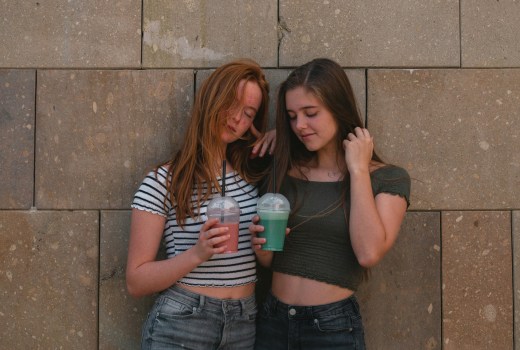
Shooter Flash: “The Chemistry of Friendship” by Alison Wassell

It starts with us sharing a packet of cheese-and-onion crisps, and before we know it we’re sharing everything: sucking liquorice lozenges and laughing at our black tongues in the cloakroom mirror, buying an orange lolly every lunchtime from the ice-cream man who parks on the school field, figuring out that the vending machine outside the sixth-form common room dispenses hot chocolate for ten pence when it should be twenty. We giggle like a couple of conspirators, planning what we’ll say when our dishonesty is discovered, being almost disappointed when it never is. 

People describe us as joined at the hip, our names coupled like Tom and Jerry, Mork and Mindy, Starsky and Hutch. We meet up one Saturday to go Christmas shopping and buy cheap aftershave sets for our dads and stationery sets for our mums that will never be used. We watch Abba the Movie at the cinema and bump into Janice with her twin sisters, pointing at each other when Janice asks us who dragged who there. 

By the second year, the cracks are showing. We’re no longer we but you and I. Little things start to matter. The way you shield your work with your arm in class, the tall tales you expect me to believe about your dad being a Russian spy, the time you make yourself sick on the chocolates I give you for your birthday and blame me for buying them, the comments about my greasy hair, my crooked teeth, the spots on my chin. 

More divides us than unites us. When I come top in English you say the only thing I can do with that is teach. You’re destined for greater things with your science subjects. I secretly gloat over the way you use long words incorrectly. Hypothetical, lugubrious, lackadaisical, you haven’t a clue what any of them mean, but spit them out anyway. I start spending lunchtimes alone in the library.

We stop sharing secrets. When my periods start I don’t mention it. You cheat on me with Janice, go to see Kate Bush without inviting me, despite me having spent two nights copying out song lyrics from the album sleeve for you because all you had was a counterfeit tape. I  confide in my mother that I don’t think I even like you anymore. She says she can’t stand most of her friends, which doesn’t help.

I fantasise about breaking up with you, make a list of grievances and grounds for separation, imagine a blazing row, a stomping off, a slamming of a classroom door, everyone taking sides. You’re the one who ends it though, with a whisper rather than a scream, one Wednesday morning in the chemistry lab when I struggle to light the Bunsen burner. “Useless,” you mutter. Just that, nothing else. By the end of lunchtime you’ve emptied your desk and gone to sit next to Janice. That’s when I realise you’ve been making a list of your own all along.

 *

Alison Wassell is a writer of short and very short fiction from Merseyside, UK. Her words have been published by Fictive Dream, Does It Have Pockets, WestWord, Trash Cat Lit, Frazzled Lit, Bath Flash Fiction Award, FlashFlood Journal and elsewhere.

Shooter Flash: “Drift” by Sammi LaBue

Alex wore her half of our heart necklace long after high school, but when they found her across the bay, she wasn’t wearing jewelry. Just her long hair around her neck like a noose of wet string. 

She finally moved to New York from Tampa two years after I had. She lived in Queens and I lived in Brooklyn, but we made Beach Day an official weekly holiday, no matter the weather, to remind us of home, and I got her a job at the bar where I worked.

She found me in the walk-in refrigerator during the shifts we shared. I’d mix cheap vodka with cranberry juice and slices of lemon, our seventeen-dollar happy-hour cocktail, and she’d talk about her new friends, her roommates, her artsy kind of sadness. The refrigerator’s vacuum seal suctioned us in behind her, as if to preserve us. 

*

We’d walk down the beach warp-powered by the Adderall she brought. I thought of our purse of shells and treasures, our iPhones and keys left behind, thinly veiled by faded bath towels. But she’d say, Let’s never go back, smiling. 

Days would slip by without a whisper from Alex. “Sometimes friends drift apart,” Mom said when I called her instead. Then Alex would be back again, our teeth hard-set against the cold of the walk-in. Her voice sounding more and more like the silent void of her voicemail.

Want an adderall, a xanax, anything else? The sand-stained coin purse started to fill with chalky blue-and-white pills – nothing like sea glass. 

*

Still on for Beach Day?

Is it going to rain?

Meet at DD, right?

Im Here

?

I waited outside of Dunkin Donuts flipping between my doppler app and messages and back again. A green mass crept across the screen pixel by pixel.

When the smell of rain had washed over the roasted nuts cart and the car exhaust, Alex appeared with her hands shoved into the pockets of her leather jacket. I was getting worried. She wasn’t wearing her necklace. Where’s your bag?

After the intersection, she threw a laugh over her shoulder then ran across the boardwalk and down to the beach. I chased after her, rain needling my skin.

She dropped her clothes in the sand. The metallic reflection of the waves striped her skin, her hair melted out across the water’s surface as she waded deeper. 

Alone on the beach, time expanded as she pushed out and out. 

I remembered bike races to the beach back home and how you could eat the heavy evening heat right out of the air. 

I remembered her theory about being adopted, even with her mother’s round, clamshell eyes, those straight eyelashes, the scattered sand freckles across her nose. 

I remembered the first day she showed up to work drunk, when she breezed past the walk-in window.

The storm faded as fast as it arrived, and then so did she. I could see her. I could see her, until I couldn’t. Like a star stared at too long in the night sky, she flickered out as the lifeguard’s whistle blared. 

* * *

Sammi LaBue is a Brooklyn-based writer and educator. She founded Fledgling Writing Workshops (Best Workshop in NYC, Timeout 2019) and is the author of Words in Progress (DK 2020), a creative writer’s guided journal. Her writing can be found in Literary Hub, Glamour, The Offing, Mutha Magazine, Hobart, and Sonora Review, among others. She received her MFA from the Vermont College of Fine Arts, is The Penn Review’s 2024 Poetry Prize winner, and has recently finished a dual memoir written in collaboration with her mom.

Shooter Flash: “Friends First” by Danni Silver

People always asked why we weren’t together. Some were genuinely perplexed that two people with our spiritual chemistry took things no farther than friendship. Others needled, certain that we secretly wanted each other, or that one of us was hiding an unrequited passion.

My friendship with Scott sprang from business drinks in a small New England town, where I was working as events manager at the arts center and he was organising a music festival. As we started to enjoy the conversation and order more cocktails on expenses, we progressed to topics close to our hearts: movies, bands, outdoor adventures. He summoned a friend, Theresa, to join us and we moved on to a more raucous bar, and then another, our ranks swelling along the way.

Scott had a talent for picking up strangers. Charismatic, funny and offensive in equal measure, he was unafraid to talk to people or make a fool of himself. He attracted attention and divided opinion, but those who were drawn to him – almost always women – revolved around him, saucer-eyed satellites to his gravitational pull.

As our friendship grew, I stood by him when he cheated on his girlfriends and defended him when people in our community griped about his provocative comments and drunken antics. We laughed at the suspicions of others who doubted our motives with each other. Everyone assumed we were sleeping together, or had at least fooled around, or kissed, or something. So many conventional people in our small town; we were determined to be unconventional.

We notched up record-worthy hours in each other’s company, to the eye-rolling of his roommate. When Scott adopted a dog one winter, we took it out together last thing at night, clinking the ice cubes in our glasses of whiskey and trying not to slip along the dark, snow-packed alleyway.

That winter our friendship was two years old. I took pride in the purity of my platonic friendship with Scott. I took pleasure in the constancy of my position. He spun through women like a kid on carnival rides. He had aspirations to write and manufactured drama so he would have experiences to mine. “Let’s make it interesting,” he would say when we went to a bar or an art opening or a party. He usually did.

Some of Scott’s girlfriends lasted longer than others; some held privileged positions in his heart, far beyond the breakup. But the fact was, after a certain point they were no longer around, and I was.

He told his girlfriends that he loved them early on, sometimes in the first week. Their interpretation differed from his meaning. There was a correlation between how soon Scott uttered – or, more typically, let slip in half-sleep – the ultimate romantic declaration and the lifespan of the relationship.

I castigated him for such careless avowals. He was leading these women on, collecting hearts like scalps.

He laughed it off; it wasn’t his responsibility if people took him seriously. “I love table. I love chair,” he said.

When I left Vermont to move halfway across the country for a new job, we spoke almost daily, texted constantly. When, yet again, he cheated on his latest girlfriend and bemoaned the depressing state of his stagnant existence, I offered him a room in my apartment that was opening up for the summer. I hid the fact of his dog from the landlady and reduced his rent, splitting the difference between my cheaper room and his.

Scott drove across country in his battered jeep with his belongings in the back and his dog riding shotgun. Having closed the geographic gap, it came as a surprise when, only weeks later, I sensed a strange distance between us. Amidst the proximity of our shared domesticity, Scott had started to withdraw from me. No rounds of direct discussion, polite civility, affectionate overtures or total avoidance could bring us back together.

Scott spent more time with other friends. He visited greenmarkets with an old roommate and basked in the naked devotion of a PHD dropout (a man, for once). He found an ad in a neighborhood coffee shop advertising guitar lessons with a local musician. She lived nearby and, sixty-dollar-hour by hour, Scott ensured his admiration became mutual. Out came the whiskey and the indie playlists. Through the flimsy door that separated our rooms, I could hear his barking laughter, her vocals scratching through lyrics like a tormented cat.

I suggested things might improve if Scott moved out of the apartment. He agreed, then lingered. Eventually, I decided to take the initiative. Scott moved into my room, which was larger than his, its three windows level with the treetops on our street.

One day after moving out, I ran into a mutual friend of ours. I filled him on on the developments in the apartment, right up to Scott taking over my room.

“Well, he won that chess game,” he said.

Somewhere, my relationship compass had swung off course and remained stuck, pointing my heart in the wrong direction. I had a history of intense friendships, complete with breakups more painful than any with boyfriends. I remained on better terms with my romantic exes than my platonic ones. In exalting friendship, I had placed too much of a burden upon it.

Recently, I met a man in a Spanish language class. I had considered, before the first day, that romantic prospects might be a bonus. Out of eight of us in the group, there were three men. No, no, no, I thought within the first minute of class.

One of them – the most talkative, ADD-riddled one – turned out to be funny, intelligent and unexpectedly gentlemanly. During post-class drinks, he lingered to chat with me. He wondered if I were “cajole-able” for movies, as his friends were tuned solely to the wavelength of Transformers. He asked if I’d like to browse an art market one Saturday afternoon, which segued into eating and drinking on a Saturday night.

Maybe it’ll go somewhere – but we’re becoming friends first.

*

Danni Silver is a pen name. She is a freelance writer based in Pittsburgh, USA, whose work has appeared in numerous magazines and news outlets across the country.