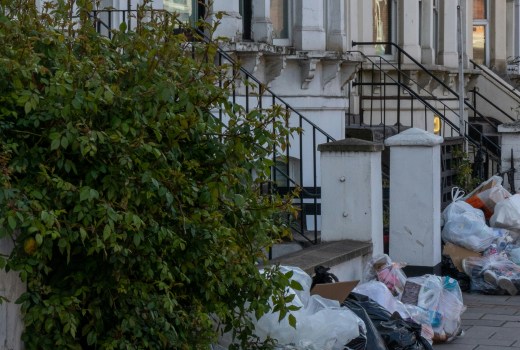
Shooter Flash: “Trash” by Bethany Swett

Marg got used to the smell after her first week on the job. Slinging the slick black garbage sacks into the oily maw of the truck all morning, she got so steeped in the stench that she ceased to notice it. It was like water: once you were in it, you were wet. The smells, like drenching rain, only bothered you if you had something to keep nice in the first place.

She tied up her waist-length dreads after Cal, the jerk-off, pretended to feed them into the chomper on her first day. Jack, who drove the truck, more kindly suggested she might want to consider restyling if she didn’t want to end up processed like meat through a grinder. But her dreads were the product of years, connecting her way back to Burning Mans (Men?) of yore. Another life. She’d rather chop off a leg.

The loose bags sagging into each other on the sidewalk she tossed straight into the chomper. Trash cans and recycling got slotted into the mechanical arms and lugged in a big metallic hug into the bowels of the truck, then dumped back down again, like a kid too big to get picked up for long.

Marg hustled to the next set of bins on the worn-out street, its townhouses faded from lack of care and grayed-out by a drizzle of rain. The buildings were mostly brick with concrete stoops; sometimes old people shuffled around out front and hobos, towing errant shopping carts, rooted through the trash. Anyone looking like they had a job tended to scurry in and out like mice after cheese, wearing the cheap suits of office drudgery. Marg knew they looked down on her, if they looked at all, yet she wouldn’t trade places. She didn’t like sitting still, feeling pinned down.

She set a can into the last empty slot on the truck and hit the lift button. As the arms hauled up their load and dumped the contents, something clinked out onto the sidewalk near Marg’s boots. Its glint caught her eye, and she bent to pick it up: a silver ring set with a small diamond. Marg turned it over awkwardly with her thick padded gloves. She looked up at the nearest house, which had a matt-black door and window-frames, recently painted, not peeling like most of the others. No-one was racing out after a missing ring, anyway.

“Come on bird nest, let’s move it,” Cal yelled as the truck lumbered up the street, leaving Marg in its wake, gawking.

Quickly she tugged off her glove and shoved the ring in her pocket, fumbling with the zipper to yank it closed before hustling on up the street to catch the blundering truck, which was gassing and steaming like an old bull elephant.

Later, when Marg returned to the high-rise apartment she’d occupied for the last three years, she sat down and pulled the ring out of her pocket. It winked at her weakly in the dim light. She tried to slide it on. It was too small for her ring finger, but it fit on her pinkie. She twirled it there for a moment, then pulled it off and sank back into the sofa, opening up her phone.

She swiped and tapped to a familiar profile, bracing for the usual self-flagellating burn that came from scrolling his photos: the man she’d loved with the woman he’d left her for, living their best lives. The woman who, in fact, he’d been with before he did Marg the courtesy of leaving. She’d got better lately at resisting the urge to torture herself, but the ring had reminded her, and lured her back.

To her disappointment, though, his feed hadn’t been updated much for several months. Taking time… said one of his posts, captioning a mountainscape with a trail of hug emojis and hang in there buddy comments – and one saying, girls come and go but beer is always there!

With a crackle of anticipation Marg sat up and clicked through to the girlfriend’s profile page. She saw, among her numerous public pictures, the woman draped around the shoulders, torso, and assorted other body parts of a bronzed, toned, tall, and very much different man.

“Wow,” she exhaled to herself, flopping back into the cushions. She felt giddy, but also oddly queasy. Marg realised she was still in her work clothes, faintly off-gassing the morning’s garbage, and headed for the shower, scooping up the diamond ring from the table.

In the bathroom she shucked off her clothes and rummaged in a drawer, coming up with a thin silver chain. She slid off the cheap charm that had swung from it and replaced it with the ring. Squinting down at herself, she attached the chain around her neck, and looked up at the mirror, at the person standing amid the rising steam, bare but for a glint of light resting just above her heart.

One woman’s trash… Marg thought, fingering the ring. Maybe the saying would prove true for one man’s trash, too.

*

Bethany Swett works for a tech company by day and writes fiction the rest of the time. She has published short stories in Lilith, Quick Fiction, Bayou Magazine, 365 Tomorrows, and elsewhere. She lives in Denver, Colorado, with her dog Sushi.

Shooter Flash: “Friends First” by Danni Silver

People always asked why we weren’t together. Some were genuinely perplexed that two people with our spiritual chemistry took things no farther than friendship. Others needled, certain that we secretly wanted each other, or that one of us was hiding an unrequited passion.

My friendship with Scott sprang from business drinks in a small New England town, where I was working as events manager at the arts center and he was organising a music festival. As we started to enjoy the conversation and order more cocktails on expenses, we progressed to topics close to our hearts: movies, bands, outdoor adventures. He summoned a friend, Theresa, to join us and we moved on to a more raucous bar, and then another, our ranks swelling along the way.

Scott had a talent for picking up strangers. Charismatic, funny and offensive in equal measure, he was unafraid to talk to people or make a fool of himself. He attracted attention and divided opinion, but those who were drawn to him – almost always women – revolved around him, saucer-eyed satellites to his gravitational pull.

As our friendship grew, I stood by him when he cheated on his girlfriends and defended him when people in our community griped about his provocative comments and drunken antics. We laughed at the suspicions of others who doubted our motives with each other. Everyone assumed we were sleeping together, or had at least fooled around, or kissed, or something. So many conventional people in our small town; we were determined to be unconventional.

We notched up record-worthy hours in each other’s company, to the eye-rolling of his roommate. When Scott adopted a dog one winter, we took it out together last thing at night, clinking the ice cubes in our glasses of whiskey and trying not to slip along the dark, snow-packed alleyway.

That winter our friendship was two years old. I took pride in the purity of my platonic friendship with Scott. I took pleasure in the constancy of my position. He spun through women like a kid on carnival rides. He had aspirations to write and manufactured drama so he would have experiences to mine. “Let’s make it interesting,” he would say when we went to a bar or an art opening or a party. He usually did.

Some of Scott’s girlfriends lasted longer than others; some held privileged positions in his heart, far beyond the breakup. But the fact was, after a certain point they were no longer around, and I was.

He told his girlfriends that he loved them early on, sometimes in the first week. Their interpretation differed from his meaning. There was a correlation between how soon Scott uttered – or, more typically, let slip in half-sleep – the ultimate romantic declaration and the lifespan of the relationship.

I castigated him for such careless avowals. He was leading these women on, collecting hearts like scalps.

He laughed it off; it wasn’t his responsibility if people took him seriously. “I love table. I love chair,” he said.

When I left Vermont to move halfway across the country for a new job, we spoke almost daily, texted constantly. When, yet again, he cheated on his latest girlfriend and bemoaned the depressing state of his stagnant existence, I offered him a room in my apartment that was opening up for the summer. I hid the fact of his dog from the landlady and reduced his rent, splitting the difference between my cheaper room and his.

Scott drove across country in his battered jeep with his belongings in the back and his dog riding shotgun. Having closed the geographic gap, it came as a surprise when, only weeks later, I sensed a strange distance between us. Amidst the proximity of our shared domesticity, Scott had started to withdraw from me. No rounds of direct discussion, polite civility, affectionate overtures or total avoidance could bring us back together.

Scott spent more time with other friends. He visited greenmarkets with an old roommate and basked in the naked devotion of a PHD dropout (a man, for once). He found an ad in a neighborhood coffee shop advertising guitar lessons with a local musician. She lived nearby and, sixty-dollar-hour by hour, Scott ensured his admiration became mutual. Out came the whiskey and the indie playlists. Through the flimsy door that separated our rooms, I could hear his barking laughter, her vocals scratching through lyrics like a tormented cat.

I suggested things might improve if Scott moved out of the apartment. He agreed, then lingered. Eventually, I decided to take the initiative. Scott moved into my room, which was larger than his, its three windows level with the treetops on our street.

One day after moving out, I ran into a mutual friend of ours. I filled him on on the developments in the apartment, right up to Scott taking over my room.

“Well, he won that chess game,” he said.

Somewhere, my relationship compass had swung off course and remained stuck, pointing my heart in the wrong direction. I had a history of intense friendships, complete with breakups more painful than any with boyfriends. I remained on better terms with my romantic exes than my platonic ones. In exalting friendship, I had placed too much of a burden upon it.

Recently, I met a man in a Spanish language class. I had considered, before the first day, that romantic prospects might be a bonus. Out of eight of us in the group, there were three men. No, no, no, I thought within the first minute of class.

One of them – the most talkative, ADD-riddled one – turned out to be funny, intelligent and unexpectedly gentlemanly. During post-class drinks, he lingered to chat with me. He wondered if I were “cajole-able” for movies, as his friends were tuned solely to the wavelength of Transformers. He asked if I’d like to browse an art market one Saturday afternoon, which segued into eating and drinking on a Saturday night.

Maybe it’ll go somewhere – but we’re becoming friends first.

*

Danni Silver is a pen name. She is a freelance writer based in Pittsburgh, USA, whose work has appeared in numerous magazines and news outlets across the country.