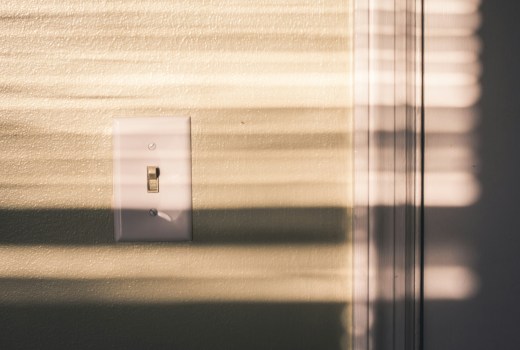
Shooter Flash: “The Power of Five” by Natalie Horner

If I don’t flick this light switch on five times, a member of my family will die. Five of us in total, one flick per person.

I don’t like odd numbers. If I flick the switch five more times that will equal ten, an even number. But that will be more than five times, twice more than the number I need. 

I have thirty seconds to decide before the clock strikes 5pm. Five o’clock is when I flick the kitchen sockets on to start dinner.

Time is not an odd number. 

Time is relative and how many relatives do I have? Five. 

Flick. Flick. Flick. Flick. Flick.

Dash for the kitchen, five seconds left. 

Flick-kettle. Flick-microwave. Flick-oven. Flick-steamer. Flick-coffee maker.

Clock strikes 5pm; made it in the nick of time.

I don’t even need all these things for tea. I’m only having five chicken nuggets with five splashes of ketchup. I could turn off four and leave one on. 

Four plus one equals five, maybe?

Yes, it’ll work. I haven’t done it before but the power of five is there. 

Flick. Flick. Flick. Flick. 

Nope, I don’t like it. Flick oven off. Five times. I guess I’m not having tea.

The phone rings five times before I answer.

“Hello, who’s speaking please?”

There are sobs. “John, John, John. It’s Mum, Mum, Mum.” Her power of three. “It’s your dad, dad, dad. He’s dead, dead, dead.” Her voice becomes a whisper.

“What happened, Mum? Tell me?”

“I don’t know.” More sobs. “Did you change with the power of five?” The world crashes. “Did you change with the power of five?” I hear the echo. “Did you change with the power of five?” 

*

Natalie Horner is from South Yorkshire and lives with her husband, son, and a cat called Puss. While continually adding books to her TBR pile, she has completed her first novel and is working towards publication. Twitter/X: @WriterNat1122

Submissions open for “Nightlife” issue

General submissions are now open for Shooter’s Spring/Summer 2024 issue, themed “Nightlife”.

Writers should send short stories and non-fiction of 2,000-6,000 words and/or up to three poems by the deadline of May 12th. Stories, essays, memoir and poetry should relate to nocturnal happenings: dating, working the night shift, crime, clubbing, dinner, sex, partying, witchcraft, ghosts, childbirth, insomnia, even nocturnal wildlife.

The theme is open to wide interpretation, but writers should adhere to the submission guidelines. Other opportunities currently open to writers include the 2024 Shooter Poetry Competition and Shooter Flash, which accepts entries on a rolling basis.

Issue 17: The Unknown

The theme of our seventeenth issue, “The Unknown”, enticed writers to contemplate strangeness and difference of all kinds: in travel and identity, race and sexuality, religion and history. The broad scope in subject matter yielded a corresponding range of tones in authors’ handling of their themes, from sinister to comic.

Lisa S Lee opens the issue with a punchy short piece, “Not Quite Conversations”, born from her experience as a Korean American in the USA. Two more non-fiction tales punctuate the issue: “Variations on the Murder of my Stepfather”, in which Jessica Hinds takes a playwright’s view of the father figure in her life, and Alex Barr’s “A Nice Trouser”, his humorous memoir about an inscrutable Eastern European translator.

As ever, the edition offers a trove of compelling short fiction, all with diverse takes on the theme. Nathan Pettigrew depicts a Christian pastor in “Pride Month” at odds not only with the local imam in his Louisiana parish, but also with his own daughter. Two authors imagine very different responses to bereavement: in “Blue”, Chelsea Utecht conjures the supernatural consequences of a mother’s grief, while the protagonist of Sarah Turner’s “En Route to Elsewhere” takes off for South America following the death of her best friend. Warren Benedetto satirises a group of frenemies in his New York story “A Perfect Fit”, in which superficial preoccupations lead to a murky outcome. Billy Craven’s traveller in rural Ireland rues a wrong turn in his flash fiction piece, “In the Loop”. 

From geographic to time travel, the Unknown issue also showcases the 2023 Shooter Short Story Competition winner. “The Ones Who Came Before” by Alice Gwynn revolves around a child who strays much farther than usual at a castle playground. Gwynn won the accolade for her evocative descriptions and skilful handling of plot twists in a story with deeper undercurrents of identity and loss. 

The work of six poets (Martha Coats, Jenny Mitchell, Cecile Bol, Alexander Gast, Lawrence Bridges and Ben Groner III) complements the edition’s prose with distinctive perspectives on motherhood and love, emigration and art, other places and times. 

Finally, Nicholas West closes the issue with his debut publication, the formally innovative “GPS” – a timely play on technological concerns with an apocalyptic outcome. Here, in Shooter’s Unknown issue, the end of the world can be synonymous with the beginning of compelling adventures in literature.

To order a copy of the Unknown issue, please visit the Subscriptions page.

Shooter Flash: “Sabbath” by Rebecca Klassen

Mum called it Suicide Sunday and had done so since she was a girl.      

‘A day so boring you wanted to kill yourself,’ she told me. I wondered if other parents said similar things to their teenagers. 

Throughout her childhood, she’d adhered to the Sabbath traditions of duty and no play, though this was more under her parents’ guidance than God’s. Post church, she would sit on the stairs in her best clothes and listen to the heathen neighbour children through the wall, blowing recorders and laughing. She’d been round there once for tea. The mother had given them sugar sandwiches and let them gouge holes in the lawn with sticks. 

‘Mind my bloody azaleas,’ the mother had told them. Mum had repeated ‘bloody’ to her mother and had never been allowed back.

When my grandfather died, Mum was a freshly divorced, single parent. With grandfather gone, Nana expected Mum to attend Suicide Sundays again with me in tow. The new criteria no longer required Mum at church, though we were told it would be nice if we came along once in a while. Only knitting, reading, and watching Songs of Praise were permitted in Nana’s chintzy sanctum. Watching other programmes risked a brazen ‘hell’ or ‘bugger’ slipping into the atmosphere to sully the day.   

One late autumn Suicide Sunday, I pivoted round and round on my backside in front of Nana’s gas fire, hoping that, like a rotisserie chicken, I would eventually cook on all sides. Nana worked her knitting needles. Mum stretched so that her feet almost touched the fire’s orange bars, the heat making her tights give off a plastic smell. I watched Mum nodding off, imagining having to grow up here every day. A new family lived next door with the sounds of computer game music, squabbling, and giggling coming through the walls.   

As the gas fire reddened my cheeks, I suddenly stopped pivoting as I remembered the crumpled piece of paper in my schoolbag. 

‘Mum?’

‘Hmm?’ 

‘I’ve got cookery class at school tomorrow. I’ve got to take ingredients in.’

Mum’s eyes flicked open. Nana’s needles stopped.

‘What have you got to make?’ 

‘Apple crumble. Sorry, I forgot.’

Both women were on their feet.

‘What’ve you got at home?’ Nana asked Mum.

‘No apples, that’s for sure.’ 

Nana went to the kitchen, Mum close behind. Cupboards banged over notes of infuriation.

They returned, Mum carrying a bag. 

‘Nana’s only got Braeburn apples. We’ll have to see if we’ve got the other ingredients at home.’

‘Can we go to the shop for the rest?’ I asked.

Nana shook her head.

‘You should’ve told me yesterday,’ Mum said to me. I’d always wanted to leave Nana’s before Songs of Praise, but not like this. Mum apologised to Nana.

Nana shrugged. ‘Sometimes life throws us trials.’

The drive home was quiet. Intermittently, I apologised. Mum said she knew I was sorry, yet there was no talk of forgiveness. 

‘It’s always up to me to sort these things, never your father,’ she said. After that, I stopped apologising. 

I couldn’t picture where my father was or who he might be with, and I didn’t know when I would see him again. Even though her father was dead, Mum had the same dilemmas, but the similarities didn’t unite us. 

When we got home, Mum put the butter, wrapped in its golden foil, on the kitchen table.   

‘We need oats too,’ I said tentatively, ‘because it’s a healthy crumble.’ 

‘Bring me the recipe.’

I brought her the forgotten list, which she read while I brought Nana’s bag of Braeburns to the table. Mum weighed and decanted ingredients into plastic tubs. Little white clouds billowed; granules were spilt. She banged the cinnamon jar on the counter. The clumps wouldn’t burst, so she threw it in the bin. I put the tubs into the bag with the apples. The butter remained unweighed on the table. Mum put away the scales and muttered as something tumbled from the cupboard. 

‘Where shall I put the butter?’ I asked. Mum rounded on me as more clutter fell from the cupboard. 

‘Up my arse!’ she yelled. 

‘Okay, but you’ll have to come to school tomorrow.’

My words floated precariously into the air. They’d been a gamble, particularly on a day we didn’t laugh. Mum said nothing as she put her face in her hands. The silence built over the hum of the fridge. I wanted to cram the words back into my mouth and fill my cheeks with the trouble they’d caused. Then her shoulders shook as her legs folded. Her hands dropped. She was laughing, shaking all over.

*

Rebecca Klassen is co-editor of The Phare. Her work has featured in more than forty publications including Mslexia Best Short Fiction, Popshot, Ellipsis Zine, Burningword, Barren, and The Wild Word. She has won the London Independent Story Prize, and was shortlisted for the Oxford Flash Prize and the Laurie Lee Prize. She regularly performs her work at Cheltenham Literature Festival and Stroud Book Festival.

Unsettling Tales Scoop 2023 Short Story Awards

Alice Gwynn has won the 2023 Shooter Short Story Competition with her eerie, twisting tale, “The Ones Who Came Before”, while Edward Barnfield has come runner-up with his dystopian fiction, “Isolation”.

Shooter’s readers and judge, editor Melanie White, appreciated Gwynn’s atmospheric tale for its evocative descriptions and skilful handling of plot twists in a story with deeper undercurrents of identity and loss. Gwynn, a British ex-pat who lives in New Hampshire in the US, said via email that a trip to the UK last year inspired her piece, which is set in the grounds of an ancient castle. Gwynn writes flash fiction and poetry as well as short stories, and has previously published work in Prachya Review, Grey Sparrow Journal, Consequence Magazine, Wilderness House Literary Review, and elsewhere.

Barnfield achieved second place in the competition with “Isolation”, a subtle dystopian fiction with creeping menace that contest readers found particularly convincing. Barnfield, a researcher living in the Middle East, has had work published by Roi Fainéant Press, Ellipsis Zine, The Molotov Cocktail, Third Street Review, Galley Beggar Press, and others.

In addition to the contest winners, two writers gained honorable mentions for their stories: Bethany Wren, for “Rosemary, Patron Saint of Honey”, and Joe Wheelan, for “Unravelled”.

Both “The Ones Who Came Before” and “Isolation” are available to read on Shooter’s website, while Gwynn’s story also appears in the Autumn/Winter 2023 issue of Shooter, which is themed “The Unknown”. Print copies of the magazine can be ordered at the Subscriptions page.

The 2024 Shooter Poetry Competition will open early in the new year, while the 2024 Shooter Short Story Competition will open mid-year. Until then, prose writers are welcome to submit flash fiction and non-fiction to the monthly Shooter Flash contest on a rolling basis. General submissions for Shooter’s Spring/Summer 2024 issue will open to all in the new year.

In the meantime, happy reading, and happy holidays from Shooter Literary Magazine!

Shooter Flash: “A Good Son” by Sarah Macallister

Peter couldn’t come home for Christmas because his wife dragged him to her family. Susan always played the victim, but she was no wilting flower; she was a parasitic weed.

My son used to be an easy child. No tantrums. Other mothers had to tear themselves away from their children at the school gates, from guttural sobs that made your ears bleed. I pitied those mothers, who’d failed where I’d succeeded. 

I remember the first parent-teacher meeting. Mrs Forsyth sat across from us, wearing a frown and short hair. She reported that our son had stamped on another boy’s head. Peter never behaved that way at home. I knew it must be a mistake. At other parent meetings, we heard that he pulled hair, hit, stole food, and peed on a girl’s coat. Mrs Forsyth clearly didn’t like him, so I moved him to another school. After that, there were no bad reports. 

I started as keys jangled in the lock. Harold whistled and threw open the front door. 

“Something smells good! Baked a cake?” He squeezed around the table and pulled me into his stout stomach. Fruity hops blossomed from his mouth.

“Been at Dopey Does?”

“Don’t you mean The Staggering Stags?”

We snickered together, as if this was the first time we’d made this joke. After I knotted my pinny, I glugged oil into the frying pan and ignited blue flames. Bubbles frisked in the oil and I slid raw meat to sizzle. I laid the table with chutney and a vase of dried honesty. We tucked in. Harold drank another pint and the amber beer glowed while he tipped back his head.

“Heard from Peter today?”

“No, he’s too busy. Working late, poor boy.”

Cake for pudding. Harold poured custard over his bowl. Steam spiralled while he rummaged for a spoon, clanking the cutlery, and shaking the table as he shuddered the drawer shut. I ate mine with a dessert fork.

Not long after Harold climbed into bed, he was foghorn snoring. The harder I tried to ignore it, the more frustrated I grew, until tears streamed into my pillow. Rain lashed the roof and windows, the wet whipping of a cat o’ nine tails. The doorbell rang. 

I swiped my cheeks and flurried downstairs in my nightie. I clicked the hall lamp. My neck shivered as I reached for the handle. It was so late. Who could it be? An outline blurred in the pebbled glass. A man’s height.

“Mum?”

Only Peter. I fumbled to unlatch and clasp the handle, ready with my welcome smile. My thoughts drifted to the kitchen. I opened the door and threw a glow into the seething chattering darkness, which swallowed it whole.

Rain-dark hair plastered his scalp and he looked white, sick. As I fell back to let him enter, my smile fixed, he planted himself on the threshold and leaked on the flagstone floor.

“Peter, are you alright?”

He shook his head and shuddered within the sodden coat. His eyes wouldn’t meet mine.

“You’re cold,” I said, desperate to shut the night out, but Peter only stood by the door and twitched.

“Come in, love.” He shuffled forward and I sealed us safely inside. I trundled off to the kitchen and flicked the kettle to boil, tipping bags into red cups. I wondered whether to give Peter some cake.

“I made a mistake.” Peter spoke slowly, each syllable dropping like the rain. He hovered under the kitchen doorframe, coat on and dripping wet. I could not make the kettle boil any faster. I didn’t know what to do with my hands, so I turned and smiled.

“What?” I asked, but I didn’t want to hear. “Wait, let’s get you dried off first.” I wanted to scurry for towels and clothes, but Peter was blocking the doorway as he answered my question.

“I made a mistake.” His voice broke and a croaking, throaty gurgle slithered into my kitchen, raw like uncooked meat.

“Oh, everyone makes mistakes, darling. Now let’s get you warmed up with a nice cup of—”

He looked me right in the eye.

“A mistake,” he spat back at me. “Susan’s gone.”

Something unfamiliar crawled across Peter’s face. A sneer. He was sneering at me. 

Boiled water steamed from the kettle, its innards raging with bubbles, until the dainty click snapped it off. I turned my back on Peter and poured the tea. 

“Would you like your bag left in?” 

He didn’t reply, so I took a teaspoon and squeezed the bag against the side of the cup before fishing it out. I was meant to say something. My pathetic mother, he was thinking, who can’t face reality, whose eyes are cross-stitched shut. I didn’t know what to say. 

I held the scalding cup against my palm, so the handle faced Peter. He could either take it, or watch my face strain to remain calm as hot china burned my skin. He took it like a good son.

Shooter Flash: “The Last Day of the Rest of Your Life” by Johanna Bernhuber

It’s the first day of middle school and you’re still in bed. I laid out your clothes for you last night, warm from the dryer and freshly folded. Now, I pour your juice, flip your pancakes, and call your name for the third time. You already sleep like a teenager, though you’re one year and two months short.

Summer has been long. Your hands are more used to a fishing rod than a pen. Every day you trail grass and dirt into the house from your sneakers; your bare feet spatter chlorine trails across the kitchen floor. School seems like an impossibility after two months of total freedom.

You slouch to the counter and eat, monosyllabic. My upbeat chatter bounces off you like a cartoon forcefield. You carry your breakfast things to the sink and I give you a hug, which is momentarily accepted. I’m proud of you, I say, feeling the bird bones of your shoulder blades beneath the thick sweatshirt. You’ll do great. 

I hustle you out the door and grab my own keys, handbag, scarf. You hoist your new bulletproof backpack over one shoulder. We play your music in the car as you gaze out the window: wide front lawns, trees dripping crimson leaves. The right turn to your old school, where we turn left. You can probably ride this journey on your bike but not yet. For now you’re safe in my car.

I pull up at the kerb and can’t resist smoothing your hair, though you shrug me off. A big kid now. Have a good first day sweetheart, I say. You get out and swing your backpack over both shoulders. 

When you shut the car door, you stoop and give me a small wave. I can tell from the look on your face that you’re being brave, masking the nerves. A new school, new kids, new teachers. Part of you wants to get back in the car and drive back to summer, even as you lope toward the stone steps. I put on a big smile and wave back, thumbs up. I keep looking, and waving, just in case you look back again, one last time. 

You climb the steps alongside the other kids and all of you wait, one by one, to pass through the metal detectors, into the unknown.

*

Johanna Bernhuber is a psychologist who has written for the Chicago Sun-Times, and has published short fiction and nonfiction in Whitefish Review and Denver Quarterly. She has three children and lives in Illinois with her husband, one dog, and too many books.

Shooter Flash: “In the Wake Of” by Elizabeth Vidas

She caught Stan coming out of the bathroom, one hand down his pants as he fumbled with his shirttails.

“Stan, come with me,” she said. “I have something to show you in the hydrangeas.”

Not the most seductive line, but Stan was her second-to-last target, she was tired, and he would certainly follow her into the bushes or under the kitchen sink if she asked. Sure enough, in five minutes she had undone his carefully tucked dress shirt, and he was grasping at her breasts with puffy palms.

Stan was the twelfth man Louisa had kissed that night. Most had been easy marks, though the professors were suspiciously self-assured: they grabbed her waist or hiked up her leg as if used to younger, suppler limbs. Only one – a grad student – had seemed ill at ease. He’d stammered, acting calm, but there was sweat on his mustache. She’d reconciled herself to a quick peck.

She crossed the lawn to the bar, a fold-out table draped in white cloth. Pouring a martini, she glanced around. Her garden looked well, of course. The Cambridge wives chatted vigorously next to the hydrangeas, determined to play at normality. Their husbands stood beside them, subdued. The pockets of guests had thinned out – Louisa smiled into her drink, thinking that soon she would be in a Manhattan studio. She would call Hannah from social-work school, and they would meet at Café Figaro. Maybe she would even look up some Sacred Heart girls; she assumed they were still on the Upper East Side. Scrutinizing their perms and reminiscing about Sister Margaret’s mole might be a laugh. 

She eyed her final target. David was standing by what she called the baby fountain, a cherub holding a bird bath. She stepped from stone to stone on the garden path until she reached him. He looked down as she approached, giving his Dark and Stormy a swirl. They watched the amber tornado settle in his glass.

“This is one of your better parties,” he said.

“Well. It’s not every day one’s husband retires from teaching and married life.”

He sighed. “Louisa.”

It was petty, but she wouldn’t admit it, so she looked towards the garden instead. The last of the guests were leaving: some gave fake, cheery waves while others walked determinedly towards their cars. 

“I kissed all your friends.”

“You did what?

“I kissed all of them. Paul and Jared were a little gropey – I think they’re used to a student set. And Aaron was mechanical. He’s been handsome for so long, he must rely on muscle memory now. Stan was greedy—”

“You kissed Stan?”

“That’s what shocks you?”

“Louisa, what are you doing?”

“I’m kissing all the men. Because after twenty years, I don’t owe anything to anyone. I didn’t join the wives’ book clubs or go to your colleagues’ asinine lectures—”

“So I’m responsible for that? Twenty years ago you were so prophetic you thought you’d save yourself the trouble?” 

“I didn’t save myself from anything.”

The porch light went on, and Louisa glanced over automatically. Inside was the sofa bed where he’d been sleeping. Each morning he was gone by the time she woke up; seeing his reading glasses on the wicker table always gave her a stomach cramp. Just two round lenses, but somehow they conjured the arc of his lips, the hair between his eyebrows he refused to pluck.

“I’m going to kiss you, David.”

He said nothing, looked at the porch lights. It amazed Louisa that he was leaving her for an older woman – an unattractive one, no less. She’d seen her at the university, gray bob and blue blazer. Louisa put a hand between his shoulders and turned his face towards hers. His mouth was motionless, his eyes unfocused; she suspected he was parleying with Elaine in his mind. She kissed him, and they were back at the café in the Village, where she’d leaned across the checkered tablecloth as he’d described Plato’s chair. Where he’d confessed how he’d been scared of the man-sized monkeys in Wizard of Oz. He was squinting through his glasses at the opera; he was folding them into his pocket before grabbing her by the vest, kissing her in front of the Washington Square Arch, and she knew she would follow him to the end of the earth, into any hydrangea bush, or onto the porch bed, as she did now.

*

Elizabeth Vidas is a writer and teacher living in Montpellier, France. Her short story “Smoldering” will appear in the upcoming issue of Western Humanities Review.

Shooter Flash: “Drifting Apart” by Gordon Pinckheard

You can’t get very far away from each other on a 33-foot sailboat. Graham was sitting in the cockpit, Linda on the foredeck. There were about twenty-five feet between them. They both wanted more.

There was a bump against the hull.

*

Out in the middle of the Atlantic, there was not much to think about. Only one person to talk with, to relate to, to be irritated by. Graham knew the right way to do things on a boat; he had taken courses, Linda had not. He carefully explained what she was doing wrong, but she ignored him. Her knots came undone, the sails flapped; they were not making the progress that he expected.

With only the two of them on board, watches were tough. Neither of them got much sleep. Alone in the cockpit at night, sliding between dreams and dark night, Graham had fantasies. Fantasies of freedom. The company of another woman, a younger woman, a better woman. Sometimes, a naked woman.

Linda was seasick. Pills did prevent vomiting, but she complained of stomach cramps and headaches. She refused to cook, unable to keep her balance down in the swaying interior.

“I’ll be glad when this is over,” she said.

“Over? Don’t say that. After this crossing, there’s the coast of Europe to explore! Wandering port to port. It’ll be great!”

“No,” Linda spat. “We’re using my money, and I say no. Once we’re across, we stop, settle down. Stop moving.” Her face was pale, taut.

Graham clamped his mouth shut. After a pause, he said, “OK, if that’s how you want it.” Looking away from her, he scanned the empty horizon, the ridges of endless waves. Freedom, he thought. 

That night he couldn’t entice any naked women out of the darkness. “My money” occupied his thoughts. He had shackled himself to such a wife! They had only spent a fraction of her wealth. What was to happen to his big adventure? An adventure he had dreamt of since childhood. Freedom was sliding out of reach. Linda wanted to trap him in a “normal” house. Was he man or mouse? No way! Feeling reassured, he smiled as he dozed, conjuring satisfying fantasies. Fantasies of unfettered freedom, spending money. Without Linda.

*

There was a bump against the hull. Graham looked astern, expecting to see something floating away in their wake. There was a partially submerged buoy, but it was following them, attached by a short length of rope. The rudder must have caught a drifting buoy. He turned off the autopilot and moved the wheel, hoping the rope would slide off the blade. The wheel was stiff and hard to turn; the rope must have jammed between the top of the rudder and the hull.

They dropped the sails and, using a boathook, Graham tried to pull the buoy and its tether loose from the boat. Failing, swearing, he lowered the inflatable dinghy from the foredeck. Maybe the rope could be freed working at sea level. He really didn’t want to have to swim beneath the boat. The oars were stored away down below; he’d manage without them. He was about to get into the dinghy, still swearing, when Linda said, “I’ll do it.”

“No, I’ll do it,” he said. “I do everything else; I’ll do this too.”

“Piss off! You don’t do everything. I’m fed up with you making a martyr of yourself. There’s no one else here to impress. I’ll be glad to get off this damn boat, even if it’s only for ten minutes.”

“OK, let’s see you do it then.” He sat down in the cockpit and watched her clamber over the lifelines, down the steps on the transom into the grey inflatable.

She caught the buoy’s rope and looked up at Graham. “You’ll have to move the dinghy forward,” she said. “I have to pull the rope forward, not back.”

He untied its painter from the stern and dragged the dinghy forward along the hull. He tied the line around a stanchion.

In the dinghy, Linda pulled at the buoy’s rope. It came loose, and she dropped it in the water. The partially submerged buoy and its rope drifted away from the boat.

“See? I got that done. I don’t need to hear any more of your crap. Now move me back to the stern.”

Graham looked down at her.

“Not hear more of my crap? Fair enough. Goodbye, Linda.” He bent down to the knotted painter.

Briefly, she sat frozen. Then she rushed to the front of the dinghy, balanced precariously on the inflated tube, and reached up to grab him. Her left hand caught his jacket while her right struck at his head. Ignoring the blows, he remained leaning forward, working at the knotted painter. With all her weight, she pulled him down towards her, pummelling his head. He toppled into the well of the dinghy, landing awkwardly. She fell onto his back, striking at him with both fists. He rolled over, protecting his head with his forearms while they struggled.

“For God’s sake, quit it!” The fear and desperation in his voice stopped her. The painter was caught around his arm – the loose painter.

They looked towards their sailboat, across clear water; wind was blowing the boat and dinghy apart faster than either of them could swim.

Silently, Graham moved to the stern, leaving Linda alone at the bow. The endless sea surrounded them, the horizon broken only by a single receding sailboat. There were about three feet between them. There would never be more.

*      *      *

Gordon Pinckheard lives in County Kerry, Ireland. Retired from a working life spent writing computer programs and technical documents, and encouraged by Thursday Night Writers (Tralee), he now writes anything he likes to entertain himself and – hopefully – others. His stories have been published by Daily Science Fiction, Gemini, Page & Spine, Allegory, Every Day Fiction, Flash Fiction Magazine, and others.

Issue 16: On the Body

The body is the house that we live in, whether it’s newly built or dilapidated, with sleek modern lines or sagging timbers. People might be content with the houses they inhabit, growing comfortable over the years in familiar rooms; others might be eager to embark on extensive renovations. We all hope to live in secure abodes but, without strong defences, their boundaries are sometimes breached.

Bodily contemplations inevitably revolve around fundamental milestones of birth and death, the physical dimension of love and the way we are perceived by others. Writers explore these themes and more in Shooter’s “On the Body” issue, our sixteenth edition of the magazine. 

Nolcha Fox opens the issue with her whimsical poem “Skin”, delicately depicting the membrane between our outer and inner lives. Elizabeth Tannen and Ruth Lexton craft lyric insights into childbirth and early motherhood, while Natalie Moores and Harry Wilding offer wry verses on physical desire and its consequences. Steve Denehan also provides a humorous interlude on the subject of temporary tattoos. On the darker side of bodily experience, David Holper challenges the suggestion that “America Is Not a Racist Country”, and James McDermott closes the issue with two poignant poems about the death of his father from Covid-19.

In addition to the issue’s poetic nuts and bolts, the spring/summer edition features the winner of the 2022 Shooter Poetry Competition: Jenny’s Mitchell’s “Female Dedication”, which revolves around hardships experienced by the narrator’s mother and grandmother. Mitchell has previously won the Poetry Book Awards; her debut collection, Her Lost Language, was named a “Poetry Book for 2019” by Poetry Wales and her second collection, Map of a Plantation, is on the syllabus at Manchester Metropolitan University.

Many of the edition’s prose writers skilfully combine humour and acute observation in their responses to the theme. Sarah Archer weaves comedy out of the despair of ageing (to forty-one years old) in her story “Ripe”. April Farrant challenges sexism and double standards in her political piece, “Set Menu”, while Mark Keane mines the strange standards of the art world in “Exhibition”. Sage Tyrtle considers how far a makeover might go in “Up Next on The Repair Store”. A sinister threat emerges in Nathan Breakenridge’s “Full of Trees”, and Alison Milner connects the dots of loss in her moving flash fiction, “Constellation”.

Several pieces of non-fiction also punctuate the issue, all very different. Ona Marae, in “No Apology Here”, provides a powerful account of the assault she experienced as a teenager and the wider prevalence of sexual violence in society. Robin Hall recalls financially challenging times in his L.A. memoir “Dance Like Everyone Is Watching”, about his brush with male striptease. And in the most literal interpretation of “On the Body”, Sally Gander considers the significance of tattoo art in her essay “No Commitment Necessary”.

Whatever environment you inhabit – cosy apartment or sprawling manor, stylish penthouse or sparse yurt – I hope you will settle down cosily within that most important of edifices, your own skin, to enjoy this diverse and compelling edition of Shooter.

To order a copy of the On the Body issue, please visit the Subscriptions page.

The 2023 Short Story Competition and general submissions to do with The Unknown are open to entries until September 24.