Shooter’s final print edition: #20, the Sweet Hereafter issue

Not all endings are painful – some might lead to a wonderful new opportunity, or an unexpected adventure, or reveal a silver lining. This is the slant of our 20th issue’s theme, Sweet Hereafter. When it comes to death, perhaps there really is a glorious afterlife. If your marriage crumbles, a better love might be just around the corner. 

The Sweet Hereafter theme is partly a nod to the fact that this is the final print edition of the magazine, and partly to the death of my mother, Anita White, earlier this year. While there is not much that is sweet about that loss (apart from release from the ravages of cancer), it gives rise to certain, more uplifting reflections: appreciation of loved ones, gratitude for the good things we have, and – who knows – perhaps Mom really has attained her own personal version of heaven. If so, she’s got her feet up in a grand stately home reading good books by the fire, walking dogs amid a lush pastoral landscape, and hosting dinner parties full of scintillating debate and fine food that someone else, for once, has gone to the trouble of cooking.

In that vein, she would have been highly amused by Stephen Oliver’s take on a custom-made afterlife in “Müesli”. While what follows death is one of the obvious responses to the Sweet Hereafter theme, there are a range of other interpretations, too. Among the fiction writers, Mike Wheet imagines an unconventional route to late parenthood in “Sweetheart”. Michael Shelley depicts a young girl struggling with the new woman in her bereaved father’s life in “The Story of Emma the Human Toothpick”, and Julie Esther Fisher delves into a teenager’s post-traumatic escape to the Highlands in “Scottish Moon”.

The non-fiction writers also mine diverse terrain. In “An Apple for the Cool Kids”, Alexandra O’Sullivan rises to the challenges of her professional second act, embarking on a new career as an English teacher in Australia. Emily Larkin leaves the Mormon faith behind in “God’s Not Invited to My Wedding”, while Stephen Fabes laces up for a midlife marathon in “Late Blooming in the Pyrenees”.

The theme attracted a wonderfully rich and varied response from the poets as well. Amber Watson opens the issue with two compelling poems on foster parenting. In a bumper issue for poetry, eleven other poets explore adolescence and literary revisionism, birth and death in the natural world, life after relationships and life after life. A bonus feature is the winner of this year’s Shooter Poetry Competition, Bethan Murphy’s “Birth Plan”, in which stark, poignant contrasts challenge childbirth expectations. Sylvie Jane Lewis, whose beautiful pair of hare poems close out the issue, also won second place in this year’s contest.

Since devising Shooter more than ten years ago, I’ve gained enormous satisfaction from unearthing the literary gems for each issue, assembling each edition and sending the magazine out into the world. In 2015, when the first issue was published, I was sharing a small London flat with my beloved dog Robbie (of issue 12 fame) and, following a series of relationships that were not meant to be, yearning to have children. Shooter #7, the New Life issue, arrived in tandem with my daughter, and my husband followed five years later, somewhere between On the Body and The Unknown. Following our wedding in 2023, I would have felt squeamish about publishing a True Love issue, as far too on the nose.

So from the early days of all the time in the world to devote to Shooter, to the increasing squeeze of obligations (some welcome, some less so) of childcare, marriage, ageing parents and a day job, midlife has chipped away at my ability to produce the magazine on time and do it justice. I hope to keep the essence of Shooter alive online, perhaps with a new digital iteration at some point, and to maintain elements like the monthly Shooter Flash. In the wake of the print edition, I also hope that Shooter’s sweet hereafter might lead to the fulfilment of a few new dreams – and, perchance, some extra sleep.

To order a copy of the Sweet Hereafter issue, please visit https://shooterlitmag.com/subscriptions.

Shooter Flash: “Winter Camp” by Gary Finnegan

The middle distance absorbed her gaze. Her sleeves, her nerves, frayed. Moths had chewed holes in the coats of the children; the children had eaten nothing for days. Days had been given to a journey, to the mantra, ‘Things will be better when we get to the camp.’ 

Now, her five-lined brow, like sheet music without a note, knew hope was a hollow lie. To be hungry and afraid and uncertain and on the move was the second-worst state of being. Hungry, afraid, uncertain and stationary was worse by miles. 

‘Did you wash those hands,’ she said, clawing at the paws of the youngest, fussing at a tap. ‘Got to wash those hands every time here, okay? Every time. Or you’ll get sick, like her.’

She nodded towards the next tarp, the day-old home of a family nursing a preschooler through the vomiting bug that was pinballing its way through the camp. 

Her own youngest straw-haired child stood passive and slack as her mother worked the gaps between the child’s fingers with a cement-coloured flannel. 

‘Did you change that vest,’ the mother asked. ‘Gotta change damp vests or you’ll get sick.’

She was curt, she knew that, but child management was the only available task and had to be done with vigour. It was, she reminded herself, in the children’s interests that their mother maintained standards. If you slid into apathy, you accepted death’s call.

The child was silent, and had been since they arrived. The three of them – the father having stayed behind – filed down the line until they reached an unribboned tent. There they tied the piece of cloth collected at the gate around a pole ‒ their claim on nine square metres of shelter, open on one side to the brown dust and ceaseless flow of human anguish. 

‘When is food coming, Mom?’

The older child, listless now, spoke for her sibling, spoke for everyone in the camp. The mother changed tack, opting not to lie, not to say, ‘Soon, love, just wait another while.’ 

Instead: ‘I don’t know.’

Would it have been better to stay and spend their hope under a familiar roof? As she wondered, an unwelcome competitive instinct surged within her at the sight of more new arrivals. ‘They need to shut the camp,’ she exhaled in a whisper. ‘Place is full.’

How many could be fed here? How many could make it across the border when it reopened? Who would decide who stayed, who went, who ate, and how much? 

She could do nothing. And it killed her to seek help while wishing it were denied to others.

‘Come here to me,’ she barked at the eldest child. ‘Those socks need changing.’ 

*

Gary Finnegan’s fiction has appeared in Litro, The London Magazine, The Phare, Roi Fainéant and Flash Fiction Magazine. He is the winner of the Frazzled Lit Short Story Award 2025 and received an Agility Award from the Arts Council of Ireland in August 2025. He has an MA in creative writing from Maynooth University and is working on a novel. 

Shooter Flash: “On the Rocky Shore” by Clayton Lister

We were happy. Fatherless, but who needs one? Money was tight, but if it wasn’t, would we have appreciated what did come our way?

My brothers tormented me, of course. Every youngest’s tribulation. Which is why I had escaped the house on this particular afternoon. Some trivial thing, I am sure, only blown big by excessive sensitivity. Mum’s favourite – youngest’s privilege – even she had warned me against this weakness. Why is anybody tormented if not for a reaction?

In any case, umbrage was nothing a buffeting wind couldn’t salve. And some hundred yards off the esplanade, close to the shore’s rocky drop into the North Channel, I recognised my sister as that there lass conferring with some fella. It didn’t take long to comprehend my redemption in this scenario. 

But had I time to run home? 

So, I gambled. I burst my lungs. Regardless, from the foot of our stair, drew air enough to holler, “Ali! Mac! It’s June! With a fella!”

Mum was off the sofa and in the hall doorway even before they had hurtled down full pelt like the heroes to me they truly were. She need pull me to safety out of their way. 

Ali had the advantage of ready-donned trainers and was gone. But Mac, eldest, most naturally athletic of us all, lost barely a moment slipping his on. The prospect of coming second to anyone in any pursuit galled Mac.

Mum’s squeeze of my shoulder told me, “Follow.”

Back on the esplanade, I clocked June strolling alone now and her fella soon enough. Picking his way across the sea-slick rocks, he paused to raise his binoculars; amid the wind, crash, suck and cackle of the surf, he heard nothing of Ali’s approach. I hadn’t a hope of hearing their exchange. This rankled. So, my raw lungs regardless, the scorch of lactic acid regardless, hauled my arse to the steps.

Mac, for his part, had slowed seeing Ali detain the fella. But by the time I gained the beach, he’d drawn level, and Mac wasn’t one for blather. He punched hard and without questions. How impressive do you think the thud of that wee fella’s head on the rocks must have been? Ali kicked him for good measure.

Upon clocking the action, June had doubled back. She checked the fella’s anorak and wallet. Mac and Ali rolled him off the rock’s edge. 

What would have been the point in my catching up now only to double back myself? But before they could thank me or give me my share, behind and above me, June spied someone at the esplanade rail. Our elderly neighbour Morag wrapped tight in her knee-length mac and plastic hairnet, no doubt awaiting the bus to her daughter’s. 

It would have been rude not to acknowledge her. At the top of the steps, in turn, we did.

“Perverts,” Mac lamented. 

Morag agreed. “Aye. They’re everywhere.”

So they are. And who needs thanks or money, anyhow?

*

Clayton Lister has had stories published online and in magazines, with a few shortlisted for prizes. In 2023, Stairwell Books published his first novel, The Broke Hotel. He’s now trying to interest publishers in his second, The KamaDevas: Opening.

Shooter Flash: “Whiteout” by Julia Carver

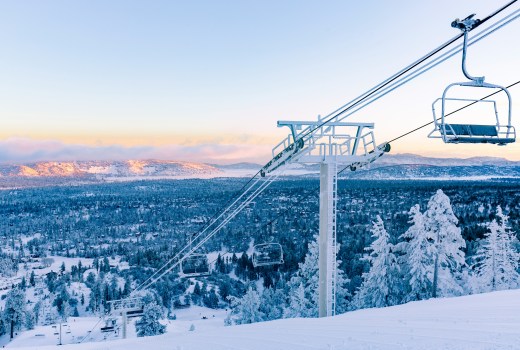
The ski lift bumped Rick onto its metal bench and toted him skyward. Glittering slopes fell away, frosted runs and dark crevices of trees winding down to the valley floor far below. In the distance, toy cars pulled into the parking lot from the snaking highway, which ribboned back along the edge of the foothills, over the frozen river and behind the humpbacked mounds of earth that sheltered town.

As they’d put the newspaper to bed later than usual the night before and he’d woken to a whiteout, Rick figured he could be late for the weekly editorial meeting. The editors would gripe but after three years of covering small-town courts, cops and haemorrhoid-inducing council meetings, he didn’t care.

He propped one ski on the footrest and let the other swing, gently rocking the chair. The landscape lay silent and serene, air refreshing as ice water. He nodded to a beat in his head. He’d left his headphones in the house this morning, as well as his ski gloves, hustling to get out of there while Candice was in the shower. She was wigging him out with all the baby stuff, having ramped up her mission since turning thirty.

He couldn’t imagine having kids. It just didn’t compute. He figured it would happen some day, sure — later, down the line. But this was his first job out of grad school. He was living in the now; the future was a nebulous concept hanging somewhere in the distance, blank and unfathomable as the winter sky.

The chairlift groaned and, with an icy scrape, clanged to a halt. Rick’s chair bounced and he stopped swinging his leg, waiting for the cable to resume its uphill tow. He craned his head to see what was happening at the base. No-one was in sight and no-one else appeared to be riding the lift, either.

Rick sighed and settled back. Empty quads dotted the way ahead to the exit ramp, an aerial ellipsis that marked time between the end of one run and the start of another. He blew into his hands and watched the thickening snowfall settle on the swaying chairs. He would miss the whole meeting at this rate, but whatever.

A crimson ski patroller was flashing down from the lift tower, carving swift turns beneath the stalled chairs. He slid to a precise halt under Rick, skis perfectly parallel.

“How you doing up there?” he called. “You alright?”

“Yup. What’s happening?” Rick called back.

“Bullwheel’s stuck. We’re takin’ a look at it. Just be a few minutes I reckon. Otherwise we’ll have to get someone out here to evacuate you. You ok to hang tight for now?”

“Yeah,” said Rick, startled at the prospect of being winched down like a cat from a tree. “How will—” he started, but the patroller had pushed off already, surfing the sparkling snow drifts around the chairlift pillars like powder waves.

Damn, he thought, a cold crackle running over his body. Why in hell had he come out here before work? He could have gone to the meeting, on time, and driven out here afterwards to hit a few runs during lunch.

The fingers on his left hand were tingling now, a pins-and-needles sensation. What if he didn’t get down soon? His fingers were nipped; soon actual frostbite would set in. What if he lost fingers? How would he do his job?

Candice would leave him. She was already disgruntled; why would she stick with a digitally-compromised freak? She might have to support him. Would loss of fingers qualify for disability? This thought calmed Rick slightly. Benefit money. Ok. He could take some time, write a novel. That might not be so bad.

He peered down at the ground: it was a solid fifty, maybe sixty-foot drop. This was crazy; he was stranded. His phone was sitting in the car. No skiers had gone by in thirty minutes.

To the east, he could see skiers riding the Marmot lift. Because Thunder was down, everyone was avoiding the area. Rick’s goggles began to steam up. He worked a rigid finger behind the lens to wipe it clear and finally spied someone, a snowboarder, carving turns down the Ampitheater run. 

“Hey!” he shouted, waving his arms. “Hey! Over here!” The boarder had seen him, had cut away from the centre of the run and was sliding towards him. She sent up a powder spray as she swung the board round sharply and edged to a halt. She pushed up her goggles.

Oh god, Rick thought.

“Rick?” The girl peered up at him, first in disbelief, then amusement. He found himself, momentarily, flashing back to their last interaction, when he’d laid into her for missing an assignment at the courthouse. “What’re you doing up there?”

“Hi Jaz,” he said. “They sent you out here?”

“Mike heard ski patrol was gonna evacuate someone over the scanner,” she said, slinging her backpack onto the ground and fishing out equipment. “Told me to come get the shot.” She grinned, fitting lens to camera.

“Come on, Jaz,” Rick said. “Give me a break. Mike’ll flip his lid. Can you go get ski patrol instead? I’ve been sitting up here for over half an hour. My fingers are about to fall off.”

Jasmine cocked her head. “I’ve got to get the shot, Rick,” she said.

Two patrollers swept towards them towing a rescue sled. “We’re gonna get you down,” called the one from earlier. Jasmine planted her snowboard next to the pillar, trudged through the snow for a better angle and started snapping the rescue mission. Rick wished he’d jumped when he had the chance.

The patrollers slung a rope over the lift cable. One of them rooted himself into the snow to belay the other, who climbed up to Rick’s chair. “Howdy,” he said when he reached the top, strapping Rick into a harness with expert efficiency.

“I could probably just climb down myself,” Rick grumbled. Jasmine was clicking away.

“Gotta strap you in. Safety regulations,” said the patrolman, signalling his partner to let out the rope. Dangling Rick between his legs, he rappelled them both earthward. Rick felt like a bit of meat on a line: editorial bait. His legs buckled when he reached the ground.

He dreaded to think how he would explain himself to Mike. His job, his relationship, his life — everything seemed suddenly, thanks to one innocent matutinal detour, to teeter at the edge of a crevasse. He dug his poles into the snowpack and pushed off, quickly, to catch up with Jasmine.

“Jaz!” he called out, drawing level. She’d strapped her pack back over her neon jacket and was rocking her way downhill in the slouchy, rhythmic manner of snowboarders. “Jaz, just say they evacuated the person before you got there. Don’t show them the pictures.” She turned, but Rick couldn’t see through the tinted lens of her goggles.

Jasmine pulled ahead. Snow was falling in fat, heavy flakes, whiting out his view. Like broken bar lights, her neon form started to sputter behind the curtain of snow. Whatever, he thought. He’d catch up with her in the parking lot. Right now, he’d just try to focus on the short run he was going to get, and forget about the other stuff. It was really blizzarding; he could hardly see five feet in front of him. The earth, the sky, the world was white: a blank, empty void, full of nothing, and he was skiing right into it.

*

Julia Carver is a former news reporter who lives in Gunnison, Colorado, with her husband and two dogs. She has published fiction in the Whitefish Review, Salt Hill, Helix, Tahoma Literary Review, and elsewhere. She is currently working on a novel.

Submissions open for “Sweet Hereafter”

Submissions are open for issue #20 of Shooter Literary Magazine, with the theme of “Sweet Hereafter”.

We’re looking for stories, essays, memoir and poetry to do with afterlives: life after death, life after work, life after having a baby, life after divorce… Anything to do with what follows a major change in life, when someone or something ends and significant adjustment occurs. Pieces that treat heavy subject matter – grief, heartbreak, loss, bereavement, ageing, death – with a light or humorous touch would be especially welcome. A positive (or wild, or bizarre, or comic) spin on what comes after a difficult ending or change would be in keeping with both parts of the theme.

The theme is open to wide interpretation, but please adhere to the submission guidelines. In addition to thematic relevance, we seek engaging, elegant writing that maintains a high literary standard.

Writers should send short stories and non-fiction of 2,000-6,000 words and/or up to three poems by the deadline of June 22, 2025. Please submit according to the guidelines at https://shooterlitmag.com/submissions.

Shooter Flash: “Thursday’s Dresden’s” by Jacksón Smith

Twenty minutes past my reservation. I’m late for a meeting. My foot taps; I check emails. The Barber – thick beard, leather apron – rolls up his sleeves. One-man shop. Too late to go anywhere else. 

Last week my new manager said I looked like a highland cattle. I had to Google it. Turns out: majorly insulting, and a brag about his Scottish whisky tour with the Board. Clean it up, he said, pointing his toothpick at my hair, or quit and go back to hacky sacking with your pals. 

Finally, the Barber’s done sweeping the last guy’s hair. The bell rings. In comes an old bald man. Tall-faced and sorta droopy, with delicate wireframes and a beige cardigan.

The Barber clasps the man’s shoulders and escorts him into the well-worn chair. 

What a way to run a freaking business. I stand and hold up my iPhone. “I have a reservation.”

The Barber’s face screws. “With who?”

“What do you mean with who?”

He points with his scissors at the clock. “Twelve thirty on Thursday’s always Dresden’s.”

“For what?” I point at the man, who is bald. 

“Well, oh.” The old man adjusts his glasses. “It’s not – well, yes. You’re right.”

“Ritual,” Barber says. His voice is mirthful, different than before. “Thursdays we have fun. Dresden gets The Works.” 

“Oh come on, I made a reservation online.”

The Barber taps his scissors on his beard like he’s thinking. “Huh, online!” He snaps the bib around the man’s neck. 

And what the hell do you say to that? 

So I sit, arms crossed. Make them feel bad for making me late. 

The Works: steaming towel, oil lather, peppermint, huge calloused hands massaging his scalp, the both of them talking, laughing (giggling, even), on and on. Twelve-inch feather dusters, leaky urethras, son-in-laws, thin mints (the Barber’s daughter is a Girl Scout). 

Emails buzz my pocket. I ignore them; my foot stills. The Barber’s cheeks flush (a joke about sauerkraut), and then he hands Dresden a mirror. Jesus, does he really need to examine his – but I catch myself. It doesn’t matter, his baldness.  

I rub my temples. I have a strange, beautiful image in my mind of a bunch of cattle playing hacky sack. The crisp sound of beans on a hoof.

I tried, boss. I tried to don the tie, to be a businessman, to have a nice framed photo on Mom’s mantel, just like my brother’s, but go ahead, mock me, fire me, because, well, I guess Thursday’s Dresden’s for Christ’s sake. 

“Hey,” I lean forward. “Do you have another order form? I love thin mints.”

*

Jacksón Smith is a writer based in Washington, DC. His work has appeared in G20, Diplomatic Courier, Childhood Education, and The Golden Antlers. He studied PPE and Creative Writing at Claremont McKenna College. His fiction explores the tension between logic and absurdity, the surreal within the mundane, and the strange ways people collide with their pasts.

Shooter Flash: “If, Man, Son” by Al Crow

And—which is more—you’ll be a Man, my son! – “If” by Rudyard Kipling

Pint up, contents down, and I’m up, down the corridor. Drink then piss. Same old drill for an old soul. No need to spell it out. Quite a walk actually, for an ageing gent like me who’s really, really got to go, but I get there fine. In time. Double take on the sign. Notice the rhyme. Didn’t notice the sign before though. A little horseman with an oversized sombrero and a machine gun on the door of the gents. Supposed to be funny. So little effort in the rest of what goes for a boozer in this Monopoly-board railway station and there this six inch gun-toting Mexican lad on the bogs. They must be making sure the really leathered blokes still get the right place. Well, I’m not that gone. Not by halves. I push. Pull the next one, and it gives me four urinals, a sink and a single cubical with the door shut. Quite the drinker’s vista. Two gentlemen already there. One in the crapper. Pair of jeans resting on lime green trainers. Some old rocker at the far wall-mounted john. Leathers, raggedy beard, and a steely stare towards the poster at his front, which is adverting erectile disfunction. 

A man like me. A place like this. All these ifs in my head. 

You can try and drink away the ifs, but they’ll get you in the pisser. That’s the actual pisser, I think. When the ifs come for you in the pisser. 

The raggedy rocker nods a hard-arse glare my direction. Spurs me into life. I take the second lane, so there’s one slot between this half-price Slash’s slash and me, while I’m not so bang up against the sink that this will turn into a problem. Not that anyone here is going to wash their hands, but thems the rules. Decorum, anyway. Me and the rocker, we’re both hoping no-one else comes in and has to tuck in between us, but we’re okay. For now. So, I hunt out my Johnson in these tight arse pants I got from Amazon about a month before the sixty seconds that I’m drinking so shit hard not to think about happened. 

I yank a boxer leg up first, which is too long to get myself under, so I try to unfathom the intricacies of a knob-tunnel system that’s more impenetrable than the Tora Bora caves. This might be taking a while, but I’m gazing forward. Always look forward in the gents. Golden rule, and the poster at my eye level blurs into focus. It’s goading me to Be The Best, and I realise I’m far from the best, so far from my best. Haven’t been the best in me for so long. Don’t need an ad to tell me that. I got sucked into something for my boy. He was infinite. Perpetual. So much life in those gleaming eyes that it didn’t seem possible that he could be anything but there – couldn’t be anything by twenty and sharp and charming, always catching a ball or a cute girl’s eye – and I didn’t encourage him. He found that path himself. 

Sure, he was playing up to his old man. Sure, there were footsteps. Boots to fill. An apple and a tree. Sure, he was imitating, emulating, coating himself in what he thought was the very best of me, only I never said he should go down that route. I never told him the person he should be. 

In the pisser, here I am, playing that card as if it’s a get out of jail free. 

Ha. There it is again. I’m a poet and I know it. A poet like all those messed up word-wankers that went before me with their drinks and their England. Take Kipling, my mirror. He wrote all that clap about being a man, then he bluffed his short-sighted son passed a medical and square into a cavalry charge, gifted the blundering vole the once in a lifetime opportunity to have a jog at a gun post. The national treasure never forgave himself. Funny that you learn that one at school. Funny, not funny. 

“This country grinds you down.” 

It’s the rocker speaking, breaking the rule of not talking to strangers in the gents. He’s pressing the dispenser as if he genuinely believes there might be some soap in there and it’s like time has slipped. I didn’t notice him move from the urinal and the thought strikes me that perhaps he’s God and Jesus is taking a dump above the lime-green trainers in trap two. 

I wipe a stray tear. Guess that’s a more logical explanation of why he’s talking at me. 

“Too fucking right,” I say. 

As I do, the room is filled with the sound of the toilet flushing. It echoes about the bare-walls until it feels like the place is going to be filled, and I imagine drowning in there. I picture myself floating above the urinals and the sink, being washed higher until my head knocks on the ceiling and I smile at the rocker and take a last breath, which allows me a few moments under the tear and bog water, before the air seeps from my lungs and the darkness comes into my head, pushing away all the ifs with its milky-black ooze. 

“Well, you have a good afternoon Buddy,” the rocker says. “Perhaps go a little easier on the sauce.”

I smile.

I’m about to say something when the cubical door opens, and the kid who comes out is about twenty, blond hair, slightly foppish, and one of those smiles. For a moment, I think it might be him. My boy. I think it might, and he looks across. Those eyes unchanged. For a moment, I’m flooded, dragged further beneath that boat load of ifs.

*

Al Crow works across fiction, creative non-fiction and poetry, exploring this challenged world and human fragility. Recent work is featured in The Last Song, Words for Frightened Rabbit; Masculinity: an anthology of modern voices; Last Light, an anthology of Apocalypse Poetry; Lighthouse and The London Magazine.

Shooter Flash: “Trash” by Bethany Swett

Marg got used to the smell after her first week on the job. Slinging the slick black garbage sacks into the oily maw of the truck all morning, she got so steeped in the stench that she ceased to notice it. It was like water: once you were in it, you were wet. The smells, like drenching rain, only bothered you if you had something to keep nice in the first place.

She tied up her waist-length dreads after Cal, the jerk-off, pretended to feed them into the chomper on her first day. Jack, who drove the truck, more kindly suggested she might want to consider restyling if she didn’t want to end up processed like meat through a grinder. But her dreads were the product of years, connecting her way back to Burning Mans (Men?) of yore. Another life. She’d rather chop off a leg.

The loose bags sagging into each other on the sidewalk she tossed straight into the chomper. Trash cans and recycling got slotted into the mechanical arms and lugged in a big metallic hug into the bowels of the truck, then dumped back down again, like a kid too big to get picked up for long.

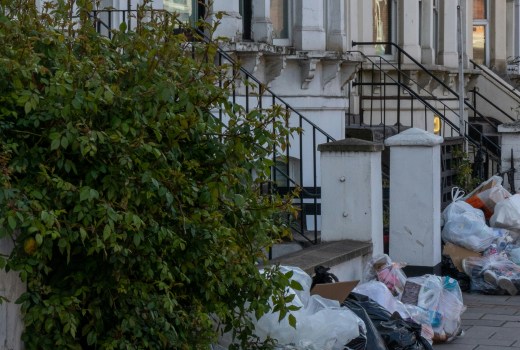
Marg hustled to the next set of bins on the worn-out street, its townhouses faded from lack of care and grayed-out by a drizzle of rain. The buildings were mostly brick with concrete stoops; sometimes old people shuffled around out front and hobos, towing errant shopping carts, rooted through the trash. Anyone looking like they had a job tended to scurry in and out like mice after cheese, wearing the cheap suits of office drudgery. Marg knew they looked down on her, if they looked at all, yet she wouldn’t trade places. She didn’t like sitting still, feeling pinned down.

She set a can into the last empty slot on the truck and hit the lift button. As the arms hauled up their load and dumped the contents, something clinked out onto the sidewalk near Marg’s boots. Its glint caught her eye, and she bent to pick it up: a silver ring set with a small diamond. Marg turned it over awkwardly with her thick padded gloves. She looked up at the nearest house, which had a matt-black door and window-frames, recently painted, not peeling like most of the others. No-one was racing out after a missing ring, anyway.

“Come on bird nest, let’s move it,” Cal yelled as the truck lumbered up the street, leaving Marg in its wake, gawking.

Quickly she tugged off her glove and shoved the ring in her pocket, fumbling with the zipper to yank it closed before hustling on up the street to catch the blundering truck, which was gassing and steaming like an old bull elephant.

Later, when Marg returned to the high-rise apartment she’d occupied for the last three years, she sat down and pulled the ring out of her pocket. It winked at her weakly in the dim light. She tried to slide it on. It was too small for her ring finger, but it fit on her pinkie. She twirled it there for a moment, then pulled it off and sank back into the sofa, opening up her phone.

She swiped and tapped to a familiar profile, bracing for the usual self-flagellating burn that came from scrolling his photos: the man she’d loved with the woman he’d left her for, living their best lives. The woman who, in fact, he’d been with before he did Marg the courtesy of leaving. She’d got better lately at resisting the urge to torture herself, but the ring had reminded her, and lured her back.

To her disappointment, though, his feed hadn’t been updated much for several months. Taking time… said one of his posts, captioning a mountainscape with a trail of hug emojis and hang in there buddy comments – and one saying, girls come and go but beer is always there!

With a crackle of anticipation Marg sat up and clicked through to the girlfriend’s profile page. She saw, among her numerous public pictures, the woman draped around the shoulders, torso, and assorted other body parts of a bronzed, toned, tall, and very much different man.

“Wow,” she exhaled to herself, flopping back into the cushions. She felt giddy, but also oddly queasy. Marg realised she was still in her work clothes, faintly off-gassing the morning’s garbage, and headed for the shower, scooping up the diamond ring from the table.

In the bathroom she shucked off her clothes and rummaged in a drawer, coming up with a thin silver chain. She slid off the cheap charm that had swung from it and replaced it with the ring. Squinting down at herself, she attached the chain around her neck, and looked up at the mirror, at the person standing amid the rising steam, bare but for a glint of light resting just above her heart.

One woman’s trash… Marg thought, fingering the ring. Maybe the saying would prove true for one man’s trash, too.

*

Bethany Swett works for a tech company by day and writes fiction the rest of the time. She has published short stories in Lilith, Quick Fiction, Bayou Magazine, 365 Tomorrows, and elsewhere. She lives in Denver, Colorado, with her dog Sushi.

Shooter Flash: “Drift” by Sammi LaBue

Alex wore her half of our heart necklace long after high school, but when they found her across the bay, she wasn’t wearing jewelry. Just her long hair around her neck like a noose of wet string. 

She finally moved to New York from Tampa two years after I had. She lived in Queens and I lived in Brooklyn, but we made Beach Day an official weekly holiday, no matter the weather, to remind us of home, and I got her a job at the bar where I worked.

She found me in the walk-in refrigerator during the shifts we shared. I’d mix cheap vodka with cranberry juice and slices of lemon, our seventeen-dollar happy-hour cocktail, and she’d talk about her new friends, her roommates, her artsy kind of sadness. The refrigerator’s vacuum seal suctioned us in behind her, as if to preserve us. 

*

We’d walk down the beach warp-powered by the Adderall she brought. I thought of our purse of shells and treasures, our iPhones and keys left behind, thinly veiled by faded bath towels. But she’d say, Let’s never go back, smiling. 

Days would slip by without a whisper from Alex. “Sometimes friends drift apart,” Mom said when I called her instead. Then Alex would be back again, our teeth hard-set against the cold of the walk-in. Her voice sounding more and more like the silent void of her voicemail.

Want an adderall, a xanax, anything else? The sand-stained coin purse started to fill with chalky blue-and-white pills – nothing like sea glass. 

*

Still on for Beach Day?

Is it going to rain?

Meet at DD, right?

Im Here

?

I waited outside of Dunkin Donuts flipping between my doppler app and messages and back again. A green mass crept across the screen pixel by pixel.

When the smell of rain had washed over the roasted nuts cart and the car exhaust, Alex appeared with her hands shoved into the pockets of her leather jacket. I was getting worried. She wasn’t wearing her necklace. Where’s your bag?

After the intersection, she threw a laugh over her shoulder then ran across the boardwalk and down to the beach. I chased after her, rain needling my skin.

She dropped her clothes in the sand. The metallic reflection of the waves striped her skin, her hair melted out across the water’s surface as she waded deeper. 

Alone on the beach, time expanded as she pushed out and out. 

I remembered bike races to the beach back home and how you could eat the heavy evening heat right out of the air. 

I remembered her theory about being adopted, even with her mother’s round, clamshell eyes, those straight eyelashes, the scattered sand freckles across her nose. 

I remembered the first day she showed up to work drunk, when she breezed past the walk-in window.

The storm faded as fast as it arrived, and then so did she. I could see her. I could see her, until I couldn’t. Like a star stared at too long in the night sky, she flickered out as the lifeguard’s whistle blared. 

* * *

Sammi LaBue is a Brooklyn-based writer and educator. She founded Fledgling Writing Workshops (Best Workshop in NYC, Timeout 2019) and is the author of Words in Progress (DK 2020), a creative writer’s guided journal. Her writing can be found in Literary Hub, Glamour, The Offing, Mutha Magazine, Hobart, and Sonora Review, among others. She received her MFA from the Vermont College of Fine Arts, is The Penn Review’s 2024 Poetry Prize winner, and has recently finished a dual memoir written in collaboration with her mom.

Shooter Flash: “Red Light Green Light” by Johanna Bernhuber

Mornings were always rushed, but Angie was particularly antic today – racing around, playing, not getting dressed when asked for the twentieth time. Susan had ten minutes to get her to school and she wasn’t even dressed yet herself.

“Come on!” she bellowed, as Angie tore past wielding a set of streamers like the Olympic torch. “Get dressed now!” And before she could push it away: You little shit, she thought. 

Delete, delete, delete, she thought frantically and froze. She could hear nothing but the sound of Angie playing, still not getting dressed.

Susan hurried to the bathroom and looked in the mirror, peering closely into her eyes. Her heart seized when she perceived, deep within the right pupil, a speck, not of green, but of red.

She ran into Angie’s room, where the child was finally struggling into her sweatshirt. Susan grabbed her slim, warm body and hugged her tightly. “I love you,” she said. “I love you so, so much.”

“Mom!” Angie protested, squirming. “I’m trying to get dressed!” But her little face was smiling, and when she finished pushing her arms through the sleeves, she threw them around her mother’s waist and returned her hug.

Maybe it’s alright, Susan thought, stroking Angie’s smooth hair and dropping a kiss upon her head. It was just a small blip. Maybe nothing will happen.

“Come on,” she said gently, kissing her one last time. “We’re going to be late.”

Together they got up and got ready to leave, Susan gathering Angie’s backpack, water bottle and jacket while Angie strapped on her shoes. She threw on a long coat over her pyjamas. The house looked like a hurricane had hit it, but Susan resolved to tackle the mess later, once Angie was safely in school.

They reached the door, opened it, and were halted by a man dressed in gray on the doorstep.

“No,” Susan gasped, clutching Angie. 

“Mrs Harber,” the man said. “We received an alert of a verbal infraction.”

“No,” Susan gabbled, “it was nothing. I was just trying to get Angie dressed and now she is, you see, and we have to get to school. She’s late as it is. We must get going, will you please let us by?”

“Verbal infractions need to be followed up,” the man said, waving forward a woman, also in gray, who waited behind him. “Let’s have a little chat.”

The woman held out her hand to Angie. Susan hung on.

“You musn’t,” Susan gasped. “She’s very well looked after. I look after her, all the time, every day. I love her, you mustn’t take her.”

“We just need to speak with your mom,” the woman said to Angie, ignoring Susan. “You come with me. I’ll get you a special treat, would you like that? But come now otherwise you might get into trouble, and you don’t want that.”

Angie looked up at Susan. Her hazel eyes, always so beautifully clear, shone with worry. Her mouth quivered. “Don’t worry Mom,” she whispered. “It will be ok.” She eased from Susan’s arms and went with the beckoning woman, who led her to a van parked on the street in front of the house.

Susan tried to go after her, but the man in gray blocked her path.

“Shall we?” he said, gesturing into the house.

Susan sobbed, Angie having melted from view, and turned helplessly to retreat into the house, collapsing on the nearest sofa. The man perched on a neighboring armchair and leaned forward.

“Mrs Harber, I am Agent Blain,” he said. “Do you know why I’m here?”

“Yes,” Susan said, miserably. “But it was only a split second, a careless moment. I was frustrated. It didn’t mean anything. I love my child, more than anything. It was just a moment.”

“Mrs Harber,” the agent said, “life is made up of moments.” He paused. “That’s why moments are important. Do you feel unable to perform the day-to-day duties of motherhood?”

Susan shook her head vigorously. 

“No, not at all. I mean, I’m fine – I’m in control. I’m happy.” She smiled awkwardly, against the tears. 

“You may think it’s just one thought, but our research shows that actions – negative actions – don’t occur without the negative thoughts that precede them. With right thinking, right actions follow.”

Susan nodded, kneading her hands in her lap.

“It won’t happen again,” she said hoarsely. “It’s never happened before.” Forcefully, she pushed I’m not lying I’m not lying across her brain.

“It’s true this is your first infraction,” said Agent Blain, standing up and adjusting his jacket – the one all agents wore, with the high, circular collar. “And as such we will return your child to you, with a warning. But we will, you understand, have to take some precautions. Including placing you under elevated watch.” He moved to the door and, as he opened it, Susan could see the woman in gray leading Angie back up the path to the house. 

“You’d better get this one to school,” the woman said, releasing her with a pat on the back.

“Yes of course,” Susan said, flooded with relief. “Right away. Thank you.” She knelt down to hug her daughter close, but felt Angie stiffen.

“Are you ok?” she asked, pulling back to look at her. In the background, the agents’ van pulled away from the kerb. Angie looked slightly dazed.

“Why did you think that?” she whispered.

“Oh sweetheart,” Susan said, feeling stabbed through the heart. “It wasn’t about you, it wasn’t. It was just – you weren’t cooperating, and I felt stressed. I didn’t mean it. It wasn’t something I said.”

“But you thought it.” Angie’s voice rose.

“That’s not the same. You can’t always control your thoughts.” She hesitated, then added, “But we do have to try.”

“That’s what the lady said.” Angie looked up, frowning, and met Susan’s gaze. Looking into her eyes, Susan caught her breath.

Deep within Angie’s right pupil, surrounded by the soft flecked gold of her iris, glowed a bright speck of green.

Which then, within Angie’s accusatory face, abruptly flicked to red.

* 

Johanna Bernhuber is a psychologist who has written for the Chicago Sun-Times, and has published short fiction and non-fiction in Whitefish Review, Ginosko and Denver Quarterly. She has three children and lives in Illinois with her husband, one dog, and too many books.