Shooter Flash: “Love Lessons from a Chameleon” by Sherry Morris

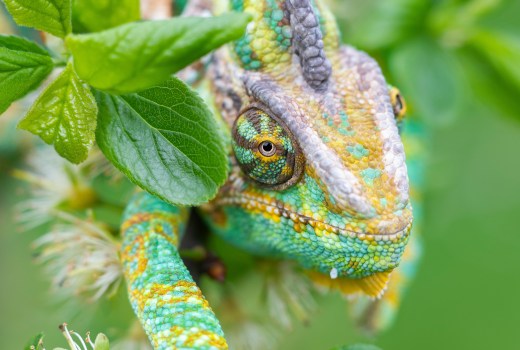
We met in the Algarve. He sunned on decorative rocks. I sipped Love on the Rocks by the pool. He approached me – drawn, perhaps, to my scarlet bikini or maybe my crimson drink. Initially, I was put off by his leathery hide. Didn’t like his independently roving eyes. Or his two-inch claws. Then he fanned his crest, flashed bright-bold shades of reds, blues, greens and golds – a mating ritual I supposed. What can I say? His primitive nature struck a chord. 

Khem wasn’t much of a looker but the things he did with his tongue… And when his tail wrapped tight around my waist, I felt safe – like he’d never let me go. 

We didn’t have much in common it’s true – except a shared love of basking in the sun. Sometimes that’s enough. 

Back in Bolton, I introduced him to Mum. She cried. Said even Dodo Darrell was better than this. I pointed out at least chameleons chew their food. Friends said a relationship between an Old-World lizard and a twenty-first-century lass wouldn’t work. Perfect, I said – Khem wasn’t work. We married in a registry office, accompanied by more tears from Mum. I wore plain cream while Khem blazed like a Christmas tree, nearly noble, with a thimble-sized top hat balanced on the tip of his crest. The sun shone on us that whole glorious June day and I knew I was right.

We were ridiculously happy at first. No one understood how easy it was to communicate. Myth says chameleons colour-match to their environment. Fact knows it’s mood. The men I’d known before Khem had kept their feelings buried, hidden deep. With him, emotion blazed across his skin. No game playing. No need to guess how he felt. It was bliss. We humans think we’re better – so sophisticated, more complex. Simple ways are often best. 

We didn’t last but it’s not what people think. Chameleons prefer a solitary life and everyone wanted to meet. At cocktail parties when Khem opened his mouth wide and bobbed his head from side to side, it was mistaken as friendly greeting. Once introductions were made, I’d find Khem a quiet room with curtains he could cling to. I’d explain it wasn’t bad manners – chit-chat just wasn’t his thing. Once he got to know someone in a quiet arboreal setting, he sometimes enjoyed a gentle stroke under his chin. He was a creature at ease on his own.

I saw the pity-smiles and shaking heads. Heard what narrowing eyes said: our relationship wasn’t real. A couple couldn’t be apart and still truly together. Some even suspected he was nothing but a lounge lizard, just along for a free ride.

I fell into that people-pleasing trap women do. Posted staged scenes on social media of domestic bliss cuddled up with Khem. Ensured I always colour-coordinated with him instead of acknowledging my own moods.

When Khem turned brown I told myself it was brumation – brought on by winter dark, damp and cold. I bought a basking bulb, additional heat lamps. Refreshed all the yucca and rubber tree plants. Pleaded with Khem to pretend Bolton was the Algarve.

He left anyway. 

Mum came round all dry-eyed and canary-smile, wrapped smug-tight in I-Told-You-So’s. Proclaimed I was a silly goose not knowing marriage had to manage rainy days too. Said I’d be alright, even happy, as soon as I was Bolton-normal like them. Friends offered to help me throw a party – everyone could take a plant. I saw it then – the problem wasn’t Khem, but them. 

I moped for months. Dressed all in grey. Wore a neon-yellow scarf as a warning for Mum to stay away. She didn’t understand my colours. Nobody in Bolton did. A well-intentioned friend suggested I look for love in Antarctica. The place was full of penguins. They mate for life she said. I shuddered. I had nothing against tuxedoed birds but knew my heart would never find love in a cold world. 

I returned to the Algarve. Moved into a block of flats with extensive grounds and a communal pool. Met Tadeu – the on-site gardener. He’s shy, slow-paced, has a seductive sunbeam smile and wears an impressive array of Hawaiian shirts. With his bald head and stocky build, he bears more than a passing resemblance to a terrapin – especially when basking on one of the larger, flat slabs of rock near the pool. Now his tongue isn’t as long or strong. I only speak one word of Portuguese, still – we’re off to a promising start. 

Tadeu works early mornings, then joins me poolside afternoons. Often, we are the only two, appreciating the glorious heat, sunshine and each other – communicating through bouquets of flowers he presents, his bright shirts and my vivid bikinis. Now sometimes we complement each other. Other times we clash – and that’s absolutely fine. What matters is we show our true colours. Let rain enhance our relationship. 

It’s true Mum had a point with her tough-love marriage message. But I also learned something valuable from Khem – self-love. When he appears one day out of the blue on a stone, all healthy-glow and rainbow-shimmer, I smile and wave hello. Giggle when he tongue-flicks my way. Whisper as he lumbers off to catch some lunch, Obrigado, Khem.

*

Originally from Missouri, USA, Sherry Morris writes prize-winning fiction from a Scottish Highland farm where she pets cows, watches clouds and dabbles in photography. She also presents Sherry’s Shorts – an online radio programme of short fiction with Highland Hospital Radio. Visit Uksherka.com for her published work and listen to episodes of Sherry’s Shorts on hhr.scot.

Shooter Flash: “The Oak” by Jennie Stevenson

“And this is you,” says Eva, showing me into my new home.

It’s pleasant enough – The Oaks is very upmarket – but we both know what it really is: death’s waiting room. My things, already delivered, are the pitiful sum of an entire life: trinkets, books, photo albums I haven’t opened in years. At least my wardrobe is a rainbow of velvets and silks.

A vase of spring flowers stands on the table, from Eva, and my eyes prick with tears. How long has it been – if ever – since someone gave me flowers?

There’s a soft thwock from outside: my flat, on the first floor, overlooks the tennis court. A man in tennis gear is exiting the court, an elderly woman on each arm, laughing. His hair is white, but his shoulders are broad, his arms still muscular and tanned. 

“Found the quarterback,” I murmur. The kind of guy who would never notice me.

Eva laughs. “That’s Tom. He’s quite popular with the ladies.” I bet.

My new doctor arrives. I notice Eva stealing glances at him as he checks over my medical records, and I don’t blame her – if I were a few years younger, I might have flirted with him myself.

They leave and the room feels empty. I need some air.

*

When I reach the huge oak in the centre of the retirement village, I stop to rest my aching hips on the bench curving around its trunk. A voice startles me: the jock, a ribbon of sandpaper between his fingers.

“Hi. I’m Tom.”

He’s carving ornate patterns on the arm of the bench: leaves, flowers, birds.

“Oh! It’s beautiful. You’re a woodworker?”

He smiles. “Used to be. Still am when my hands let me. You?”

“I’m… I used to be a travel writer.”

He sighs. “I would have loved to travel. What was your favourite place?”

I laugh. “I can’t choose. It would be like choosing a favourite child.”

“Tell me about them.” So I do. I tell him about haggling for spices in the crowded passages of Istanbul’s Grand Bazaar, the drifting cherry blossom in Kyoto in spring, the dizzying cliffs of the Italian riviera. After a while he stops carving, closes his eyes and listens so intently I think he’s fallen asleep.

When I’ve finished, he asks, “Do you play chess?” When I say no, he laughs and says he’ll teach me. “Same time tomorrow?”

*

His chess set is exquisite. “I’ll make you one too,” he tells me. “My shelves are full, and if I offer to make anything for the ladies here they’ll only get the wrong idea.” Subtext: he can offer one to me, because he couldn’t possibly be interested.

“No grandchildren?” I ask, lightly.

He sighs. “No. I never – met the right person. I was engaged once, but for the wrong reasons, so I broke it off. You?”

“No. Same.” Our eyes meet – a fleeting understanding? Or am I kidding myself?

*

As the branches above us turn green, he teaches me to play chess, and then he carves a set for me. I bring my photo albums, the pages sticking together, and show him places I’ve been and known and loved, and sometimes he carves and sometimes he just closes his eyes and listens. 

Then he brings his photographs to show me: cribs that will become family heirlooms, a bookcase for an eccentric professor, a couple of fiddles he made just for the challenge of it.

One day, we find a couple locked in an embrace on what I’ve come to think of as our bench: Eva and the doctor. I wink at her as they disappear toward the doctors’ quarters.

*

Eva stops by our bench a few weeks later, smiling as she looks from one to the other of us. Above, the leaves are just starting to turn.

I ask about the doctor and she tells us that they’ve split. “I want to focus on work… and honestly? He’s kind of a dick.” 

Tom laughs heartily, but after she’s gone, his mood turns. “Sex before marriage, career before a relationship… It’s a different world to the one where we grew up. Makes me wonder how things could have been different…” He sighs. “In the next life, I guess.”

“Do you believe in reincarnation?”

He shrugs. “I don’t know. I just want to believe I could have a do-over. It’s only when you get to the end you realise what really matters.”

“What would you do differently?”

He shrugs again. “Travel?” He places his hand next to mine, and my blood fizzes. “Be braver.” He slips his hand over mine, and my heart judders in my chest. “And I hope… I hope I would have met you sooner.”

I turn toward him, and our eyes meet, and then he kisses me. And I’m aware of everything and nothing: the thousand sighing leaves above us, his hand cupping my face, the solid bench beneath us and the beating of my heart. He breaks off and smiles at me. “Same time tomorrow?”

*

I’m woken by hammering on my door. The world outside is cold and grey, shrouded in fog.

Eva. She’s holding something in her hands, but it’s her eyes I notice first: they’re swollen and red.

“I’m sorry. This should get easier, but it never does. And I wanted to be the one to tell you.”

His huge heart: a massive heart attack.

“I think he would have wanted you to have this.” 

She hands me the object: a carving of two figures on a bench, hand in hand, their foreheads touching, one with broad shoulders and still-muscular arms. I see the sharp crease in my trousers, the scarf in my pocket, my neat goatee: how clearly he saw me. How much love went into this. How much time we wasted. And across the bottom, the flowing inscription: To Jack, until the next life. All my love, Tom.

*  *  *

Jennie Stevenson is an English graduate currently working as a freelance content writer. Born and brought up in the north of England, she now lives in southern Sweden with her husband, where they are comfortably outnumbered by their children and pets.

Shooter Flash: “Love in Transit” by Isabelle Spurway

I am on a train going from Saint Petersburg to Helsinki, reading a novel about an American infiltrator in Russia. Every now and then I look out of the window, wishing to see something interesting. We are driving along the edge of a forest and birch trees stand bunched up together, tall and thin, their narrow tops piercing through grey clouds. I scan the flashes of wilderness for a wolf, or a Siberian tiger, but instead there’s just trees and grass. Across the aisle is an old woman and opposite her a young man. She is about sixty and he is about twenty-five. They have struck up a conversation. He is in love. She is wary. It is going like this:

‘We walked around Petersburg all night then got breakfast in the morning. We spoke about everything.’

‘How did you meet her?’

‘In a bar. We got to talking about our situations.’

‘And what was her situation?’

‘She lived there.’

‘And you?’

‘I live in Helsinki, used to live in Russia. I am Russian.’

‘Why did you move?’

‘My mother died when I was young. I left for university in Finland.’

‘I’m sorry.’

‘It was tough for a while, but the universe looked after me.’

He sounds earnest. As if all he’s ever done is put his trust into something bigger than himself.

‘And led you to this girl, I presume.’

‘Yes.’

‘When will you see her again?’

‘I’m going back to Petersburg in two months’ time.’

‘And you’re sure it’s love?’

‘Yes. Yes, I’m sure it’s love.’

A good place to fall in love, Saint Petersburg. I imagine him declaring his feelings on Nevsky Prospekt, in the middle of the busy pavement, perhaps on Anichkov Bridge. Behind him beautiful buildings, pastel-coloured palaces. He says the words during the white night, tinged by the electric blue of dusk. 

I peek at the man. He has lovely brown hair and chiseled cheeks. He looks like the kind of person to fall in love during the night. More mysterious, more passionate. Falling in love during the daytime seems almost pathetic in comparison.

‘Be careful,’ the woman says.

I learnt earlier that she is from Israel. I wonder if anyone her age believes in falling in love after one night. Maybe she has fallen in love before, during night-time, and maybe her heart was broken. It is harder to see the old woman’s face; she is facing the same direction I am. I catch a glimpse of red hair, wispy and frail.

‘I’ve never been careful,’ says the man. 

Someone once told me that most Russians are careful, but maybe he has never been so when it comes to love. Maybe when love is real, nobody is careful.

He asks her about Israel now. She is travelling alone. She has always wanted to see Russia. She has read about it all her life. Israel is beautiful. Saint Petersburg is beautiful. Yes, I hope Finland is beautiful too. It’s a beautiful world, isn’t it? All these places, all these beautiful places…

The train rolls on and the old woman gets up to retrieve something from her bag, stored in the hold. I turn my head slightly, so that she’s in my periphery. I catch a glimpse of her face. She has a long, ragged scar that runs from her right eye to the bottom of her cheek.

It has started raining outside. We pass a lake and the water pounds down through the surface, making it ripple. We’ve just made it across the border. Every now and then a little wooden cabin appears in the middle of the trees. I spot one with a red front door and a pile of logs out front. As soon as we pass it the rain stops and the clouds begin to part slowly, waiting for the sun to shine through.  

*

Isabelle Spurway has a master’s degree in Creative Writing from the University of Kent and currently lives just outside London. She writes many of her stories during her commutes to and from the city and finds most of her inspiration in travel.