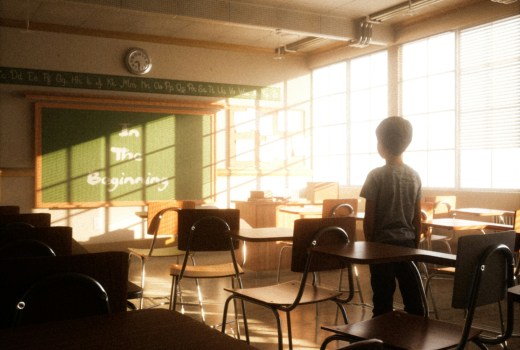
Shooter Flash: “Techspeak” by Angela Ball

The televisions, everywhere, switched on at full volume. Mobile phones jingled and landlines rang, although no-one was at the other end if someone tried to answer. Tablets flashed with non-stop videos and the incessant content of streaming services. Technology cried in full voice, crowing and bleeping and flashing AI-generated content. The people – harassed particularly in cities and built-up areas – were unable to silence it.

Harriet was confused by her mother’s frenetic behaviour on what should have been an ordinary school day. She had little grasp of the scale of the problem, despite her mother’s flailing signs, for Harriet had been born deaf. The sun shone and the day looked inviting. While her mother ran about with her hands over her ears, pulling cords out of sockets and jabbing at the remote control, Harriet got herself ready for school and walked to the bus stop.

There wasn’t much traffic in the development, but Harriet noticed the drivers in each car that passed were focused on the radio console, swerving here and there while pressing buttons. When Harriet reached the bus stop, her friend Charley was there waiting for her as usual, but the bus failed to arrive.

Something weird is going on, she signed to Charley. Their school was two miles away in the town centre; eventually the girls gave up on the bus and decided to walk through the woods to get there. Along the way they overtook a jogger standing beside the path, busy pulling apart his ear buds. When Harriet glanced back she saw him hurl them into the trees in frustration, small white orbs flying amid the leaves like the last of the cherry blossom.

The streets in town had fallen unusually still by the time they reached the school gate. Ms. Cleo released the gate for them; school also seemed subdued.

Where is everyone? Charley signed. Harriet tugged her toward class: We’re late.

Mr. Subikoff waved them in from his teacher’s chair. Only a smattering of children were at their places; the partially deaf students weren’t there. There was no-one left who could listen, but books, at least, had not been compromised; everyone could read. Mr. Subikoff indicated where they should turn to in their history books.

It became hard to concentrate as the students noticed, along the street outside their window, the few remaining people stumbling by were clutching their heads, evidently in pain, with crimson blotches blooming at their ears. One by one, they began to fall, adults and the elderly and children alike. Once they fell to the ground, whether on the pavement or in the middle of the road, they failed to get up again.

The children in the classroom trembled and caught each other’s wide-eyed gazes. Some signed urgently to Mr. Subikoff. Though rigid and pale himself, he insisted they look down at the texts before them. 

Harriet, in a state of disbelief, made herself focus on the page before her. The black lines formed letters, the letters formed words. She re-immersed herself in the sentences and began to lose herself in the tale they told. Outside was the adult world; someone would make sense of it for her later. Here was meaning she could understand. She could enter the book and it would save her. For now, at least, the words would make sense, and that would save her.

*

Angela Ball writes short fiction and poetry when not working as a solicitor in Stratford-upon-Avon. Her work has been published in Ghastling, Neon, Riptide, Tar Press and elsewhere. She is currently working on her first novel, about an underworld gang on whom the survival of the planet depends.

Shooter Flash: “Red Light Green Light” by Johanna Bernhuber

Mornings were always rushed, but Angie was particularly antic today – racing around, playing, not getting dressed when asked for the twentieth time. Susan had ten minutes to get her to school and she wasn’t even dressed yet herself.

“Come on!” she bellowed, as Angie tore past wielding a set of streamers like the Olympic torch. “Get dressed now!” And before she could push it away: You little shit, she thought. 

Delete, delete, delete, she thought frantically and froze. She could hear nothing but the sound of Angie playing, still not getting dressed.

Susan hurried to the bathroom and looked in the mirror, peering closely into her eyes. Her heart seized when she perceived, deep within the right pupil, a speck, not of green, but of red.

She ran into Angie’s room, where the child was finally struggling into her sweatshirt. Susan grabbed her slim, warm body and hugged her tightly. “I love you,” she said. “I love you so, so much.”

“Mom!” Angie protested, squirming. “I’m trying to get dressed!” But her little face was smiling, and when she finished pushing her arms through the sleeves, she threw them around her mother’s waist and returned her hug.

Maybe it’s alright, Susan thought, stroking Angie’s smooth hair and dropping a kiss upon her head. It was just a small blip. Maybe nothing will happen.

“Come on,” she said gently, kissing her one last time. “We’re going to be late.”

Together they got up and got ready to leave, Susan gathering Angie’s backpack, water bottle and jacket while Angie strapped on her shoes. She threw on a long coat over her pyjamas. The house looked like a hurricane had hit it, but Susan resolved to tackle the mess later, once Angie was safely in school.

They reached the door, opened it, and were halted by a man dressed in gray on the doorstep.

“No,” Susan gasped, clutching Angie. 

“Mrs Harber,” the man said. “We received an alert of a verbal infraction.”

“No,” Susan gabbled, “it was nothing. I was just trying to get Angie dressed and now she is, you see, and we have to get to school. She’s late as it is. We must get going, will you please let us by?”

“Verbal infractions need to be followed up,” the man said, waving forward a woman, also in gray, who waited behind him. “Let’s have a little chat.”

The woman held out her hand to Angie. Susan hung on.

“You musn’t,” Susan gasped. “She’s very well looked after. I look after her, all the time, every day. I love her, you mustn’t take her.”

“We just need to speak with your mom,” the woman said to Angie, ignoring Susan. “You come with me. I’ll get you a special treat, would you like that? But come now otherwise you might get into trouble, and you don’t want that.”

Angie looked up at Susan. Her hazel eyes, always so beautifully clear, shone with worry. Her mouth quivered. “Don’t worry Mom,” she whispered. “It will be ok.” She eased from Susan’s arms and went with the beckoning woman, who led her to a van parked on the street in front of the house.

Susan tried to go after her, but the man in gray blocked her path.

“Shall we?” he said, gesturing into the house.

Susan sobbed, Angie having melted from view, and turned helplessly to retreat into the house, collapsing on the nearest sofa. The man perched on a neighboring armchair and leaned forward.

“Mrs Harber, I am Agent Blain,” he said. “Do you know why I’m here?”

“Yes,” Susan said, miserably. “But it was only a split second, a careless moment. I was frustrated. It didn’t mean anything. I love my child, more than anything. It was just a moment.”

“Mrs Harber,” the agent said, “life is made up of moments.” He paused. “That’s why moments are important. Do you feel unable to perform the day-to-day duties of motherhood?”

Susan shook her head vigorously. 

“No, not at all. I mean, I’m fine – I’m in control. I’m happy.” She smiled awkwardly, against the tears. 

“You may think it’s just one thought, but our research shows that actions – negative actions – don’t occur without the negative thoughts that precede them. With right thinking, right actions follow.”

Susan nodded, kneading her hands in her lap.

“It won’t happen again,” she said hoarsely. “It’s never happened before.” Forcefully, she pushed I’m not lying I’m not lying across her brain.

“It’s true this is your first infraction,” said Agent Blain, standing up and adjusting his jacket – the one all agents wore, with the high, circular collar. “And as such we will return your child to you, with a warning. But we will, you understand, have to take some precautions. Including placing you under elevated watch.” He moved to the door and, as he opened it, Susan could see the woman in gray leading Angie back up the path to the house. 

“You’d better get this one to school,” the woman said, releasing her with a pat on the back.

“Yes of course,” Susan said, flooded with relief. “Right away. Thank you.” She knelt down to hug her daughter close, but felt Angie stiffen.

“Are you ok?” she asked, pulling back to look at her. In the background, the agents’ van pulled away from the kerb. Angie looked slightly dazed.

“Why did you think that?” she whispered.

“Oh sweetheart,” Susan said, feeling stabbed through the heart. “It wasn’t about you, it wasn’t. It was just – you weren’t cooperating, and I felt stressed. I didn’t mean it. It wasn’t something I said.”

“But you thought it.” Angie’s voice rose.

“That’s not the same. You can’t always control your thoughts.” She hesitated, then added, “But we do have to try.”

“That’s what the lady said.” Angie looked up, frowning, and met Susan’s gaze. Looking into her eyes, Susan caught her breath.

Deep within Angie’s right pupil, surrounded by the soft flecked gold of her iris, glowed a bright speck of green.

Which then, within Angie’s accusatory face, abruptly flicked to red.

* 

Johanna Bernhuber is a psychologist who has written for the Chicago Sun-Times, and has published short fiction and non-fiction in Whitefish Review, Ginosko and Denver Quarterly. She has three children and lives in Illinois with her husband, one dog, and too many books.

Unsettling Tales Scoop 2023 Short Story Awards

Alice Gwynn has won the 2023 Shooter Short Story Competition with her eerie, twisting tale, “The Ones Who Came Before”, while Edward Barnfield has come runner-up with his dystopian fiction, “Isolation”.

Shooter’s readers and judge, editor Melanie White, appreciated Gwynn’s atmospheric tale for its evocative descriptions and skilful handling of plot twists in a story with deeper undercurrents of identity and loss. Gwynn, a British ex-pat who lives in New Hampshire in the US, said via email that a trip to the UK last year inspired her piece, which is set in the grounds of an ancient castle. Gwynn writes flash fiction and poetry as well as short stories, and has previously published work in Prachya Review, Grey Sparrow Journal, Consequence Magazine, Wilderness House Literary Review, and elsewhere.

Barnfield achieved second place in the competition with “Isolation”, a subtle dystopian fiction with creeping menace that contest readers found particularly convincing. Barnfield, a researcher living in the Middle East, has had work published by Roi Fainéant Press, Ellipsis Zine, The Molotov Cocktail, Third Street Review, Galley Beggar Press, and others.

In addition to the contest winners, two writers gained honorable mentions for their stories: Bethany Wren, for “Rosemary, Patron Saint of Honey”, and Joe Wheelan, for “Unravelled”.

Both “The Ones Who Came Before” and “Isolation” are available to read on Shooter’s website, while Gwynn’s story also appears in the Autumn/Winter 2023 issue of Shooter, which is themed “The Unknown”. Print copies of the magazine can be ordered at the Subscriptions page.

The 2024 Shooter Poetry Competition will open early in the new year, while the 2024 Shooter Short Story Competition will open mid-year. Until then, prose writers are welcome to submit flash fiction and non-fiction to the monthly Shooter Flash contest on a rolling basis. General submissions for Shooter’s Spring/Summer 2024 issue will open to all in the new year.

In the meantime, happy reading, and happy holidays from Shooter Literary Magazine!