
The televisions, everywhere, switched on at full volume. Mobile phones jingled and landlines rang, although no-one was at the other end if someone tried to answer. Tablets flashed with non-stop videos and the incessant content of streaming services. Technology cried in full voice, crowing and bleeping and flashing AI-generated content. The people – harassed particularly in cities and built-up areas – were unable to silence it.
Harriet was confused by her mother’s frenetic behaviour on what should have been an ordinary school day. She had little grasp of the scale of the problem, despite her mother’s flailing signs, for Harriet had been born deaf. The sun shone and the day looked inviting. While her mother ran about with her hands over her ears, pulling cords out of sockets and jabbing at the remote control, Harriet got herself ready for school and walked to the bus stop.
There wasn’t much traffic in the development, but Harriet noticed the drivers in each car that passed were focused on the radio console, swerving here and there while pressing buttons. When Harriet reached the bus stop, her friend Charley was there waiting for her as usual, but the bus failed to arrive.
Something weird is going on, she signed to Charley. Their school was two miles away in the town centre; eventually the girls gave up on the bus and decided to walk through the woods to get there. Along the way they overtook a jogger standing beside the path, busy pulling apart his ear buds. When Harriet glanced back she saw him hurl them into the trees in frustration, small white orbs flying amid the leaves like the last of the cherry blossom.
The streets in town had fallen unusually still by the time they reached the school gate. Ms. Cleo released the gate for them; school also seemed subdued.
Where is everyone? Charley signed. Harriet tugged her toward class: We’re late.
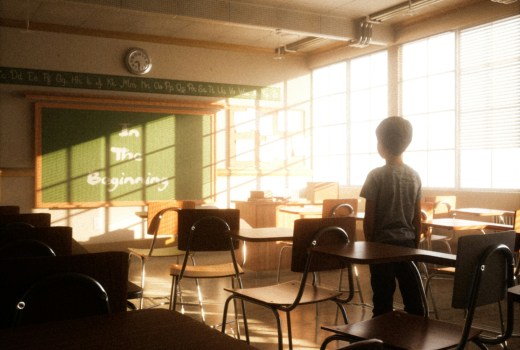
Mr. Subikoff waved them in from his teacher’s chair. Only a smattering of children were at their places; the partially deaf students weren’t there. There was no-one left who could listen, but books, at least, had not been compromised; everyone could read. Mr. Subikoff indicated where they should turn to in their history books.
It became hard to concentrate as the students noticed, along the street outside their window, the few remaining people stumbling by were clutching their heads, evidently in pain, with crimson blotches blooming at their ears. One by one, they began to fall, adults and the elderly and children alike. Once they fell to the ground, whether on the pavement or in the middle of the road, they failed to get up again.
The children in the classroom trembled and caught each other’s wide-eyed gazes. Some signed urgently to Mr. Subikoff. Though rigid and pale himself, he insisted they look down at the texts before them.
Harriet, in a state of disbelief, made herself focus on the page before her. The black lines formed letters, the letters formed words. She re-immersed herself in the sentences and began to lose herself in the tale they told. Outside was the adult world; someone would make sense of it for her later. Here was meaning she could understand. She could enter the book and it would save her. For now, at least, the words would make sense, and that would save her.
*
Angela Ball writes short fiction and poetry when not working as a solicitor in Stratford-upon-Avon. Her work has been published in Ghastling, Neon, Riptide, Tar Press and elsewhere. She is currently working on her first novel, about an underworld gang on whom the survival of the planet depends.

