Submissions open for “Sweet Hereafter”

Submissions are open for issue #20 of Shooter Literary Magazine, with the theme of “Sweet Hereafter”.

We’re looking for stories, essays, memoir and poetry to do with afterlives: life after death, life after work, life after having a baby, life after divorce… Anything to do with what follows a major change in life, when someone or something ends and significant adjustment occurs. Pieces that treat heavy subject matter – grief, heartbreak, loss, bereavement, ageing, death – with a light or humorous touch would be especially welcome. A positive (or wild, or bizarre, or comic) spin on what comes after a difficult ending or change would be in keeping with both parts of the theme.

The theme is open to wide interpretation, but please adhere to the submission guidelines. In addition to thematic relevance, we seek engaging, elegant writing that maintains a high literary standard.

Writers should send short stories and non-fiction of 2,000-6,000 words and/or up to three poems by the deadline of June 22, 2025. Please submit according to the guidelines at https://shooterlitmag.com/submissions.

Shooter Flash: “Friends First” by Danni Silver

People always asked why we weren’t together. Some were genuinely perplexed that two people with our spiritual chemistry took things no farther than friendship. Others needled, certain that we secretly wanted each other, or that one of us was hiding an unrequited passion.

My friendship with Scott sprang from business drinks in a small New England town, where I was working as events manager at the arts center and he was organising a music festival. As we started to enjoy the conversation and order more cocktails on expenses, we progressed to topics close to our hearts: movies, bands, outdoor adventures. He summoned a friend, Theresa, to join us and we moved on to a more raucous bar, and then another, our ranks swelling along the way.

Scott had a talent for picking up strangers. Charismatic, funny and offensive in equal measure, he was unafraid to talk to people or make a fool of himself. He attracted attention and divided opinion, but those who were drawn to him – almost always women – revolved around him, saucer-eyed satellites to his gravitational pull.

As our friendship grew, I stood by him when he cheated on his girlfriends and defended him when people in our community griped about his provocative comments and drunken antics. We laughed at the suspicions of others who doubted our motives with each other. Everyone assumed we were sleeping together, or had at least fooled around, or kissed, or something. So many conventional people in our small town; we were determined to be unconventional.

We notched up record-worthy hours in each other’s company, to the eye-rolling of his roommate. When Scott adopted a dog one winter, we took it out together last thing at night, clinking the ice cubes in our glasses of whiskey and trying not to slip along the dark, snow-packed alleyway.

That winter our friendship was two years old. I took pride in the purity of my platonic friendship with Scott. I took pleasure in the constancy of my position. He spun through women like a kid on carnival rides. He had aspirations to write and manufactured drama so he would have experiences to mine. “Let’s make it interesting,” he would say when we went to a bar or an art opening or a party. He usually did.

Some of Scott’s girlfriends lasted longer than others; some held privileged positions in his heart, far beyond the breakup. But the fact was, after a certain point they were no longer around, and I was.

He told his girlfriends that he loved them early on, sometimes in the first week. Their interpretation differed from his meaning. There was a correlation between how soon Scott uttered – or, more typically, let slip in half-sleep – the ultimate romantic declaration and the lifespan of the relationship.

I castigated him for such careless avowals. He was leading these women on, collecting hearts like scalps.

He laughed it off; it wasn’t his responsibility if people took him seriously. “I love table. I love chair,” he said.

When I left Vermont to move halfway across the country for a new job, we spoke almost daily, texted constantly. When, yet again, he cheated on his latest girlfriend and bemoaned the depressing state of his stagnant existence, I offered him a room in my apartment that was opening up for the summer. I hid the fact of his dog from the landlady and reduced his rent, splitting the difference between my cheaper room and his.

Scott drove across country in his battered jeep with his belongings in the back and his dog riding shotgun. Having closed the geographic gap, it came as a surprise when, only weeks later, I sensed a strange distance between us. Amidst the proximity of our shared domesticity, Scott had started to withdraw from me. No rounds of direct discussion, polite civility, affectionate overtures or total avoidance could bring us back together.

Scott spent more time with other friends. He visited greenmarkets with an old roommate and basked in the naked devotion of a PHD dropout (a man, for once). He found an ad in a neighborhood coffee shop advertising guitar lessons with a local musician. She lived nearby and, sixty-dollar-hour by hour, Scott ensured his admiration became mutual. Out came the whiskey and the indie playlists. Through the flimsy door that separated our rooms, I could hear his barking laughter, her vocals scratching through lyrics like a tormented cat.

I suggested things might improve if Scott moved out of the apartment. He agreed, then lingered. Eventually, I decided to take the initiative. Scott moved into my room, which was larger than his, its three windows level with the treetops on our street.

One day after moving out, I ran into a mutual friend of ours. I filled him on on the developments in the apartment, right up to Scott taking over my room.

“Well, he won that chess game,” he said.

Somewhere, my relationship compass had swung off course and remained stuck, pointing my heart in the wrong direction. I had a history of intense friendships, complete with breakups more painful than any with boyfriends. I remained on better terms with my romantic exes than my platonic ones. In exalting friendship, I had placed too much of a burden upon it.

Recently, I met a man in a Spanish language class. I had considered, before the first day, that romantic prospects might be a bonus. Out of eight of us in the group, there were three men. No, no, no, I thought within the first minute of class.

One of them – the most talkative, ADD-riddled one – turned out to be funny, intelligent and unexpectedly gentlemanly. During post-class drinks, he lingered to chat with me. He wondered if I were “cajole-able” for movies, as his friends were tuned solely to the wavelength of Transformers. He asked if I’d like to browse an art market one Saturday afternoon, which segued into eating and drinking on a Saturday night.

Maybe it’ll go somewhere – but we’re becoming friends first.

*

Danni Silver is a pen name. She is a freelance writer based in Pittsburgh, USA, whose work has appeared in numerous magazines and news outlets across the country.

Shooter Flash: “Sabbath” by Rebecca Klassen

Mum called it Suicide Sunday and had done so since she was a girl.      

‘A day so boring you wanted to kill yourself,’ she told me. I wondered if other parents said similar things to their teenagers. 

Throughout her childhood, she’d adhered to the Sabbath traditions of duty and no play, though this was more under her parents’ guidance than God’s. Post church, she would sit on the stairs in her best clothes and listen to the heathen neighbour children through the wall, blowing recorders and laughing. She’d been round there once for tea. The mother had given them sugar sandwiches and let them gouge holes in the lawn with sticks. 

‘Mind my bloody azaleas,’ the mother had told them. Mum had repeated ‘bloody’ to her mother and had never been allowed back.

When my grandfather died, Mum was a freshly divorced, single parent. With grandfather gone, Nana expected Mum to attend Suicide Sundays again with me in tow. The new criteria no longer required Mum at church, though we were told it would be nice if we came along once in a while. Only knitting, reading, and watching Songs of Praise were permitted in Nana’s chintzy sanctum. Watching other programmes risked a brazen ‘hell’ or ‘bugger’ slipping into the atmosphere to sully the day.   

One late autumn Suicide Sunday, I pivoted round and round on my backside in front of Nana’s gas fire, hoping that, like a rotisserie chicken, I would eventually cook on all sides. Nana worked her knitting needles. Mum stretched so that her feet almost touched the fire’s orange bars, the heat making her tights give off a plastic smell. I watched Mum nodding off, imagining having to grow up here every day. A new family lived next door with the sounds of computer game music, squabbling, and giggling coming through the walls.   

As the gas fire reddened my cheeks, I suddenly stopped pivoting as I remembered the crumpled piece of paper in my schoolbag. 

‘Mum?’

‘Hmm?’ 

‘I’ve got cookery class at school tomorrow. I’ve got to take ingredients in.’

Mum’s eyes flicked open. Nana’s needles stopped.

‘What have you got to make?’ 

‘Apple crumble. Sorry, I forgot.’

Both women were on their feet.

‘What’ve you got at home?’ Nana asked Mum.

‘No apples, that’s for sure.’ 

Nana went to the kitchen, Mum close behind. Cupboards banged over notes of infuriation.

They returned, Mum carrying a bag. 

‘Nana’s only got Braeburn apples. We’ll have to see if we’ve got the other ingredients at home.’

‘Can we go to the shop for the rest?’ I asked.

Nana shook her head.

‘You should’ve told me yesterday,’ Mum said to me. I’d always wanted to leave Nana’s before Songs of Praise, but not like this. Mum apologised to Nana.

Nana shrugged. ‘Sometimes life throws us trials.’

The drive home was quiet. Intermittently, I apologised. Mum said she knew I was sorry, yet there was no talk of forgiveness. 

‘It’s always up to me to sort these things, never your father,’ she said. After that, I stopped apologising. 

I couldn’t picture where my father was or who he might be with, and I didn’t know when I would see him again. Even though her father was dead, Mum had the same dilemmas, but the similarities didn’t unite us. 

When we got home, Mum put the butter, wrapped in its golden foil, on the kitchen table.   

‘We need oats too,’ I said tentatively, ‘because it’s a healthy crumble.’ 

‘Bring me the recipe.’

I brought her the forgotten list, which she read while I brought Nana’s bag of Braeburns to the table. Mum weighed and decanted ingredients into plastic tubs. Little white clouds billowed; granules were spilt. She banged the cinnamon jar on the counter. The clumps wouldn’t burst, so she threw it in the bin. I put the tubs into the bag with the apples. The butter remained unweighed on the table. Mum put away the scales and muttered as something tumbled from the cupboard. 

‘Where shall I put the butter?’ I asked. Mum rounded on me as more clutter fell from the cupboard. 

‘Up my arse!’ she yelled. 

‘Okay, but you’ll have to come to school tomorrow.’

My words floated precariously into the air. They’d been a gamble, particularly on a day we didn’t laugh. Mum said nothing as she put her face in her hands. The silence built over the hum of the fridge. I wanted to cram the words back into my mouth and fill my cheeks with the trouble they’d caused. Then her shoulders shook as her legs folded. Her hands dropped. She was laughing, shaking all over.

*

Rebecca Klassen is co-editor of The Phare. Her work has featured in more than forty publications including Mslexia Best Short Fiction, Popshot, Ellipsis Zine, Burningword, Barren, and The Wild Word. She has won the London Independent Story Prize, and was shortlisted for the Oxford Flash Prize and the Laurie Lee Prize. She regularly performs her work at Cheltenham Literature Festival and Stroud Book Festival.

Issue 16: On the Body

The body is the house that we live in, whether it’s newly built or dilapidated, with sleek modern lines or sagging timbers. People might be content with the houses they inhabit, growing comfortable over the years in familiar rooms; others might be eager to embark on extensive renovations. We all hope to live in secure abodes but, without strong defences, their boundaries are sometimes breached.

Bodily contemplations inevitably revolve around fundamental milestones of birth and death, the physical dimension of love and the way we are perceived by others. Writers explore these themes and more in Shooter’s “On the Body” issue, our sixteenth edition of the magazine. 

Nolcha Fox opens the issue with her whimsical poem “Skin”, delicately depicting the membrane between our outer and inner lives. Elizabeth Tannen and Ruth Lexton craft lyric insights into childbirth and early motherhood, while Natalie Moores and Harry Wilding offer wry verses on physical desire and its consequences. Steve Denehan also provides a humorous interlude on the subject of temporary tattoos. On the darker side of bodily experience, David Holper challenges the suggestion that “America Is Not a Racist Country”, and James McDermott closes the issue with two poignant poems about the death of his father from Covid-19.

In addition to the issue’s poetic nuts and bolts, the spring/summer edition features the winner of the 2022 Shooter Poetry Competition: Jenny’s Mitchell’s “Female Dedication”, which revolves around hardships experienced by the narrator’s mother and grandmother. Mitchell has previously won the Poetry Book Awards; her debut collection, Her Lost Language, was named a “Poetry Book for 2019” by Poetry Wales and her second collection, Map of a Plantation, is on the syllabus at Manchester Metropolitan University.

Many of the edition’s prose writers skilfully combine humour and acute observation in their responses to the theme. Sarah Archer weaves comedy out of the despair of ageing (to forty-one years old) in her story “Ripe”. April Farrant challenges sexism and double standards in her political piece, “Set Menu”, while Mark Keane mines the strange standards of the art world in “Exhibition”. Sage Tyrtle considers how far a makeover might go in “Up Next on The Repair Store”. A sinister threat emerges in Nathan Breakenridge’s “Full of Trees”, and Alison Milner connects the dots of loss in her moving flash fiction, “Constellation”.

Several pieces of non-fiction also punctuate the issue, all very different. Ona Marae, in “No Apology Here”, provides a powerful account of the assault she experienced as a teenager and the wider prevalence of sexual violence in society. Robin Hall recalls financially challenging times in his L.A. memoir “Dance Like Everyone Is Watching”, about his brush with male striptease. And in the most literal interpretation of “On the Body”, Sally Gander considers the significance of tattoo art in her essay “No Commitment Necessary”.

Whatever environment you inhabit – cosy apartment or sprawling manor, stylish penthouse or sparse yurt – I hope you will settle down cosily within that most important of edifices, your own skin, to enjoy this diverse and compelling edition of Shooter.

To order a copy of the On the Body issue, please visit the Subscriptions page.

The 2023 Short Story Competition and general submissions to do with The Unknown are open to entries until September 24.

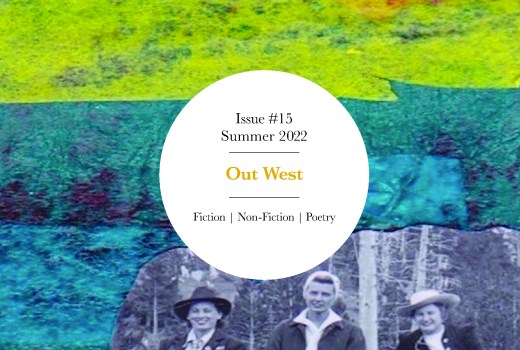
Issue 15: Out West

I was once an Eastern greenhorn, a city girl lured to the Rocky Mountain West by the promise of big skies and open ranges, rodeo riding and cowboy culture. I found myself in a small town in a sweeping landscape, where the sense of space expanded inner horizons as much as outer ones. Years later, back in England, I made another westward move (admittedly on a more modest scale), from London to the green hills of the Cotswolds.

The allure of the West, of wild(er)ness and migration, underpins much of Shooter’s Out West issue. Some of the edition’s writers celebrate classic aspects of Western mythology (horses, reinvention, seeking a better life), while others confront its downsides (toxic masculinity, guns, prejudice). Beyond myths conjured by pioneer history and movie lore, the issue sifts through these ideas to explore personal, nuanced elements of the American West. And beyond that fabled frontier, writers examine East/West culture clashes and mind-expanding experiences in the United Kingdom, New Zealand, and even Sudan.

One piece that does so with a satisfying dose of humour is Georgia Boon’s opening story, “West Country”, about an actress sent to the south-western corner of England to bond with her equine costar. Horses also feature in “Nice Riding” by Becky Hansen, her memoir about a simple yet potent accolade from a straight-shooting cowboy.

The issue’s other two pieces of fiction explore darker aspects of the theme. Zachary Kellian depicts the toxic masculinity within a group of Nevada desert dowsers in “Set in Stone”, when one of the drill workers is forced to come to terms with his sexuality. Annie Dawid, in “Acts of Nature, Acts of God”, imagines a Wyoming coroner’s struggle following the gun death of a ten-year-old boy.

Travelling abroad gives rise to very different experiences for two of the issue’s non-fiction authors. In “What’s in a Name?”, Parnian Sadeghi writes of the challenge to her identity after moving from Iran to the U.K. For Barbara Tannenbaum, visiting New Zealand from California following a cancer diagnosis leads to an uplifting revelation.

Abundant poetry rounds out the issue’s prose (for the first time featuring an equal number of fiction and non-fiction pieces). Sally St Clair and Callista Markotich take inspiration from history and literature in “Californian Bone Soup” and “Language Lorn, Riding to Mexico”. Dreams of travel infuse Nicholas Hogg’s “Mariner”, while Millie Light conjures a strong sense of place in her two Cornish poems. Sinister elements lace Meghan Kemp-Gee’s “The Fugitive” and Richard Lister’s Darfur-set poem “Apart”. In “The Student with Spurs”, David M Schulz conveys the limitations of the Western dream, while John Laue rounds out the issue with some whimsical yet lucid Californian haiku.

Finally, don’t miss Lynette Creswell’s historical fiction, “Malkin Tower”, winner of the 2022 Shooter Short Story Competition. Inspired by the 1612 witch trials in Pendle, northwest England, Creswell conjures a compelling, suspenseful tale with a vividly murky setting. The story revolves around a young girl forced to testify against her mother and sister, who stand accused of witchcraft. “Malkin Tower” underscores that injustice can occur in any era – or, as other work in this edition shows, at any point on the compass.

Cover art by C R Resetarits

To order a copy of the Out West issue, please visit the Subscriptions page.

The 2022 Poetry Competition is now open to entries, and the theme for the winter 2023 issue will be announced imminently online!