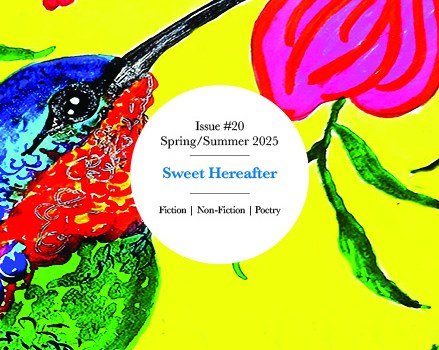
Shooter’s final print edition: #20, the Sweet Hereafter issue

Not all endings are painful – some might lead to a wonderful new opportunity, or an unexpected adventure, or reveal a silver lining. This is the slant of our 20th issue’s theme, Sweet Hereafter. When it comes to death, perhaps there really is a glorious afterlife. If your marriage crumbles, a better love might be just around the corner. 

The Sweet Hereafter theme is partly a nod to the fact that this is the final print edition of the magazine, and partly to the death of my mother, Anita White, earlier this year. While there is not much that is sweet about that loss (apart from release from the ravages of cancer), it gives rise to certain, more uplifting reflections: appreciation of loved ones, gratitude for the good things we have, and – who knows – perhaps Mom really has attained her own personal version of heaven. If so, she’s got her feet up in a grand stately home reading good books by the fire, walking dogs amid a lush pastoral landscape, and hosting dinner parties full of scintillating debate and fine food that someone else, for once, has gone to the trouble of cooking.

In that vein, she would have been highly amused by Stephen Oliver’s take on a custom-made afterlife in “Müesli”. While what follows death is one of the obvious responses to the Sweet Hereafter theme, there are a range of other interpretations, too. Among the fiction writers, Mike Wheet imagines an unconventional route to late parenthood in “Sweetheart”. Michael Shelley depicts a young girl struggling with the new woman in her bereaved father’s life in “The Story of Emma the Human Toothpick”, and Julie Esther Fisher delves into a teenager’s post-traumatic escape to the Highlands in “Scottish Moon”.

The non-fiction writers also mine diverse terrain. In “An Apple for the Cool Kids”, Alexandra O’Sullivan rises to the challenges of her professional second act, embarking on a new career as an English teacher in Australia. Emily Larkin leaves the Mormon faith behind in “God’s Not Invited to My Wedding”, while Stephen Fabes laces up for a midlife marathon in “Late Blooming in the Pyrenees”.

The theme attracted a wonderfully rich and varied response from the poets as well. Amber Watson opens the issue with two compelling poems on foster parenting. In a bumper issue for poetry, eleven other poets explore adolescence and literary revisionism, birth and death in the natural world, life after relationships and life after life. A bonus feature is the winner of this year’s Shooter Poetry Competition, Bethan Murphy’s “Birth Plan”, in which stark, poignant contrasts challenge childbirth expectations. Sylvie Jane Lewis, whose beautiful pair of hare poems close out the issue, also won second place in this year’s contest.

Since devising Shooter more than ten years ago, I’ve gained enormous satisfaction from unearthing the literary gems for each issue, assembling each edition and sending the magazine out into the world. In 2015, when the first issue was published, I was sharing a small London flat with my beloved dog Robbie (of issue 12 fame) and, following a series of relationships that were not meant to be, yearning to have children. Shooter #7, the New Life issue, arrived in tandem with my daughter, and my husband followed five years later, somewhere between On the Body and The Unknown. Following our wedding in 2023, I would have felt squeamish about publishing a True Love issue, as far too on the nose.

So from the early days of all the time in the world to devote to Shooter, to the increasing squeeze of obligations (some welcome, some less so) of childcare, marriage, ageing parents and a day job, midlife has chipped away at my ability to produce the magazine on time and do it justice. I hope to keep the essence of Shooter alive online, perhaps with a new digital iteration at some point, and to maintain elements like the monthly Shooter Flash. In the wake of the print edition, I also hope that Shooter’s sweet hereafter might lead to the fulfilment of a few new dreams – and, perchance, some extra sleep.

To order a copy of the Sweet Hereafter issue, please visit https://shooterlitmag.com/subscriptions.

Winners of 2025 poetry comp expose birth realities, celebrate sexual identities

Bethan Murphy has won the 2025 Shooter Poetry Competition with “Birth Plan”, while Sylvie Jane Lewis came runner-up with “Small Town Pride Parade”.

Murphy’s poem pierces idealised notions of childbirth with its series of sharp juxtapositions, which powerfully drive home the contrast between fantasy notions of birth and the often quite different reality. As an English teacher from Salisbury, Murphy has previously published poetry and flash fiction in magazines including Green Ink Poetry, Eucalyptus Lit, Arkana, and Sugar House Review.

Lewis captures with humour and energy the range of colourful characters taking part in Chichester’s first Pride Parade last year. Her poetry has been published in The London Magazine, Ink Sweat and Tears, and Them, all, and has been commended in the Ware Poets Prize and the Bridport Prize.

Both poems are available to read online at the Competition Winners page, and “Birth Plan” will also appear in the forthcoming print edition of Shooter (themed Sweet Hereafter). The magazine can be ordered via Shooter’s Subscriptions page; this issue, Shooter’s 20th, will be the final edition of Shooter in print.

Huge congratulations to this year’s poetry winners!

Coming of Age issue explores sex, loss, and startling changes

Readers of the Coming of Age edition will note a discrepancy between the issue date of Autumn/Winter 2024, and the publication date of May 2025. Sadly this was caused by the rapid decline and death of my mother, Anita White, during the early months of 2025. 

Being in midlife myself, I was somewhat prepared for this inevitable though devastating loss. My mother was not terribly old at 77 but, pushing 50 myself, it still felt in the natural course of things.

For those who suffer such a bereavement during childhood, the loss of a parent can trigger the worst, most abrupt transition to adulthood: a severe trauma that jolts them out of carefree innocence, straight into adult responsibilities and painful life lessons. Some of the pieces here grapple with this harshest of coming-of-age experiences, in particular Saturday Mars’ “An Ode to Dewey Dell Bundren”, a literary reflection on William Faulkner’s As I Lay Dying that opens the issue.

Approaching loss from the polar opposite direction, Probert Dean’s short story “A Thing That Presents Itself to the Mind” explores with black humour the demise of a very different sort of mother. Douglas Cole in “A Game of Chicken” and C S Mee in “Amy Sullivan” also tangle with death and the transitional impact it makes in their tales.

Another equally significant coming-of-age theme, sex and sexuality, crops up in much of the issue. “The Sex-Education Fairy” by Monterey Buchanan offers a fantastical method of getting embarrassing questions answered at school, while Paul Hammond’s “An Odd, Odourless Scent” takes a more oblique approach to such matters in rural Ireland. In her memoir “Love in a War Zone”, Alison Watson dissects her youthful recklessness from Budapest to New York City with honesty and verve, showing how using sex to gain love and validation rarely pans out.

The poets largely grapple with sex and death as well. Elizabeth Wilson Davies, Kait Quinn, Brian James Lewis, and Craig Dobson explore some of the thrills and implications of dawning sexuality in their poems, while Alison Tanik and Eugene O’Hare suggest the darker side. Kent Leathem and Emily Cotterill conjure burgeoning homosexuality, from the challenges of feeling like an outsider to the rewards of awakening sexual identity. Kevin Grauke, the only poet to engage with death, does so with poignant simplicity.

A few writers took a more left-field approach to the coming-of-age theme. In his poem “September Cohen”, Bradley Taylor muses on an alternate reality for musician Leonard Cohen. Cat Isidore closes out the issue with her surreal story “Milkteeth”, about a girl forced into a violent confrontation with her mother’s garden flora.

As the winner of the 2024 Shooter Short Story Competition, “The Bunker” by Dilys Lovell also appears in this edition. Competition winners are not bound by the magazine’s themes, but Lovell’s piece could easily fit the category, featuring a girl on a remote island who yearns to be free of parental constraints. Her sheltered existence is shattered by the imposition of the wider world, as well as an interloper who reflects the tension she feels between safety and the call to adventure.

It is apt that, following an edition about major change, the next issue (our twentieth) will mark the end of Shooter’s life as a biannual print magazine. Shooter will evolve, but the final print edition will be themed Sweet Hereafter, both in honour of my mother and to mark the end of Shooter’s print identity. As the Spring/Summer 2025 issue, it will follow hot on the heels of the Coming of Age edition – but as with all things that die, Shooter will not be gone, but simply carry on in a different form.

To order the Coming of Age issue, please visit the Subscriptions page. 

Submissions open for “Sweet Hereafter”

Submissions are open for issue #20 of Shooter Literary Magazine, with the theme of “Sweet Hereafter”.

We’re looking for stories, essays, memoir and poetry to do with afterlives: life after death, life after work, life after having a baby, life after divorce… Anything to do with what follows a major change in life, when someone or something ends and significant adjustment occurs. Pieces that treat heavy subject matter – grief, heartbreak, loss, bereavement, ageing, death – with a light or humorous touch would be especially welcome. A positive (or wild, or bizarre, or comic) spin on what comes after a difficult ending or change would be in keeping with both parts of the theme.

The theme is open to wide interpretation, but please adhere to the submission guidelines. In addition to thematic relevance, we seek engaging, elegant writing that maintains a high literary standard.

Writers should send short stories and non-fiction of 2,000-6,000 words and/or up to three poems by the deadline of June 22, 2025. Please submit according to the guidelines at https://shooterlitmag.com/submissions.

Issue #18: Nightlife

When night falls, new worlds open up. The time after sunset is typically the domain of romance: dinner dates, cocktail flirtations, dancing as a prelude to going home together. Bad things, also, happen more easily under cover of darkness. Criminals prowl and monsters lurk. For Shooter’s Nightlife issue, many writers were drawn to tales of the latter, and so this edition ended up developing a pulsing vein of supernatural horror.

It also turned out to be a particularly strong edition for poetry. Featuring the work of ten poets (including the 2024 Shooter Poetry Competition winner, Maryah Converse, for her political “Web of Resistance”), the issue opens with two poems that capture something of the essence of the night: “as you light up” by Dilys Wyndham Thomas and “Shivering Out” by Paul atten Ash. (The latter takes the form of a “golden shovel”, plucking lines from Sylvia Plath’s “Full Fathom Five” and using each word at the end of each line in his poem: “You float near / As keeled ice-mountains / Of the north, to be steered clear / Of, not fathomed.”)

Partygoing – raves, gigs, midnight celebrations – feature in Miguel Cullen’s “Deep Mourning Dream”, Laurie Eaves’ “Ode to My Favourite Security Guard at Kentish Town Forum” and Warren Woessner’s “New Year’s Eve – Tribeca – 1984”, yet the euphoric antics are frequently laced with sadness, loneliness, or nostalgia. Casey Lawrence’s short story “The Hunt” also stalks this terrain, though with a delicious supernatural twist.

Sleep, of course, forms another obvious element of the nocturnal realm, along with one of slumber’s mortal enemies: offspring. In her poem “nightly rodeo”, Michelle Penn crafts a delightful lyric metaphor for this sort of challenge to sleep. Two prose pieces – the fictional “Acetaminophen” by Charles Cline and non-fiction “Sleepless Nights” by Laura Healy – arrive at the intersection of sleep and children, and take off in very different directions. “Zones”, a poem by Jeff Skinner, plays with the idea of counting sheep in different time zones around the world. In “Little Slices of Death”, another personal memoir, Lisa Simone Kingstone charts the impact of drug-induced insomnia upon her life during cancer treatment.

Two fiction writers, Ross Anderson and Harley Carnell, explore the devastating emotional and physical impacts of night-time shift work in “The Sleep of Reason Begets Monsters” and “Long Night” respectively, about suicide hotline workers and food delivery drivers. Jenny Danes, in “Case History”, and Gillian Fielder in “Standing on the Bridge” evoke similarly resonant, poignant scenes of confusion and distress in their poems.

For the most part, the writing in the Nightlife issue conjures states of fear and menace, loneliness and struggle, but two prose pieces also inject joy and humour. Craig Aitchison shares his fascination with bats in “Small Packages of Delight”, while J D Strunk’s “Clean Kill” depicts a midlife-crisis camping trip gone wrong with comic suspense.

And yet, even there, fear still plays a part – so if you tend to be spooked by the shadowy forces of darkness, perhaps best to enjoy Shooter’s Nightlife issue as part of your sunlit breakfast reading.

To order a copy of the Nightlife issue, or any other edition, please visit the Subscriptions page.

Activism and injustice fuel this year’s winning poetry

The winners of the 2024 Shooter Poetry Competition share a sense of political and social injustice – one on a global scale, one at the personal level.

Maryah Converse won the competition with “Web of Resistance”, a compelling lyric palimpsest of activism that questions attitudes towards the ongoing war in the Middle East. The runner-up, “MS Multiple Choice” by Anna Mindel Crawford, adopts an innovative form to suggest the frustration and difficulty of living with chronic illness in the family.

Three other poets submitted strong entries to the contest: Megan Cartwright, Jet McDonald, and Suzi Mezei received honourable mentions for their poetry.

Both of the winning poems are available to read at the Competition Winners page. “Web of Resistance” will also appear in print in Shooter’s forthcoming “Nightlife” issue, which can be ordered at the Subscriptions page.

Prose writers get their turn during the second half of the year: the 2024 Shooter Short Story Competition will open to entries within the next few weeks.

*

Featured photo by Ehimetalor Akhere Unuabona

Submissions open for “Nightlife” issue

General submissions are now open for Shooter’s Spring/Summer 2024 issue, themed “Nightlife”.

Writers should send short stories and non-fiction of 2,000-6,000 words and/or up to three poems by the deadline of May 12th. Stories, essays, memoir and poetry should relate to nocturnal happenings: dating, working the night shift, crime, clubbing, dinner, sex, partying, witchcraft, ghosts, childbirth, insomnia, even nocturnal wildlife.

The theme is open to wide interpretation, but writers should adhere to the submission guidelines. Other opportunities currently open to writers include the 2024 Shooter Poetry Competition and Shooter Flash, which accepts entries on a rolling basis.

Issue 16: On the Body

The body is the house that we live in, whether it’s newly built or dilapidated, with sleek modern lines or sagging timbers. People might be content with the houses they inhabit, growing comfortable over the years in familiar rooms; others might be eager to embark on extensive renovations. We all hope to live in secure abodes but, without strong defences, their boundaries are sometimes breached.

Bodily contemplations inevitably revolve around fundamental milestones of birth and death, the physical dimension of love and the way we are perceived by others. Writers explore these themes and more in Shooter’s “On the Body” issue, our sixteenth edition of the magazine. 

Nolcha Fox opens the issue with her whimsical poem “Skin”, delicately depicting the membrane between our outer and inner lives. Elizabeth Tannen and Ruth Lexton craft lyric insights into childbirth and early motherhood, while Natalie Moores and Harry Wilding offer wry verses on physical desire and its consequences. Steve Denehan also provides a humorous interlude on the subject of temporary tattoos. On the darker side of bodily experience, David Holper challenges the suggestion that “America Is Not a Racist Country”, and James McDermott closes the issue with two poignant poems about the death of his father from Covid-19.

In addition to the issue’s poetic nuts and bolts, the spring/summer edition features the winner of the 2022 Shooter Poetry Competition: Jenny’s Mitchell’s “Female Dedication”, which revolves around hardships experienced by the narrator’s mother and grandmother. Mitchell has previously won the Poetry Book Awards; her debut collection, Her Lost Language, was named a “Poetry Book for 2019” by Poetry Wales and her second collection, Map of a Plantation, is on the syllabus at Manchester Metropolitan University.

Many of the edition’s prose writers skilfully combine humour and acute observation in their responses to the theme. Sarah Archer weaves comedy out of the despair of ageing (to forty-one years old) in her story “Ripe”. April Farrant challenges sexism and double standards in her political piece, “Set Menu”, while Mark Keane mines the strange standards of the art world in “Exhibition”. Sage Tyrtle considers how far a makeover might go in “Up Next on The Repair Store”. A sinister threat emerges in Nathan Breakenridge’s “Full of Trees”, and Alison Milner connects the dots of loss in her moving flash fiction, “Constellation”.

Several pieces of non-fiction also punctuate the issue, all very different. Ona Marae, in “No Apology Here”, provides a powerful account of the assault she experienced as a teenager and the wider prevalence of sexual violence in society. Robin Hall recalls financially challenging times in his L.A. memoir “Dance Like Everyone Is Watching”, about his brush with male striptease. And in the most literal interpretation of “On the Body”, Sally Gander considers the significance of tattoo art in her essay “No Commitment Necessary”.

Whatever environment you inhabit – cosy apartment or sprawling manor, stylish penthouse or sparse yurt – I hope you will settle down cosily within that most important of edifices, your own skin, to enjoy this diverse and compelling edition of Shooter.

To order a copy of the On the Body issue, please visit the Subscriptions page.

The 2023 Short Story Competition and general submissions to do with The Unknown are open to entries until September 24.

Mitchell wins 2022 Poetry Competition with “Female Dedication”

Jenny Mitchell has won the 2022 Shooter Poetry Competition with her powerful familial poem “Female Dedication”.

The poem revolves around hardships experienced by the narrator’s grandmother (as well as her mother), and won Shooter’s prize for its unflinching, spare language and compelling intensity.

Mitchell has previously won the Poetry Book Awards and her debut collection, Her Lost Language, was named a “Poetry Book for 2019” by Poetry Wales. Mitchell’s second collection, Map of a Plantation, is on the syllabus at Manchester Metropolitan University and her latest collection, Resurrection of a Black Man, was chosen as a Poetry Kit Book of the Month.

A very different type of poem, “Unrequited” by Cara Lowther, came runner-up in Shooter’s 2022 Poetry Competition. Judges enjoyed Lowther’s adept handling of the villanelle form and the poem’s deliciously bittersweet tone. An English student at Warwick University, Lowther contributes regularly to student newspaper The Boar and plans to pursue a career in journalism following graduation.

Both poems are available to read online, and Mitchell’s winning poem will also appear in Shooter’s On the Body issue, which will be published this spring.

To subscribe to Shooter’s print edition or place an advance order for the On the Body issue, please visit the Subscriptions page.

Issue 15: Out West

I was once an Eastern greenhorn, a city girl lured to the Rocky Mountain West by the promise of big skies and open ranges, rodeo riding and cowboy culture. I found myself in a small town in a sweeping landscape, where the sense of space expanded inner horizons as much as outer ones. Years later, back in England, I made another westward move (admittedly on a more modest scale), from London to the green hills of the Cotswolds.

The allure of the West, of wild(er)ness and migration, underpins much of Shooter’s Out West issue. Some of the edition’s writers celebrate classic aspects of Western mythology (horses, reinvention, seeking a better life), while others confront its downsides (toxic masculinity, guns, prejudice). Beyond myths conjured by pioneer history and movie lore, the issue sifts through these ideas to explore personal, nuanced elements of the American West. And beyond that fabled frontier, writers examine East/West culture clashes and mind-expanding experiences in the United Kingdom, New Zealand, and even Sudan.

One piece that does so with a satisfying dose of humour is Georgia Boon’s opening story, “West Country”, about an actress sent to the south-western corner of England to bond with her equine costar. Horses also feature in “Nice Riding” by Becky Hansen, her memoir about a simple yet potent accolade from a straight-shooting cowboy.

The issue’s other two pieces of fiction explore darker aspects of the theme. Zachary Kellian depicts the toxic masculinity within a group of Nevada desert dowsers in “Set in Stone”, when one of the drill workers is forced to come to terms with his sexuality. Annie Dawid, in “Acts of Nature, Acts of God”, imagines a Wyoming coroner’s struggle following the gun death of a ten-year-old boy.

Travelling abroad gives rise to very different experiences for two of the issue’s non-fiction authors. In “What’s in a Name?”, Parnian Sadeghi writes of the challenge to her identity after moving from Iran to the U.K. For Barbara Tannenbaum, visiting New Zealand from California following a cancer diagnosis leads to an uplifting revelation.

Abundant poetry rounds out the issue’s prose (for the first time featuring an equal number of fiction and non-fiction pieces). Sally St Clair and Callista Markotich take inspiration from history and literature in “Californian Bone Soup” and “Language Lorn, Riding to Mexico”. Dreams of travel infuse Nicholas Hogg’s “Mariner”, while Millie Light conjures a strong sense of place in her two Cornish poems. Sinister elements lace Meghan Kemp-Gee’s “The Fugitive” and Richard Lister’s Darfur-set poem “Apart”. In “The Student with Spurs”, David M Schulz conveys the limitations of the Western dream, while John Laue rounds out the issue with some whimsical yet lucid Californian haiku.

Finally, don’t miss Lynette Creswell’s historical fiction, “Malkin Tower”, winner of the 2022 Shooter Short Story Competition. Inspired by the 1612 witch trials in Pendle, northwest England, Creswell conjures a compelling, suspenseful tale with a vividly murky setting. The story revolves around a young girl forced to testify against her mother and sister, who stand accused of witchcraft. “Malkin Tower” underscores that injustice can occur in any era – or, as other work in this edition shows, at any point on the compass.

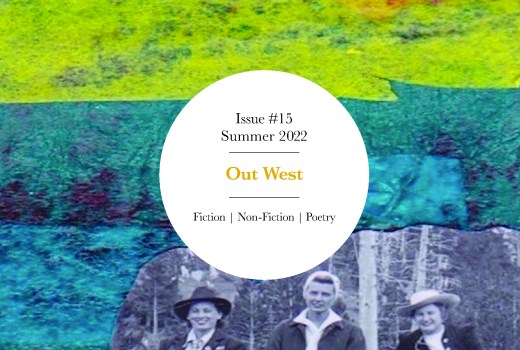
Cover art by C R Resetarits

To order a copy of the Out West issue, please visit the Subscriptions page.

The 2022 Poetry Competition is now open to entries, and the theme for the winter 2023 issue will be announced imminently online!